Robert Fournier: Inventive ceramist whose 'pebble' pots were based on natural forms
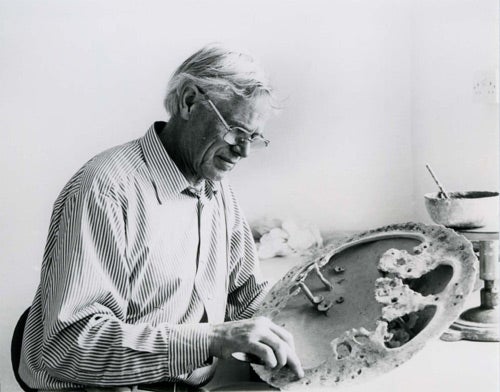
The potter Robert Fournier was as well known for his many distinguished reference books as his inventive ceramics. Something of a rebel, he was a lifelong pacifist and atheist, and his decision to become a potter was, in part, a refusal to compete in what he saw as an increasingly consumer-led society.
Fournier was born into a modest family in west London. Like his French grandfather, his father was a carpenter, who helped build aircraft in the First World War, and later motor cars. His mother, interested in politics, became a Labour alderman. At grammar school Robert did well in art, and also composed poetry, which his teacher refused to believe had been written by him. After school he joined the library service, working at Fulham Library.
Keen to live in the country, he moved to Hertfordshire with his then-partner, Sylvia. But their plans to settle were thwarted when they bought a piece of land from a con man and lost all their money. For a time he and Sylvia worked as farm labourers, horrifying their neighbours by living as a couple in a shed.
With the outbreak of the Second World War, Fournier was imprisoned in Wormwood Scrubs for refusing to enlist. During the Blitz, as bombs fell on London, he helped produce the prisoners' magazine. The death in a plane crash in Wales of his only brother, Victor, aged 21, a navigator in the RAF, confirmed his pacifist beliefs.
After the war, intent on pursuing a career in art, Fournier visited London Zoo and subsequently modelled animals, which he sold. To train as a potter, he enrolled in an evening class at the Central School of Arts and Crafts in London, where he came under the watchful eye of Dora Billington, an outstanding teacher and potter. Far from following the established approach to pottery, based on an aesthetic of quietude advocated by Bernard Leach, Billington encouraged a more eclectic view that included Mediterranean and industrial wares. Fournier took a job as a technician at the school, becoming Billington's assistant.
In 1946 he set up Ducketts Wood Pottery in Hertfordshire, where he produced slipware, tin-glaze and later mosaics. In 1948 he established the pottery department at Goldsmiths' College, London, and it was here he met Sheila Cook, one of his students, whom he married in 1961.
For a time, he and Sheila had a studio in Greenwich, before moving to Castle Hill in Kent in 1965. Here they produced stoneware, developing individual pieces as well as a range of tableware. Aware of the growing interest in ceramics, Fournier issued 500 colour slides of historical ceramics, then a revolutionary educational aid much-used by schools and individual potters.
In 1971 they settled in the beautiful village of Lacock in Wiltshire, leasing the old workhouse from the National Trust on a peppercorn rent. Here Robert Fournier consolidated his ceramics, producing what became his signature pieces, a range of "pebble" pots that were based on natural forms. With a sure understanding of the organic structures of stones, rocks and plants, he translated these into clay through the use of simple, hand-built or moulded dish shapes, or tall flattened bottles. These were decorated with areas of unglazed clay, poured, textured white glaze and dotted with small patches of rich, saturated colour. He was particularly renowned for producing a vibrant turquoise blue. The pots were shown successfully at galleries in Britain, as well as in Germany and France.
It was also at Lacock that Fournier pursued his interest in writing. A book on building electric kilns, with clear instructions and practical advice, dispelled much of the mystique around constructing simple but efficient structures. An inveterate compiler, Fournier scoured technical texts for material relevant to potters and brought his research together in dictionary form. Titles included The Illustrated Dictionary of Practical Pottery (1952), The Illustrated Dictionary of Pottery Form (1981) and The Illustrated Dictionary of Pottery Decoration (1986). More recently he collaborated with Eric Yates-Owen on British Studio Potters' Marks (1999), a comprehensive survey of the stamps and marks used in the UK by studio potters, a book that has become a collector's bible.
Ever curious about the history of studio ceramics, Robert Fournier collaborated with John Anderson to make films of David Leach and Rosemary Wren working in their studios. He also filmed Isaac Button, one of the last traditional makers of terracotta garden pots. All serve as invaluable records of working practice in the late 1960s and 1970s. As a founder of the Craftsmen (now Craft) Potters Association, he organised three memorable film festivals showing potters' films from around the world, introducing diversity and thought into what was often seen as the narrow world of studio pottery.
The Fourniers retired from potting in 1987. Visits to ancient sites in Crete and other Mediterranean islands enabled them to pursue their interest in early ceramics, while, as ardent wine buffs, they enjoyed wine tastings.
Following Sheila's death in 2000, Robert continued to write, completing several novels and beginning a memoir which, alas, remained, unfinished at the time of his death. He did, however, record his life story for the British Library National Sound Archive.
Emmanuel Cooper
Robert Charles Privet Fournier, potter: born London 16 March 1915; married 1961 Sheila Cook (died 2000); died Market Lavington, Wiltshire 19 January 2008.
Join our commenting forum
Join thought-provoking conversations, follow other Independent readers and see their replies
Comments
Bookmark popover
Removed from bookmarks