Sir Bernard Lovell: Radio astronomer and driving force behind the Jodrell Bank telescope
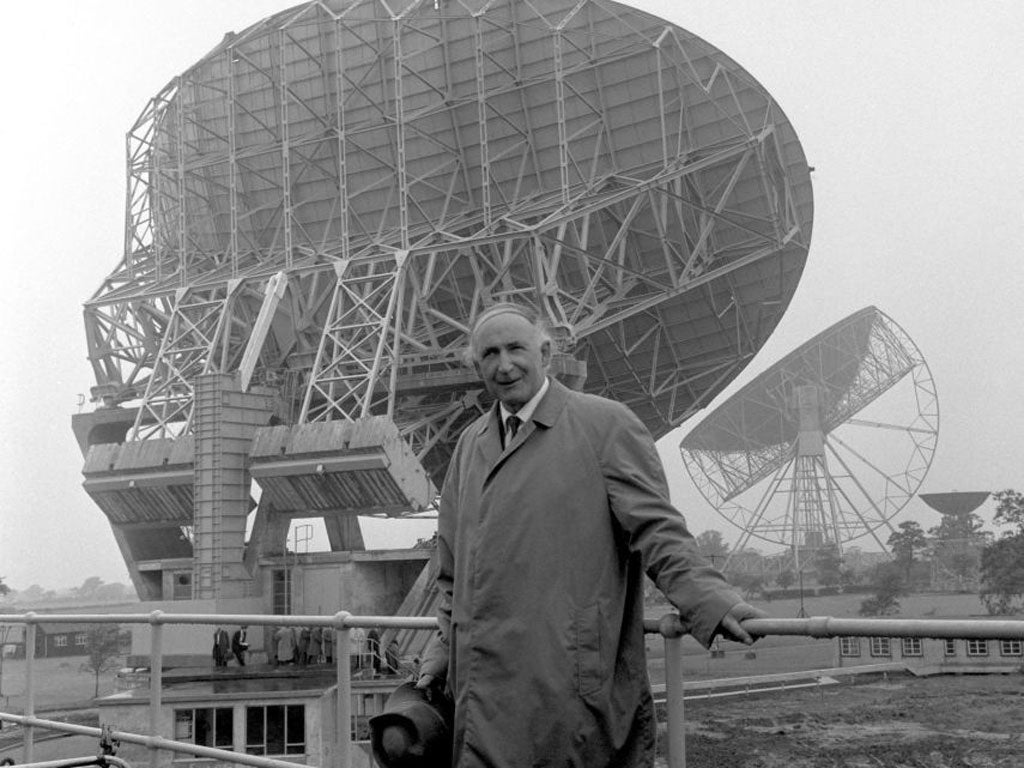
Sir Bernard Lovell, who died on 6 August aged 98, built the Jodrell Bank telescope. This achievement, at a time of post-war austerity in the Fifties, cannot be over-estimated. Some 55 years later, this giant radio telescope continues as a national icon for British science and engineering. It maintains an active UK presence in the fast-developing worlds of astronomy and space exploration. In the 1950s, the 250ft diameter steerable dish was enlisted by both the Americans and the competing Russians as the unique instrument in the world with the power to track their rocket probes into space.
Lovell's vision as director of the Manchester University's Observatory at Jodrell Bank has enabled a wealth of discoveries. Recently, the Jodrell Bank Observatory has been chosen as the headquarters of the world's biggest radio telescope, the Square Kilometre Array. This international £1bn facility, with its square kilometre array packed with mini radio telescopes, offers the most sensitive instrument yet for radio discoveries in space.
In September 1939, soon after being appointed as an assistant lecturer in the physics department of Manchester University, Lovell was seconded to the Air Ministry Research Establishment. The objective was to undertake development of centimetre wave radar equipment which would enable Bomber Command aircraft to navigate by night. Bernard was the leader of this H2S project. This led on to the development of radar able to detect submarines and its installation in Coastal Command aircraft. The experience of working under intense wartime pressure with limited facilities equipped him well for the battles he would undertake in establishing the science of using radio as a tool at the frontier of astronomical research. He was awarded the OBE in 1946 for his contributions to radar development.
On returning to the Manchester physics department under the leadership of Professor Patrick Blackett (later Lord Blackett), Lovell was determined to understand the origin of the mysterious radar echoes which had been detected by the wartime radar systems. Blackett and Lovell first hypothesized that they were due to energetic cosmic ray particles from outer space in collision with the Earth's atmosphere. Using basic ex-service radar equipment installed at the Jodrell Bank grounds of the University's botany department, Lovell and his students found that these radar echoes came from meteors as they burnt up on entering the atmosphere. These "shooting stars" leave a transient trail of ionisation which gives a radar echo.
This discovery led to an intensive study of meteors and the upper atmosphere. A major outcome of their work was the discovery of daytime meteor showers associated with known comets. Also, of particular importance, was the resolution of the debate about whether the sporadic meteors originated in the solar system or came from interstellar space; accurate radio orbit measurements showed they belonged to the solar system, orbiting the Sun. Lovell's book Meteor Astronomy (1954) is the definitive work on the subject.
Lovell saw the need for a larger telescope to give greater sensitivity in the search for the elusive cosmic rays and for the detection of signals from the "radio stars" being found at other observatories. This resulted in an upward-looking, static, parabolic telescope 218ft in diameter, made from wires stretched between scaffold poles. An aerial 176ft above the reflecting dish received the signals either in the radar or radio mode. This telescope was immediately successful in detecting fainter meteor signals, but more importantly it collected signals from the enigmatic radio stars and helped to solve the problem of their origin. Some came from within our Milky Way galaxy, others were extra-galactic. Our nearby companion galaxy, the Andromeda Nebula, was clearly seen, as well as known optical emission nebulae within the Milky Way. As more and more of these radio stars were found, the debate about whether they were Galactic or beyond our Milky Way became critical. The need for a large, fully steerable radio telescope able to receive radio signals from the whole sky became a first priority.
Hence it was that Lovell campaigned for a 250ft fully steerable telescope at Jodrell Bank. He came forward in 1950 with a proposal for a telescope costing £120,000. The Department of Science and Industrial Research (DSIR) awarded a grant for a design study. Over the next five years, the long- running saga of modifications and cost re-evaluations had to take into account the importance of creating a dish of sufficient sensitivity to detect the recently discovered 21cm neutral hydrogen spectral line – the tool that enables measurement of distance in the Universe. So the mesh surface originally proposed had to become a solid surface – with all the additional design and cost implications.
A lesser man would have been shattered by the continuing complications, but his wartime experience had taught perseverance. The ultimate cost of the telescope in 1957 was £630,000. Lovell had a working 250ft telescope, a debt of £260,000 and the possibility of a prison sentence.
The events of 4 October 1957 dramatically changed the situation. The Russians launched Sputnik 1 – the first artificial satellite to orbit Earth. Although the 250ft telescope was in the testing phase, it was fitted with radar equipment and was able to track the launch rocket as it passed over the UK, confirming the Russian announcement. In this phase of the Cold War, the defence implications were chilling. Russia was capable of launching an intercontinental ballistic missile (ICBM) and the US was still months from doing so. Lovell was saved from prison, as donors including the Nuffield Foundation and Lord Nuffield personally, helped to write off the debt. In 1969, the Jodrell Bank Experimental Station became the Nuffield Radio Astronomy Laboratory.
The versatility of this telescope was immediately demonstrated in its ability to detect a wide range of radio sources at many frequencies. An early use was as an interferometer linked to a distant telescope in order to measure the diameter of the radio sources. A subset of these sources had remarkably small diameters. These were identified as "Quasars", luminous radio emitters at the edge of the measurable universe. This discovery took the frontiers of discovery deep into the past. The same technique revealed the first gravitational lens as predicted by Einstein's theory of General Relativity.
The 250ft telescope was resurfaced in 1970/71 so that it could operate more efficiently at higher frequencies. The resulting 21cm hydrogen line measurements established the motion of nearby galaxies relative to background galaxies, and led to the measurement of the dipole component of the Cosmic Microwave Background. Exploring the CMB takes us back to the beginning of time itself.
Lovell saw the next phase of the development of radio astronomy at Jodrell Bank was to incorporate the 250ft telescope into an interferometric array of telescopes. This approach would take advantage of the large collecting area of the 250ft telescope and the high angular resolution provided by the linked telescopes. The resulting MERLIN array (Multi Element Radio Linked Interferometer Network) consists of six telescopes linked to the 250ft telescope with a maximum baseline to Cambridge of 217km. The MERLIN array makes it possible to detect radio objects at the furthest reaches of the Universe.
Alfred Charles Bernard Lovell was born on 31 August 1912, the only child of Emily Adams and Gilbert Lovell. They lived in the village of Oakland Common near Kingswood, Bristol. His mother was the captain of the local women's cricket team; his father was a Methodist preacher. Lovell attended the neighbouring Kingswood secondary school. He then went on to Bristol University, where he gained a first class degree in physics in 1934. He was awarded a PhD in 1936 for his research on the conductivity of thin metallic layers. His next move was to Manchester University, where he spent the rest of his academic life.
In his youth, Lovell played cricket and developed his ability as an organist while playing the organ in the chapel. These interests continued at University and were recognisable in his life in Cheshire. He was organist at Swettenham church until well into his eighties and served as president of the Incorporated Guild of Church Musicians. He played cricket for Bristol University both as a batsman and as a bowler. In Cheshire, he joined the local Chelford Cricket Club. Although true to his origins and a supporter of Gloucestershire, he was elected president of the Lancashire County Cricket Club. It was Lovell who promoted the use of technology in cricket; he had light meters installed at the Old Trafford ground. He was an adviser to the Test and County Cricket Board.
Effective public outreach was of major importance to Lovell. He persuaded the University to build a Science Centre, including a planetarium, adjacent to the telescope. More than 100,000 visitors per year, half of whom were school children, were introduced to the attractions of science. Lovell's keen gardening interests also inspired the Jodrell Bank Arboretum, which was established with Granada Television sponsorship and functions as a part of the Discovery Centre attractions.
Tribute must be made to Lovell's management style. At the Observatory, he gave the group leaders a free hand in their own research area, although they were accountable to him. This approach generated a family feeling with a strong loyalty to the Observatory. The outcome of Lovell's leadership can be seen in the number of observatories around the world whose senior management staff have had Jodrell Bank experience. To acknowledge his contribution, the 250ft telescope was renamed the Lovell Telescope in 1987.
Lovell won many honours. In 1955 he was elected a Fellow of the Royal Society. In 1960 he was awarded a Royal Society Gold Medal. In 1961 he was made a Knight Bachelor. He was president of the Royal Astronomical Society; vice-president of the International Astronomical Union; and in 1958 he gave the Reith lectures, entitled "The Individual and the Universe". The issues raised here in science and religion were covered in several of the 15 books he has published.
Lovell married Joyce Chesterman in 1937. They had five children. He described his home as the "family fortress". There he was sustained in the challenging trials of the telescope construction. Joyce died in 1993.
Alfred Charles Bernard Lovell, physicist and radio astronomer: born Oldland Common, Bristol 31 August 1913; married 1937 Joyce Chesterman (died 1993; five children); died Swettenham, Cheshire 6 August 2012.
Join our commenting forum
Join thought-provoking conversations, follow other Independent readers and see their replies
Comments
Bookmark popover
Removed from bookmarks