Sir Michael Levey: Art historian and writer who became an energetic and modernising Director of the National Gallery
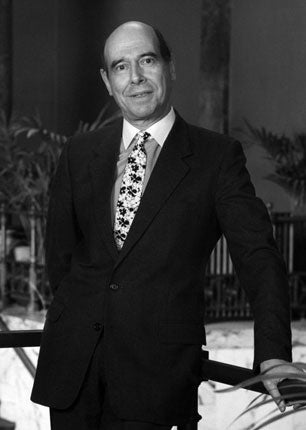
Michael Levey devoted his professional career to the National Gallery, and, in 1973, became one of its most distinguished Directors. During his 14 years in office many changes took place, and he was substantially responsible for initiating the modernisation of the gallery both in its attitudes and services to the public. New programmes were introduced, new galleries were built, and, most important of all, a number of masterpieces were added to the collection. With remarkable energy Levey also achieved a brilliant literary career, publishing widely on art, but also on music and literature, as well as several novels.
The son of a civil servant working in the Air Ministry, Levey was educated at the Oratory School in Berkshire. His early years were delightfully recalled in his memoir, The Chapel is on Fire (2000). National Service was largely spent in Egypt, where he achieved the distinction of reaching the rank of acting major in the Royal Army Education Corps. At Exeter College, Oxford, where he read English, he was fortunate to be tutored by Nevill Coghill, who, recognising Levey's exceptional ability, persuaded him to take his degree after two years; he got a first.
Coming down from Oxford, he was undecided what to do, until a girlfriend asked for help in completing an application form for the post of Assistant Keeper at the National Gallery, London. Recognising the attractions of the job, Levey also put his name forward and was duly appointed.
He soon became one of the stars of what was then a small staff. In those days, the assistant keepers undertook many of the administrative duties connected with running the gallery, as well as engaging in scholarly work on the collection. In the latter field, he completed catalogues of the 18th-century Italian school (1956), later expanded to include the 17th-century (1971), and the German school (1959), as well as writing a large number of more popular publications, covering the whole range of the gallery's holdings. As a sideline, he compiled a catalogue of the later Italian pictures in the Royal Collection (1964).
In 1968 he overtook a more senior colleague to become Keeper, and finally in 1973 he was appointed, unusually without a public competition, as Director. He was a masterly administrator; any visitor from mid-morning onwards would be confronted by a completely clear desk and an empty in-tray. He was treated by his staff with some awe, but with much affection. Feeling that he himself had been deprived of responsibility as an assistant keeper, he was generous in allowing the curators to hang their own galleries, with, admittedly, mixed results.
The National Gallery has advanced so far in public recognition that it is easily forgotten how many of today's central activities were started by Levey. His fervently held wish that the collections should be more widely known and enjoyed was matched by the greatly increased number of visitors over the period of his stewardship. He created the education department, wherein the artist-in-residence programme and a regular series of small exhibitions were introduced. Levey added new galleries within the existing building and also played a leading role in the long and controversial planning of what would eventually become the Sainsbury Wing.
Ultimately his greatest achievement, realised in the teeth of government parsimony, was the addition of no less than 55 paintings to the collection. These included a substantial number of masterpieces, including Altdorfer's Christ Taking Leave of his Mother, Rubens' Samson and Delilah and Monet's Gare St Lazare. One of his favourites, Jacques-Louis David's coolly beautiful portrait of Jacobus Blauw, involved extended negotiations in Paris and New York over a number of years before the French authorities agreed to its export. With works by Klimt, Matisse and Picasso he brought the collections well into the 20th century for the first time.
Levey lived in an environment dedicated to writing – he was married to the novelist and critic Brigid Brophy – and his output was prodigious, even during the period when he was Director of the National Gallery and when looking after his sick wife. Impeccably precise in his choice of words, he had a beautifully crafted style, which owed something to Walter Pater, whom he greatly admired and wrote about (The Case of Walter Pater, 1978).
He was a gifted interpreter of works of art, who succeeded in both conveying his own sensuous appreciation and offering stimulating new insights. His diversity of subject matter was hugely impressive. His first love was Venice; in 1959 he published Painting in 18th Century Venice, and much later he produced a monograph on his favourite artist, Giambattista Tiepolo (1986), which won the Banister Fletcher Prize. The first of his two volumes for the Penguin Style and Civilization series, Early Renaissance (1967), won the Hawthornden Prize, never previously awarded to a work of non-fiction. Painting and Sculpture in France 1700-1789 (1992) became a standard work.
Outside of his recognised field was his evocative The World of Ottoman Art (1976), and in the field of music, he wrote a deeply felt biography of his favourite composer, Mozart (The Life and Death of Mozart, 1971). His three novels – Tempting Fate (1982), An Affair on the Appian Way (1984), Men at Work (1989) – never received the same admiration. He delivered the Slade Lectures at Cambridge (published as Rococo to Revolution, 1966) and much later also at Oxford, as well as the Wrightsman Lectures in New York (Painting at Court, 1971). His last book was devoted to a much-loved artist, Sir Thomas Lawrence (2005).
In retirement, Levey spent much of his time looking after his wife, who was increasingly suffering from the debilitating effects of multiple sclerosis. Eventually he decided to leave London, and moved to the attractive Lincolnshire town of Louth, where his daughter lived. Finding the peace of mind he sought, he continued to write vigorously and communicate with a wide range of friends in letters full of wit and erudition lightly worn – he was exceptionally well read. With his sharp eye for human traits and foibles, his comments about people were delightfully piquant. His flowing conversation was marked by sparkle and great charm of manner.
On his own terms, Levey was a very warm friend, capable, as many will testify, of great generosity, both in deed and spirit. But he had a complex personality and, as he himself acknowledged, he could be difficult and idiosyncratic. Once his mind was made up, he was immovable.
His likes and dislikes, usually very strongly expressed, were unpredictable, and sometimes seemed perverse. The negative side of his taste can be seen in Fifty Works of English Literature We Could Do Without (1967), written with Brigid Brophy and Charles Osborne. In music, Bellini and Puccini were "in", whereas Bach, Beethoven and Verdi were "out". In art, Rembrandt was most definitely "out", yet he bought a major painting by the artist for the National Gallery.
Overall, he was a brilliant and gifted person of great strength of character and purpose, who fully realised his talents. His literary legacy will give pleasure for a long time to come.
Christopher White
Michael Vincent Levey, art historian and writer: born London 8 June 1927; Assistant Keeper, The National Gallery 1951-56, Deputy Keeper 1966-68, Keeper 1968-73, Deputy Director 1970-73, Director 1973-86; Slade Professor of Fine Art, Cambridge University 1963-64; Kt 1981; FBA 1983; Honorary Fellow, Royal Academy 1986; Slade Professor of Fine Art, Oxford University 1994-95; married 1954 Brigid Brophy (died 1995; one daughter); died Louth, Lincolnshire 28 December 2008.
Join our commenting forum
Join thought-provoking conversations, follow other Independent readers and see their replies
Comments