Sir Richard Rodney Bennett: Composer whose work encompassed serialism, tonality and popular music
He announced he didn’t want to write to commission any longer: ‘I’d rather paint,’ he said
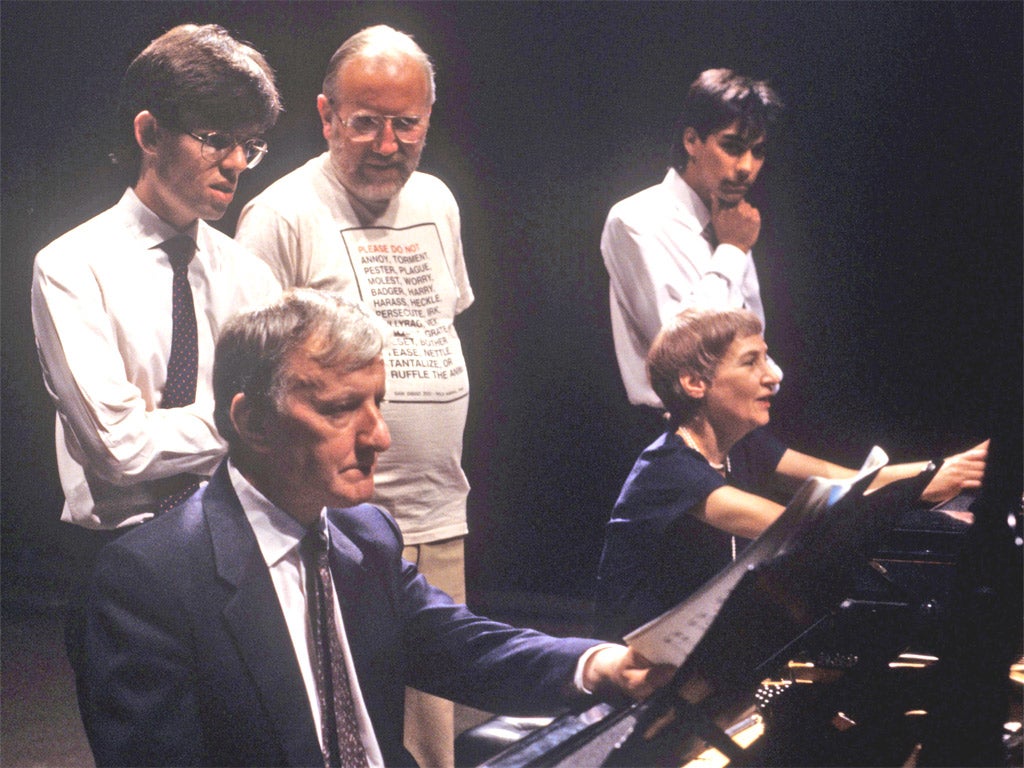
Richard Rodney Bennett once described Pierre Boulez as “a spectacular musician’’ and, for different reasons, the same epithet could have applied to himself.
Prodigiously gifted, Bennett began informal lessons with Elisabeth Lutyens when he was 10, later describing himself as “one of her first groupies”. By the age of 18 he had written his third String Quartet and at 19 he recorded his first documentary film score. A voracious listener, he absorbed not only Debussy, Ravel and Holst (with whom his mother had studied) but also the jazz in the American musicals which he heard at the cinema, whence his father, who wrote children’s books, drove him so as to be relieved of his son’s incessant piano-playing.
Born in Broadstairs in March 1936 to H Rodney and Joan Esther Bennett, he was educated at Leighton Park School, going with a scholarship to the Royal Academy of Music, where he studied with Howard Ferguson and Lennox Berkeley. But Lutyens’ search for serialism was at this stage a stronger influence and, always thorough, he found his way to Darmstadt in 1955, there encountering Boulez, who agreed to take him on as a pupil. The years in Paris (1957-59) were productive in two ways: he mastered serialism but, on the side, wrote non-serial film music (as Lutyens did). A fellow-student at the time was the pianist and teacher, Susan Bradshaw, who became a lifelong friend and with whom he translated Boulez’s Penser la Musique aujourd’hui. They later premiered Bennett’s Kandinsky Variations for two pianos.
Boulez’s influence was such that Bennett gave the first UK performances of his First Piano Sonata and, with Cornelius Cardew, his Structures I. His own music was now based upon a personalised serialism not unlike Berg’s, an idiom which years later he repudiated: “I wouldn’t want anybody now to play my pieces from those days ... when I was turning out that atonal stuff,” he was reported as saying. Nevertheless the idiom, technically consummate, produced, among many other works, three operas, all heard at Sadler’s Wells: The Ledge (1961), The Mines of Sulphur (1963) and A Penny for a Song (1967). These theatre pieces – and the influence of a good friend, the composer Thea Musgrave – enabled him to give to his abstract music a dramatic element clearly apparent in his concertos, particularly the Piano Concerto and Actaeon, in effect a horn concerto.
Still in his twenties, he wrote the music for John Schlesinger’s film Billy Liar in 1963; his Aubade was heard at the 1964 Proms (and later performed by Karajan); and he taught at the Royal Academy of Music between 1963 and 1965. His sheer professionalism kept him in constant demand and he somehow contrived to juggle the various strands of his musicality, 1974 producing, for example, the substantial Spells, for the Three Choirs Festival, the music for Murder on the Orient Express and several other smaller pieces.
In 1976 came Zodiac, commissioned by the National Symphony Orchestra of Washington to celebrate the US’s Bicentenary, which he dedicated to Elisabeth Lutyens on her 70th birthday, so declaring a pax in the row which had broken out when Lutyens had accused him of plagiarism. The work was important because it validated his “serious” credentials in America and, after what he referred to as “a big break-up” in his (very private) private life, he moved to New York in 1979, a migration concurrent with gradual disillusion with the procedures of serialism and an increasing integration of his diverse musical styles.
Noctuary (1980) combines Scott Joplin with references to Schumann and Debussy, whose Syrinx was the source of several After Syrinx pieces. At the 1979 Edinburgh Festival he was Artist-in-Residence, performing both his Horn Sonata, with Barry Tuckwell, in a programme of Saint-Saëns, Strauss and lain Hamilton, and, with Marian Montgomery, a late-night entertainment called Portrait of Ladies. His cabaret shows – with, among others, Maria Ewing – remained an engaging part of his professional life and displayed his stylishly husky gifts as a vocalist.
Bennett’s versatility also helped him to avoid the neglect which, in varying degrees, afflicted the other British composers – Peter Racine Fricker, lain Hamilton and Thea Musgrave – who had settled in America. Thus, he celebrated his 70th birthday with – at one end of the musical spectrum – a tribute to the late Queen Mother, Reflections on a Scottish Folk Song, called for by the Prince of Wales and performed by the Philharmonia Orchestra; and at the other a cabaret season with Claire Martin at London’s Pizza on the Park. Related events included BBC concerts by the Symphony Orchestra (Actaeon and the Third Symphony), the Concert Orchestra (mostly film music) and the Singers. He himself took part in a recital of his serious songs, a form for which he had a special talent, and, with John Harle, in a programme dominated by the saxophone.
Because his music was so expertly written Bennett attracted the finest performers: Stephen Kovacevich (then Bishop) premiered the Piano Concerto and played it at the 1969 Proms; Barry Tuckwell, Julian Bream, Evelyn Glennie and James Galway were among his concerto exponents; his singers included Jane Manning, Robert Tear and Philip Langridge; Antal Dorati launched his Zodiac, Christoph von Dohnanyi his Partita, a tonal work of 1995 which was given by 17 UK orchestras as the centrepiece of a scheme devised by the Association of British Orchestras.
Bennett’s enormous output (had he adopted opus numbers he would have exceeded 200) covered everything from opera and ballet to solo music and pieces for children; for films alone he wrote more than 40 scores. So it was not surprising that, as he approached 70, by now a paid-up tonalist, he confessed that he no longer wanted to write music to commission: “I’d rather paint. It’s more fun ... Also, I don’t have the musical heroes I used to have. The only one I have now is Henri Dutilleux ... I just hope it’s possible to have a late flowering like he has had.”
Last year his Murder on the Orient Express Suite was performed in a concert of film music at the Proms, and in the same season his Dream Dancing and Jazz Calendar were also featured. And at the Wigmore Hall, a few days before his 75th birthday, a double concert was given: which his Sonata After Syrinx was performed in the first concert, while in the Late Night Jazz Event, he and Claire Martin performed his arrangements of the Great American Songbook
Apparently rather a good painter, he remained reserved, urbane and audibly English. His knighthood, in 1998, he had assumed with immaculately polite detachment, having organised his Anglo-American lifestyle as deftly as he had integrated the diverse elements of his music. He was indeed a “spectacular” musician, but also a quietly humorous human being who was good at friendship.
Richard Rodney Bennett, composer: born Broadstairs, Kent 29 March 1936; CBE 1977, Kt 1998; died 24 December 2012.
Join our commenting forum
Join thought-provoking conversations, follow other Independent readers and see their replies
Comments