Stephen Gilbert: Writer who was lauded by Forster but is best known for a lurid novel about rats
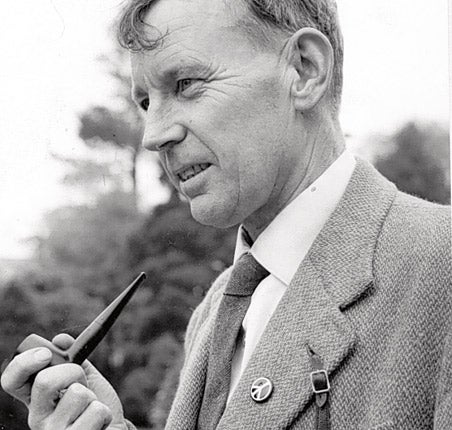
EM Forster called him "a writer of distinction", and reviews of his first novel, The Landslide, referred to "a little classic" and "an original and graceful work", yet Stephen Gilbert is chiefly remembered as the author of the more lurid Ratman's Notebooks (1968) – Willard in the American version, after it was made into a horror film by Daniel Mann (1971). Gilbert's other claim to fame is as the protege of Forrest Reid – not the only protégé, indeed, but the predominant one.
Stephen Gilbert was born in Newcastle, Co Down, in 1912, into a prosperous Northern Irish mercantile family, and grew up mainly in an affluent district of East Belfast. Like his near contemporaries CS Lewis and Louis MacNeice, the young Gilbert was sent away to prep school in England, spending the years between 10 and 13 at The Leas, Hoylake, Cheshire (he quite enjoyed his time there). Next came a Scottish public school, Loretto, where he failed to benefit from the education on offer. He left the school without passing any exams or gaining a leaving certificate.
Back in Belfast he joined the Northern Whig as a junior reporter, covering police courts in the morning, sales of work in the afternoon. (The magistrates' practice of imposing fines on failed suicides, those who'd lacked the necessary tuppence for the gas meter to finish themselves off – this was among the things that led Gilbert in later years to undertake voluntary work for the Samaritans.)
By the mid-1930s – turning his back on provincial journalism – he had joined the family firm, McCausland's tea and seed merchants, where his father was chairman and managing director (a position subsequently occupied by himself). In the meantime, in 1931, shortly after his 19th birthday, at a tennis party at the Belmont Tennis Club in Belfast, he met Forrest Reid, who was then in his mid-fifties, and began a friendship which lasted until the older writer's death in 1947.
It was not altogether a frictionless association. Gilbert has recorded his ambivalent feelings about Reid, to whom, as he freely acknowledged, he owed an enormous amount but whose demands, and interference in the younger man's affairs, could seem excessive. Reid's platonic interest in boyhood and youthful male beauty is well known, and from the start he was bowled over by the young Gilbert's striking appearance and engaging manner. The fact that Gilbert himself had literary ambitions was a bonus. Forrest Reid promptly set about enshrining his newest protégé in a novel – Brian Westby (1934) – submitting it to Stephen chapter by chapter as it was written, and never exacting from his subject more than an uneasy acquiescence. Gilbert's engagement at the start of the Second World War and eventual marriage didn't go down too well with his mentor, either.
The Landslide, published by Faber in 1943, is "gratefully and affectionately" dedicated to Forrest Reid and indeed, in its delicacy and charm, it gets close to the strand of fantasy perfected by Reid himself in his "Young Tom" trilogy. But it isn't in the least a derivative work. Neither is it at all whimsical, although its Donegal setting expands imaginatively into a kind of prehistoric terrain filled with dragons and other rare beasts. It shows an enlightened attitude towards animals, ordinary animals no less than those of a mythical character. It was a book he enjoyed writing, Gilbert said; after a day at McCausland's in the seed room putting flower and vegetable seed into packets, he would go home to his top-floor bedroom overlooking back yards in north Belfast "and enter a world that was really my own".
In the spring of 1939, having read Mein Kampf and become conscious of the need to make a stand against Hitler, he joined the Supplementary Reserve, and was at camp in Portstewart when war broke out. His subsequent experiences with the 3rd Ulster Searchlight Regiment in France from the winter of 1939 until the evacuation from Dunkirk, are vividly and dispassionately recounted in Bombardier (1944) – one of the most trenchant and rewarding novels of the Second World War (Gilbert was decorated for bravery after blowing up a bridge in the face of an enemy advance).
He felt after Dunkirk that he could best serve the war effort by returning to the family business. Throughout the rest of the war he corresponded with his fiancée Kathleen Stevenson, a distant relative, who had joined the WAAF and was stationed in North Africa (she was twice mentioned in despatches). The two were married in Belfast in 1945.
Gilbert's third novel, Monkeyface, about an ape-boy slowly acclimatising himself to the niceties of suburban living, came out three years later. It was followed by The Burnaby Experiments (1952), an intriguing read in which an eccentric millionaire co-opts a young man, Marcus Brownlow, to help with his experiments in psychic translocation (some critics have read into this novel, and indeed into all Gilbert's work, a subtext concerning the decline of the once great, industrial middle classes of Ulster). Irascible and, ultimately, dangerous, the millionaire John Burnaby has a number of traits in common with Forrest Reid – making the two authors quits with their portrayals of one another, neither of them entirely satisfactory (we may suppose) to its real-life prototype.
There were no novels between The Burnaby Experiments and Ratman's Notebooks and Gilbert, throughout the 1950s, devoted his considerable energies to becoming a successful businessman, under whose direction McCausland's blossomed into the UK's largest independent seed merchants, and raising a family of four children (born between 1947 and 1953). He was a founder member of the Campaign for Nuclear Disarmament in Northern Ireland – "because he felt it was necessary" – and he acted as Secretary during the first two years of its existence.
Like his mentor Reid, he preserved a rigorous detachment from the political conflicts of his native Northern Ireland, deploring all forms of bigotry and coercion – but when the Troubles erupted in the late 1960s he was living with his family in a house called Pembroke Lodge in West Belfast, an unlikely, indeed a hazardous, habitation for a middle-class Belfast Presbyterian who sounded like an Englishman. To make matters worse, the house was next-door to the residence of the GOC Northern Ireland, the army's commander-in-chief, and as a consequence, Gilbert's son recalled, some "interesting times" ensued for the family. They stuck it out until 1976, by which time the children had all left home, and the author and his wife moved to a village in CoAntrim.
Gilbert was a novelist of rare perceptiveness, with a wholly individual manner and outlook. There's a moment at the end of The Landslide when the boy Wolfe, having said goodbye for the last time to his beloved grandfather, goes to an upstairs window and waits until his eyes become accustomed to the gloom:
"There, climbing slowly upwards, was a dark figure. I watched intently the slow and painful progress, but at last the figure reached the cairn and seemed to disappear into the ground. I didn't know whether he had stopped there, or if he had gone on, and dropped out of sight beyond the summit."
It's a fitting valediction for a patriarch, sage and humanitarian.
Patricia Craig
Stephen Gilbert, novelist and businessman: born Newcastle, Co Down 22 July 1912; married 1945 Kathleen Stevenson (two daughters, two sons); died Whiteabbey, Northern Ireland 23 June 2010.
Join our commenting forum
Join thought-provoking conversations, follow other Independent readers and see their replies
Comments