Trevor Frankland: Painter who valued controlled passion and mathematical clarity but was also drawn to the arcane and esoteric
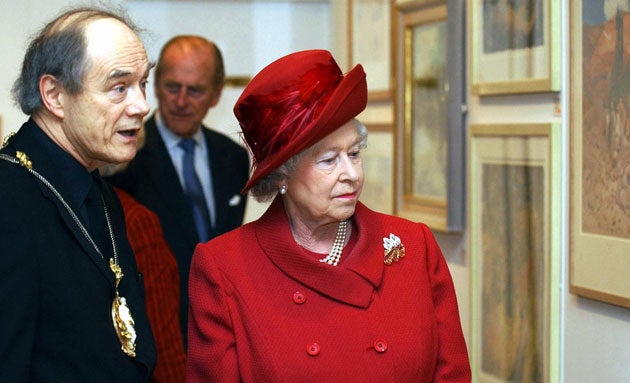
The artist Trevor Frankland was, first and foremost, an intellectual; there was a concept or scheme behind all his work.
His career encompassed many different phases and styles. For a time he concentrated on reliefs, but then in 1976 abandoned these and returned solely to painting. By the end of the 1980s he was finding the purely abstract too limiting and concrete images started to reappear in his work. His linocuts and watercolours included arrangements of objects such as cushions, garden furniture, vases, and Venetian blinds. Beyond, across a void and suspended in space archways and windows open into an imaginary landscape. This interplay of perspectives between the representational and flat patterns created what Frankland called "domestic landscapes" and became his distinctive style.
He was also heavily involved in professional organisations. For him the most significant was the Royal Watercolour Society, for which he served as president from 2003 to 2006.
Frankland was born in Middlesbrough in 1931, the eldest of four children. His father worked on the railways; his mother made cake decorations which seemed to cover every surface in the house. He attended Middlesbrough Technical School and gained whatever training he could by joining the Cleveland Sketching Club and by using the local library.
At 16 he left school and worked as an apprentice shipyard draughtsman. He hated it, but it left him with his idiosyncratic handwriting: he printed everything in capitals. Called up for service in the RAF, by luck he found that this also enabled him to attend the Laird School of Art in Birkenhead and here he was able to receive a proper grounding in art. He attended the Royal Academy Schools in London, where his contemporaries included Brian Kneale, John Hoyland, Brian Organ, and Eric Hebborn (who later became famous as a forger). He won several prizes and on graduation in 1959 a £200 Leverhulme Award that allowed him to stay and study printmaking: the damage caused by breathing in fumes from nitric acid on the etching plates caused nose bleeds for the rest of his life.
In 1957 Frankland had married Dorothy Southern, also an artist, whom he had known since they were in their teens. On leaving the RA he began work at the Medway College of Art in Rochester where he taught drawing and composition but taking other work to get by – picture restoration, book illustration, even painting a sign for a hot potato bar. He moved on to Hornsey School of Art, where he taught Visual Research Studies, eventually becoming associate senior lecturer before retiring in 1996.
In 1968 student sit-ins led to Hornsey's closure for six months. Frankland was unsympathetic to the students' aims, but he was immensely grateful for the free time the strike gave him to read widely and work on his own art projects. In a complete move away from representational art he began a series of large, three-dimensional structures made from wood and hardboard. To his great surprise and pleasure, one of these – titled Euryalus – was bought for 100 guineas by Rank Xerox for their executive dining room.
In 1969 Trevor and Dorothy took the first of many trips abroad which eventually took them through the Middle East and North Africa and beyond to Afghanistan and Iran, Pakistan and India. The abstract rhythms and patterns of Islamic art fascinated Frankland and found their way into the grid systems and network structures which typified his work of the following two decades.
In May 1970, Billingham Art Gallery gave Frankland his first of many one-man shows – many others followed and Middlesbrough Art Gallery gave him exhibitions in 1976, 1981 and 1988.
Institutional collections holding Frankland's work include Birmingham University, Middlesex University, Scarborough Art Gallery, Shipley Art Gallery in Gateshead, Hammersmith Hospital, and Williamson Art Gallery. His work is also in private collections in England, Italy and the US.
Frankland admired what the art historian Bernard Berenson called "controlled" rather than "exuberant" passion and he named Klimt, de Chirico, Balthus and Frank Stella, as important influences. Above all he valued the mathematical clarity of Nicolas Poussin. Yet he was also drawn to the arcane and esoteric. He was both a Freemason and greatly inspired by Zen Buddhism. In his upstairs studio he kept a box of yarrow sticks which he used for consulting the I Ching, the Chinese book of divination.
At his home in Wandsworth he kept two studios for his work, and his sitting room was virtually an art-reference library. Even his garden, designed to Japanese principles, was a creative work of art and featured in several television programmes.
He was elected to several artistic societies including the Royal Society of Painter-Printmakers, the Royal Society of British Artists, the London Group and the Art Workers Guild. As well as offering an outlet for sales, the societies were an opportunity for companionship, and – since he was interested in their politics – a chance for influencing their direction.
Frankland was always active, vigorous and had a strong sense of humour. In 2010 Trevor Frankland, Between Clarity and Mystery was published, to coincide with the Royal Watercolour Society's spring exhibition, at which he was the featured artist.
Eric Trevor Frankland, artist and teacher: born Middlesbrough 7 July 1931; married 1957 Dorothy Southern; died London 17 April 2011.
Join our commenting forum
Join thought-provoking conversations, follow other Independent readers and see their replies
Comments