Troy Kennedy Martin: Innovative writer who created 'Z Cars' and wrote 'Edge of Darkness' and 'The Italian Job'
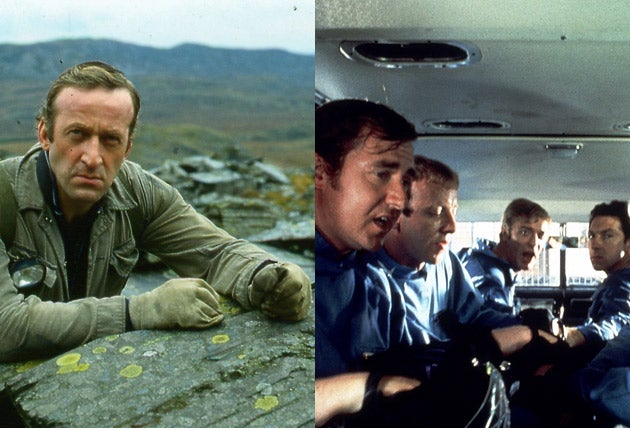
When Troy Kennedy Martin created Z Cars in 1962, he brought to British television screens for the first time an image of the police very different from the homely one depicted in Dixon of Dock Green. The result was a warts-and-all portrayal in which the guardians of the law were seen as not infallible – and no angels.
It was a notable television equivalent to what was happening in the stage plays of John Osborne and Arnold Wesker, the cinema films made by the director Tony Richardson, and the novels written by Alan Sillitoe. The stuffy old voices associated with Britain's dwindling empire and middle-class "respectability" were being replaced by these Angry Young Men, who gave a voice to working-class people and left-wing views.
The idea for Z Cars came to Kennedy Martin when he was ill in bed with mumps, relieving the boredom by listening to police messages on his radio. He set his programme in the fictional Liverpool suburb of Newtown, a symbol of the housing estates that had sprung up across Britain.
The tough Detective Inspector Charlie Barlow (Stratford Johns) and the gentler Detective Sergeant John Watt (Frank Windsor) were setting up a new crime division with mobile police officers in patrol cars nicknamed Z Victor One and Z Victor Two. Many viewers will remember scenes of policemen in the cars, shot in a studio with footage of streets and roads projected on to a screen behind them – disaster occurring when the end of a spool came too early!
John McGrath, who directed early episodes of Z Cars, did much to bring Kennedy Martin's vision to life – in a programme initially broadcast live. "In a single episode, there could be 10 or 15 sets," the writer once explained to me. "You would have actors leaping over half-frames of cars and rushing to get to the interior of the police station. It was a real adrenaline rush."
Z Cars quickly attracted up to 14 million viewers, but Kennedy Martin left after three months when the BBC decided some of his ideas were too subversive and that the villains must always be caught. Although ground-breaking, the programme was not nearly as revolutionary as the type of television Kennedy Martin subsequently espoused. There was already a movement to move small-screen drama away from its theatrical, "proscenium arch" approach – simply like filming a stage play – and develop it into a form exclusive to the medium.
Reducing dialogue and moving the story along quicker was part of the new method proposed by those such as Kennedy Martin, who wrote a widely debated article titled "Nats Go Home" in a 1964 issue of the theatre magazine Encore.
Pleading for "new language, new punctuation and new style", he called for television drama to be taken away from "a theatre of dialogue, a theatre of performance... a writer's theatre" – which he regarded as "naturalism" and capable of being produced by the BBC's talks or outside-broadcast departments. He suggested condensing dialogue through "stream of consciousness and diary form", with editing a critical component and the director taking on a more creative role.
The first evidence of this new approach was Diary of a Young Man (1964), a six-part series written by Kennedy Martin and John McGrath, with alternate episodes directed by Ken Loach and Peter Duguid – both recent graduates of a BBC training course. Victor Henry and Richard Moore starred as two Northerners arriving in London, and fresh television drama techniques included jump-cuts, still pictures, music and diary entries read in voiceover.
In Loach, in particular, the writers found someone with empathy for their wish to put on screen more "realistic" characters, not polished actors. That director clung on to elements of Kennedy Martin's "anti-naturalism" manifesto as he later gave a documentary feel to landmark plays such as Up the Junction and Cathy Come Home.
However, after 1965, Kennedy Martin did not write another original work for the BBC for 20 years, claiming that his left-wing views had made him unpopular with some executives. When he returned with the gripping conspiracy thriller Edge of Darkness (1985), it was hailed as a classic, won six Bafta Awards and was voted 15th-best programme ever by British Film Institute members nine years ago.
The six-part serial began as a detective drama, with a police officer (Bob Peck) investigating the brutal murder of his own daughter (Joanne Whalley), a member of an environmental pressure group. It moved into different territory, as the father discovers a conspiracy involving the government, the CIA and the nuclear power industry.
Although the drama was influenced by Ronald Reagan's speech announcing the "Star Wars" programme, to deploy weapons in space to defend the US from attack by nuclear missiles, Kennedy Martin also drew on the personal experience of being separated from his daughter following his divorce. Edge of Darkness was further remarkable for the way it reflected the concerns of the day, from the Thatcher government's support for nuclear weapons and its crushing of the striking miners to political activism and a background of Irish terrorism.
During the long gap between Z Cars and Edge of Darkness, Kennedy Martin continued contributing scripts to television but also found success in the cinema, most notably with his screenplay for The Italian Job (1969).
The film has gained iconic status for its memorable scenes of three Mini Coopers – red, white and blue, and driving in that order – thundering through the crowded streets, plazas and sewers of Turin, and the literal cliffhanger, with the getaway coach hanging over an Alpine precipice and a quandary over how to retrieve the gold at the far end without disaster.
Kennedy Martin bought the story from his younger brother, Ian, another successful screenwriter, who had written about a robbery in Regent Street, London. With Michael Caine as the lead character and spectacular scenes shot in mainland Europe, the reworked screenplay was turned into a memorable, if flawed, film. It also featured Noël Coward in his final screen role, as an aristocratic crook, and Benny Hill as the potty Professor Peach.
For his next film, Kelly's Heroes (1970), Kennedy Martin transposed the heist theme to Germany after his talent had been spotted by the Hollywood studio MGM. Clint Eastwood, Telly Savalas and Donald Sutherland starred as American soldiers on a raid to seize a stash of gold bars from the Nazis. Both films contained plenty of humour and made Kennedy Martin wealthy enough to become a tax exile in Antibes, before moving to Los Angeles; he eventually returned to Britain.
Born in Glasgow in 1932, Kennedy Martin moved to London with his unemployed Irish father following the death of his teacher mother when he was 15. He attended Finchley Catholic Grammar School before studying history at Trinity College Dublin.
During National Service as a junior officer with the Gordon Highlanders in Cyprus in the 1950s, he saw trouble simmering between the Turks and Greeks. This led him to write a play, Incident at Echo Six (1958), and submit it to the BBC, which accepted it and hired him as a script editor. He was soon working with some of the new wave of writers and producers who would shake up TV drama, such as John McGrath, Kenith Trodd, Roger Smith and James MacTaggart, under the director-general Hugh Greene's liberal regime during the 1960s.
He started by scripting adaptations, including Somerset Maugham's The Traitor (1959) and plays in the anthology series Storyboard (1961). His original work, The Interrogator (1961), about a police investigation into a terrorist group, was again set in Cyprus.
He was brought back to write the final episode of Z Cars in 1978 when the BBC ended its 16-year run. However, with McGrath again directing and some of the original actors making cameo appearances, it proved to be ultimately disappointing.
In the interim he had contributed scripts to series such as Redcap (1964-66), starring John Thaw as a military policeman, Colditz (1974) and The Sweeney (1975-78, created by his brother). He also wrote the film spin-off Sweeney 2 (1978) and, for the only time, a sitcom, If It Moves, File It (1970), starring John Bird and Dudley Foster as Civil Service minions. When work was scarce, he wrote – under the pseudonym Tony Marsh – episodes of the ITV soap opera Weavers Green (1966), set in a Norfolk country vet's practice.
The writer came thundering back in the 1980s with the ITV series Reilly – Ace of Spies (1983), starring Sam Neill as a British agent in Bolshevik Russia, and a five-part BBC adaptation of The Old Men at the Zoo (1983), based on Angus Wilson's novel but updated as a satire on the Thatcher age.
When Michael Grade, as BBC1 controller of programmes, saw Edge of Darkness on BBC2, he was so imp-ressed that he screened it on his own channel several weeks later, attracting an audience of eight million – almost double that for the original.
At the time, Kennedy Martin – who went through several financial crises – made known his feeling that writers were under-appreciated in Britain. "Writers here are so badly paid, it's a joke," he said. "And, although I'm not really disillusioned with England, I just think there's going to be a really hard future when the oil runs out. I'm going to be in Santa Monica with all the other British political exiles."
In Hollywood, he co-scripted the film Red Heat (1988), an action thriller starring Arnold Schwarzenegger. Following his return to Britain, he adapted Andy McNab's book Bravo Two Zero for television (1999), starring Sean Bean as the real-life SAS soldier behind Iraqi lines in the 1991 Gulf War and wrote the feature film Red Dust (2004), based on Gillian Slovo's novel about the torture and murder of a South African black during the apartheid era). He also wrote the television film Hostile Waters (1997), based on a real-life collision between American and Russian submarines.
Hollywood reworked The Italian Job for a 2003 film, while Edge of Darkness has been re-made as a feature film starring Mel Gibson, by the original television director, Martin Campbell, and will be released next year.
Anthony Hayward
Francis Troy Kennedy Martin, writer: born Glasgow 15 February 1932; married 1967 Diana Aubrey (divorced, one son, one daughter); died Ditchling, East Sussex 15 September 2009.
Join our commenting forum
Join thought-provoking conversations, follow other Independent readers and see their replies
Comments
Bookmark popover
Removed from bookmarks