U. A. Fanthorpe: Poet who championed the underdog and whose work was rooted in English history
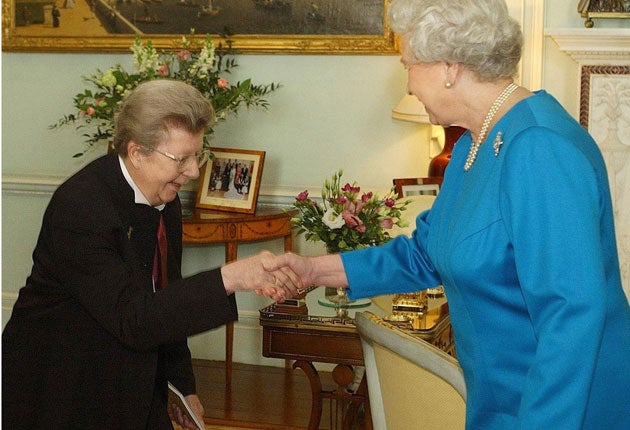
The poet U.A. Fanthorpe, who has died aged 79, was a national treasure.
Her great appeal was that despite her genteel background (16 years teaching at Cheltenham Ladies' College) she was that rare bird in Britain, someone for whom class didn't much matter.
In fact, she was more comfortable with life's minor characters. She said that she left teaching because, having been promoted to Head of Department, "Power had an effect on me I didn't like". For her, fame and power conferred a dangerous vulnerability ("Surviving is keeping your eyes open, / Controlling the twitchy apparatus / Of iris, white, cornea, lash and lid") and she consistently championed the underdog.
Ursula Fanthorpe was in the vanguard of a new wave in poetry (although such terminology sounds incongruous for poets who came to the art so late) – mature poets who began to publish in middle age after a career outside the usual poets' parish relief of editing jobs, residencies, scraps of patronage. She came to be the defining spirit of Peterloo Poets, a small publishing house founded by Harry Chambers in 1972. The list specialises in the poetry of lived experience rather than willed experiment and Fanthorpe exemplified this perfectly.
Ursula Fanthorpe was born in Kent in 1929, read English at St Anne's College, Oxford, and taught at Cheltenham Ladies' College. What stung her into poetry was her experience as a medical receptionist at a Bristol neurological hospital where she worked after she had left Cheltenham. In the introduction to her Collected Poems Fanthorpe dates the beginning of her poetry career precisely. "On 18 April 1974 I started writing poems". From the beginning she sided with the patients against the doctors, a characteristic stance. She observed the gallery of characters who passed before her en route to the doctors and made poetry from their raw troubles. There was no sense of appropriation in this – everything Fanthorpe touched in poetry was handled with dignity. She said: "At once I'd found the subject that I'd been looking for all my life: the strangeness of other people, particularly neurological patients, and how it felt to be them, and to use their words."
Her first book, Side Effects, was published in 1978. From this beginning, Fanthorpe carved out a distinctive path. Having started from such an unconventional position she inevitably took her place as one of the community of poets. She was admired by many, especially the new Poet Laureate, Carol Ann Duffy, her junior by 26 years. Fanthorpe perfected a monologue technique for our times, dusting down a form that had been little used since Browning.
Fanthorpe's most autobiographical poem, "Growing Up", is not only revealing about her own life, it provides the leitmotif for the characters who people her poems. Having disposed of the ages of her life and her unhappiness in each of them, she reaches her poetic maturity:
Called to be connoisseur, I collect,
Admire, the effortless bravura
Of other people's lives, proper and
comely...
She put this slightly differently in an interview in the only critical book published in her lifetime (Eddie Wainwright, Taking Stock, Peterloo, 1994): "I'm particularly involved with people who have no voice: the dead, the dispossessed, or the inarticulate in various ways. I'm not carrying on a campaign on their behalf but this is the theme I recognise as having a call on me: people at the edge of things."
And it is this great sympathy for others that make her the most humane poet in English of the last 30 years. Beyond her gallery of losers, it was English history that most engaged her, and as she said, the other things she wrote about were mostly of the riddling kind. Artists have found "England" a difficult theme in recent years, but for Fanthorpe English history was ever present, lurking beneath the apparent blandness of consumer society. In "Driving South", the past leaps from every hedgerow:
The bloody names pursue. York, Selby,
Richmond,
Pomfret, where Richard died. History
hounds us.
Ursula Fanthorpe was identified throughout her career with Peterloo Poets. Chambers specialises in publishing humane, straight-talking poets, often late starters, but Fanthorpe was head and shoulders above the rest. Penguin published a Selected Poems in 1986 but they didn't keep it in print. It was typical of Ursula that she kept faith with a small press.
Many of the honours the state can bestow on a poet came to her in her last 10 years: she was put on the syllabus, awarded a CBE in 2001 and the Queen's Gold Medal for Poetry in 2003, only the fifth woman in 70 years to receive it. Perhaps more important than these honours, she was loved. In 1999 The Guardian campaigned for her as their candidate for Poet Laureate. She wrote a poem for Prince Charles' 50th birthday and you realised that her feelings here were as sincere as they were for her underdogs. She was perhaps the only person in the country whose sympathies were as broad.
As a person, Ursula came across as gently fierce or fiercely gentle. She was the kind of person it is hard to imagine letting her hair down. In 2001 she was the subject of Desert Island Discs, a give-away for most, but the only eyebrow-raising choice, among the Peter Pears and Kathleen Ferrier and a Geordie folk song that seemed right in character was Cilla Black's version of Bacharach's "Anyone Who Had a Heart" – one of the great torch songs of all time but one you could hardly imagine her singing in the bath. But perhaps she did? As a character, Ursula would have fitted well into one of her own poems. The Bacharach reminds me of her poem "Patience Strong", in which she is righteously sniffy about the effusions of the "inspirational" poet but has to recognise that for the epileptic patient who is the subject of the poem, this "homespun verse / Disguised as prose" was what kept him going. She understood that our hearts often have such poor taste.
When Ursula gave readings she usually shared the platform with her long-time partner, the poet R.V. (Rosie) Bailey. Theirs was a rare union, that of a devoted couple whose kindliness and old-fashioned courtesy radiated out into the world. Ursula, despite the fierce independence of her poetry, was a vulnerable woman, prone to depression. In this world she needed protection and it was Rosie, this frail-looking but sprightly figure, who gave it. Ursula acknowledged this in a beautiful poem: "Atlas":
And maintenance is the sensible side of
love,
Which knows what time and the weather
are doing
To my brickwork; insulates my faulty
wiring...
...which keeps
my suspect edifice upright in the air.
Ursula made up for her late start through dedication and hard work. In her last years there were three books: Queuing for the Sun (2003), Homing In (2006) and From Me to You (2007). Her poetry managed the difficult feat of both being very English and also transcending it. The last poem in her Collected Poems 1978-2003 echoes Czeslaw Milosz's "And Yet the Books" and doesn't suffer in the comparison:
Fire, fear, dictators all have it in for books.
The more you destroy them, the louder we
call.
When the last book's returned, there's
nothing but the dark.
Ursula Askham Fanthorpe, poet: born 22 July 1929; Fellow, Royal Society of Literature, 1988; CBE, 2001; Queen's Gold Medal for Poetry, 2003; died 28 April 2009.
Join our commenting forum
Join thought-provoking conversations, follow other Independent readers and see their replies
Comments