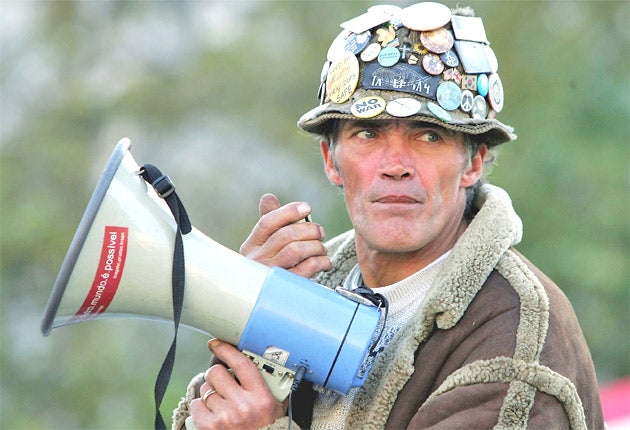
Anti-war protester Brian Haw was a very public thorn in the British Government's side.
Starting on June 2 2001, he staged a continuous round-the-clock demonstration opposite the Houses of Parliament against the UK's policy in Iraq and elsewhere.
His tent and ragtag collection of horrific pictures of war victims and hand-written posters with slogans like "BABY KILLERS" became as much a fixture in Parliament Square as the statues of Winston Churchill and Sir Robert Peel.
Haw fought off a series of attempts by the authorities to have him removed from the square, becoming a beacon for civil rights campaigners in the process.
Some dismissed him as a crackpot, but others saw his protest in the shadow of the Mother of Parliaments as a crucial test of modern British democracy.
Haw was difficult to pin down about his personal life, preferring to talk about the horrors of war and what he described as the UK Government's "murderous" military involvement in Iraq and Afghanistan.
But scraps of his fascinating biography emerged in the conversations he had with journalists.
He was born in 1949 and lived in Barking, Essex, before moving to Whitstable in Kent.
His father was one of the first British soldiers to enter the Bergen-Belsen concentration camp after it was liberated from the Nazis. Twenty years later he killed himself.
Haw spent time in the merchant navy, ran a removals business and worked as a carpenter, but his evangelical Christian faith drove him to seek out suffering.
He visited Northern Ireland during the Troubles and travelled to the killing fields of Cambodia as the country attempted to recover from years of genocide and warfare.
Haw also worked with troubled youngsters in Redditch, Worcestershire - where he lived with his wife Kay and their seven children - before starting his Parliament Square protest in mid-2001.
The demonstration began as an angry response to economic sanctions and British and American bombing raids on Iraq.
Its scope grew wider after the September 11 attacks on New York and Washington DC, and the invasions of Afghanistan and Iraq that followed.
Haw explained that he had left his family to campaign for other families suffering in war zones around the world.
"I want to go back to my own kids and look them in the face again, knowing that I've done all I can to try and save the children of Iraq and other countries who are dying because of my Government's unjust, amoral, fear- and money-driven policies," he said.
"These children and people of other countries are every bit as valuable and worthy of love as my precious wife and children."
The protest was not popular with the authorities, who repeatedly tried to shut it down.
In April 2002 Westminster City Council began legal action under the Highways Act on the grounds that Haw was a "nuisance", although the case never came to court.
The council later failed in an attempt to remove his placards for "obstruction" and "unlawful advertising", but it succeeded in limiting the hours he could use a megaphone to attack Government policies.
In November 2004 Ministers announced provisions in the Serious Organised Crime and Police Bill that were widely believed to be specifically aimed at removing Haw from Parliament Square.
The legislation, passed in April 2005, restricted the right to protest in designated areas within 1km (about half a mile) of the Houses of Parliament
Initially the High Court ruled that Haw's protest was not covered by the Act because it started before the new law came into effect.
But the case was taken to the Court of Appeal, which in May 2006 ruled that he would have to apply to the police under the Act for permission to continue his demonstration.
This was granted - but only with a series of conditions limiting the size of his protest site to an area 3m wide by 1m deep by 3m high.
On May 23, 2006 police launched a massive overnight operation to seize 90% of Haw's placards on the grounds that he had breached these restrictions.
It was also claimed that he had failed to control the site properly and left it open to terrorists.
However, a judge found that there was no case to answer the following year.
This year the Greater London Authority successfully got permission to evict Haw and his supporters from the grass area at the centre of Parliament Square.
Westminster Council is due later this year to go to court to try to get the demonstrators moved off the pavement too.
Other opponents of the demonstration expressed their opposition in a more direct fashion - the peace protester was frequently abused by passers-by and even had his nose broken several times.
But despite being repeatedly arrested and beaten up, he kept returning to his spot opposite Parliament.
Haw made an unsuccessful bid to become MP for the constituency of the Cities of London and Westminster - which includes Parliament Square - at the 2005 General Election.
He claimed his was the most democratic campaign in the country because anyone could come and speak to him at any time.
Haw's protest came to be part of the fabric of British cultural life.
It was immortalised as a work of art in January 2007 when former Turner Prize nominee Mark Wallinger meticulously recreated his camp in the august surroundings of the Tate Britain gallery.
Haw also won a Channel 4 News award for Most Inspiring Political Figure in 2007.
Join our commenting forum
Join thought-provoking conversations, follow other Independent readers and see their replies
Comments