The untold story of Obama's mother
The President's formative years are well documented, but only now are his mother's exploits in Indonesia coming to light, reports Judith Kampfner

For free real time breaking news alerts sent straight to your inbox sign up to our breaking news emails
Sign up to our free breaking news emails
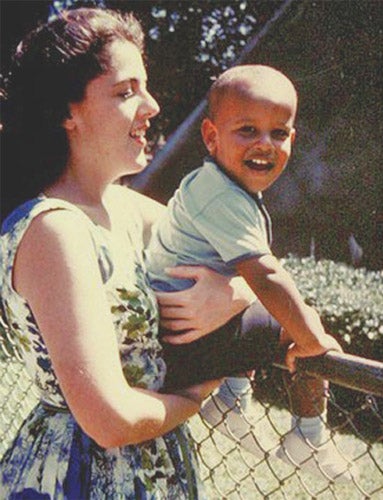
The shadow puppeteer flicks his wrist as he beats a stumpy stick against a wooden box and begins a dramatic introduction to a story about Kunti, a mother who fights for social justice. This is Pucung, a remote Indonesian village where skeletal leather puppets, some of Indonesia's best-known handicrafts, are made. The character has a mass of black hair. Ann Dunham, too, was famous for her shock of black hair, which she claimed came from a trace of Cherokee blood in her veins. Barack Obama's mother also did more for social justice in her adopted Indonesia than her son's accounts suggest.
"What is best in me, I owe to her," the 44th US President acknowledged in the second edition of his memoir Dreams From My Father. But Dunham has been little more than a footnote in his extraordinary story. In the preface, Mr Obama wrote: "She travelled the world, working in the distant villages, helping women buy a sewing machine or a milk cow or an education that might give them a foothold in the world's economy."
But he chose to highlight a dreaminess in his mother. "She gathered friends from high and low, took long walks, stared at the moon and foraged through local markets for some trifle, a scarf or stone carving that would make her laugh or please the eye." There is more than a hint of superficiality; a sense that his mother was a hippy chick.
What Mr Obama's narrative omits is any detail of how Ann Dunham was an economic anthropologist and that for 30 years she devoted herself to studying rural enterprise in Indonesia. She took on projects as a development officer with the Ford Foundation, the US Agency for International Development and the Asian Development Bank, pioneering micro-credit projects that extended small loans to the rural poor.
Dunham's legacy both as a scholar and a mother whose influences would shape her son will finally receive wider prominence later this year when her PhD treatise, which took 14 years to complete, is published by Duke University Press. A feature-length movie about her life, Stanley Ann Dunham: A Most Generous Spirit, goes into production next year.
"She wanted to know why people do things and how they do what they do – applied anthropology," says Alice Dewey, Dunham's PhD supervisor. "She was the hardest-working person I have ever met. When she came down to breakfast, she had already been working for four hours."
But Dunham was more than an academic. In Indonesia, she supported radical groups opposed to the military dictatorship. She was an activist, an adventurer, a supporter of traditional arts and culture, a teacher,and a development worker. The country today is a world leader in micro-credit. "She was a pioneer," says Adi Sasono, chairman of the Co-operative Council of Indonesia, who watched her micro-finance achievements. "She was an orang besar [great person]. In Obama's books and speeches, I see the same sensitivity, the same concern for common people and for justice."
Dunham was born in Kansas in 1942 and named Stanley Ann because her father had wanted a boy. The family moved to Hawaii where she met her first husband, Barack Obama Snr, at university. After their brief marriage ended, Dunham returned to complete her anthropology degree and met Lolo Soetoro, an Indonesian student who would become her second husband.
The young mother, aged 24, and six-year-old Barack arrived in Jakarta to join Soetoro at a difficult time. The Muslim nation was in turmoil after the bloody coup in 1965 that brought General Suharto to power. But Dunham knew she wanted to pursue her studies and Indonesia, with its plethora of islands and languages, is a social anthropologist's paradise. According to friends, she spoke fluent Bahasa Indonesian (the national language) and some Javanese. She was an amateur weaver fascinated by textiles, who amassed a significant collection of batik cloths.
Like Dunham, Kay Ikranagara, was an American anthropologist married to an Indonesian. "She had high ideals for [Barack]," she recalls. "She said anyone who didn't work hard didn't deserve to get ahead. She had traditional values like honesty, (which in Indonesia was not especially prized – getting on with people was considered more important) and she hated hypocrisy."
Dunham's cultural heroes were Gandhi and Martin Luther King. She was a peacenik and believed implicitly in racial equality. But she did not anticipate the problems her son would have a black child at school in Hawaii, says Ms Ikranagara, adding: "Maybe she was not aware enough about that. We had this belief that there should be no racial difference, so maybe that made us a little blind to the difficulties one might have in a position like that."
In the atrium of Dunham's Jakarta home, Julia Suryakusuma points to carvings and earth colours and muses that it is "a very Ann house". Ms Suryakusuma was one of Dunham's closest friends and recalls her as "new age" – in that she was interested in spirituality but also "very, very disciplined". "[Ann] was a pragmatic idealist," she adds.
Dunham divorced Soetoro in 1980. "After her divorce, she was a free woman and she expressed it in a way a woman does," says Ms Suryakusuma. "She dared to live."
With Barack settled back at school in Hawaii from the early 1970s, living with his grandparents, and his half-sister Maya with Indonesian relatives, Dunham was free to pursue her studies. Her PhD thesis "Surviving Against The Odds" is an academic but lively account of village life and structure as well as the ancient rites, the shamanism, the sexual divisions of labour and the blacksmith trade.
The village Dunham studied is Kajar, in the foothills of mountains a 90-minute drive along dirt roads from Indonesia's second city, Yogyakarta. She lodged with Maggie Norobangun, who is still alive and leads the way through a courtyard where turtles crawl. Ann was easy to live with and "always cheerful, never complaining", she recalls. She would leave early, getting on a motorbike and hiking up her batik wrap skirts, and return late. She didn't talk about her children, Ms Norobangun says, "but I knew she missed them. She would ask me often about my children".
According to Bronwen Solyom, an anthropologist whose work in Indonesia overlapped with Dunham's: "She was a fluent speaker. She asked intelligent questions because she cared."
Some have suggested that the young Barack Obama resented being separated from his mother while she worked abroad. He told one interviewer last year that she had "a certain recklessness". Whatever the truth, the President is due to visit Indonesia in November. Locally, there is already much excitement. He likes nasi goreng, the national dish of fried rice it's rumoured. But one of Dunham's former friends, anthropologist Yang Suwan, refuses to read the President's autobiography. She says she can't ever forget when Mr Obama, then a law student, was made editor of The Harvard Law Review. His mother read out an article in Time magazine. "You know Suwan, they just say 'the mother is an anthropologist'. Just that, just one sentence," she said. Suwan repeats the sentence in disgust.
If he gets around to visiting Kajar, the President will hear how its families have just clubbed together for their first low-interest loan. It will allow them to nurture what Ann Dunham called the "ingenuity" of rural Java. It was one of her cherished goals.
Judith Kampfner's documentary about Ann Dunham, Dreams From My Mother, can be heard today on BBC World Service radio
Subscribe to Independent Premium to bookmark this article
Want to bookmark your favourite articles and stories to read or reference later? Start your Independent Premium subscription today.
Join our commenting forum
Join thought-provoking conversations, follow other Independent readers and see their replies