Alexis Tsipras: He's got the euro in his hands
The former communist who leads Greece's anti-austerity Syriza party inspires devotion at home but dread in Brussels
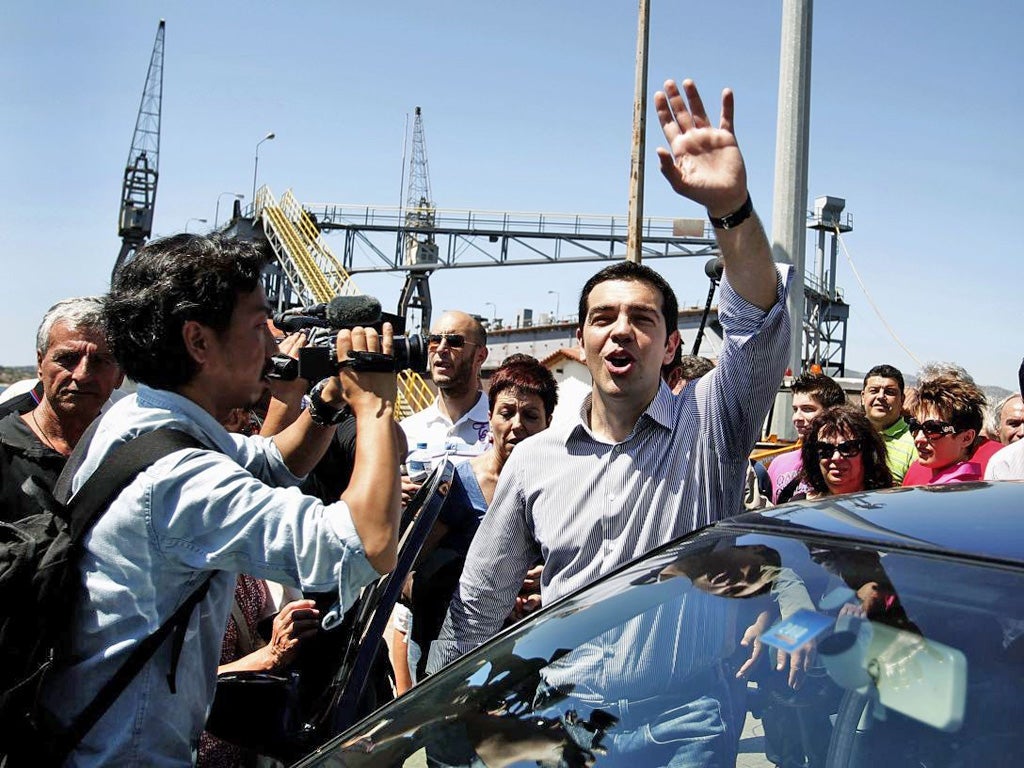
Alexis Tsipras – the name does not exactly trip off the tongue, but he is not going away. The ex-Communist radical who scraped through his engineering exams at the National Technical University of Athens, then spent 10 years on the left-wing fringes of national politics, leapt to fame when the group he heads, Syriza, the Coalition of the Radical Left, came second in Greece's inconclusive general election last month. A second poll tomorrow could see him catapulted into the prime minister's office. And if the present crisis were to give birth to truly federal Europe, he might have a key role to play in it.
His success is no thanks to the Greek establishment. The media dominated by the centrist parties that have ruled, and ruined, Greece for three decades have done their best to pin him to the margins. When he visited Germany earlier this month, only fellow leftists made him welcome – Chancellor Merkel refused to meet him. Demanding the nationalisation of the Greek banks, the expansion of the public sector, a halt to privatisation, a raise in unemployment benefits and the minimum wage, and a cut in taxes, he seems at first blush to be less a serious politician than a fantasist, a man far too removed from the bitter realities of the Greek crash to be taken seriously. Some see his success as another manifestation of the national malaise that has propelled the Golden Dawn's neo-Nazis into parliament.
Is this man merely a symptom of the Greek disease – or a possible cure?
One thing is beyond dispute: in the past months, with Athens soup-kitchen queues lengthening, school students fainting from hunger and (as Patrick Cockburn reported in The Independent on Thursday) one psychiatric hospital running out of food for its patients, this jaunty young radical with the demeanour of a Hero of the Revolution has given the Greeks something to cheer about.
In the depths of the current crisis, with the austerity programme imposed from outside producing misery without end, the most serious problem is psychological. A nation, like an individual or a family in these circumstances, suffers a drastic loss of self-confidence and self-esteem. It begins to believe all the vile things said about it by others. It starts to believe that all its sufferings are fully deserved. Morale slumps, and it is this as much as objective material conditions that makes recovery so hard.
This country whose history is at the root of European civilisation, with its gorgeous climate, rich contemporary culture and a highly educated workforce, begins to believe that it is of no value, that its sins outweigh any possible merits and that its only recourse is to slink off to some dismal hole and die. The shine is only just coming off all those wondrous toys, the subway system and the stadiums and the rest, that were the Olympic proof of Greece's new age of glory, but the game is all but over.
Tsipras has proved to be the cure for that mood. He is saying what people want to hear. And while his prescriptions may seem the stuff of pipe dreams, as his coalition has grown in popularity, the rhetoric of his mainstream opponents in New Democracy and Pasok, the socialist party, has also begun to stiffen. They are beginning to move towards the notion that Greece does not have to simply roll over and submit, that a solvent Greece within the eurozone is a matter of incalculable importance not only to Greeks but to the rest of Europe, too. Whether one considers this a shift for the better or the worse depends on how much faith and hope one invests in the European project in general.
It's important to recognise what Tsipras is not. He is not an unreconstructed Communist, not an extremist in either Greek or wider European terms. Born in 1974, he joined the youth wing of the Communist Party, the last hold-out of Stalinism in Western Europe, in his teens. The collapse of the Soviet Union threw the party into disarray and he left to join Synaspismos, the "Coalition of Left Movements and Ecology", the largest party inside Syriza, which was formed in 2004. The following year Tsipras ran as his party's candidate for mayor of Athens, and his strong showing, particularly with young voters, propelled the party to its first national success in the elections of 2007. In 2008, he was elected party president.
If his political formation was firmly in the Marxist tradition, like all others of that school in Europe he and his party have had to struggle to forge a post- Communist identity, and in a way that is similar to Nichi Vendola, the left-wing governor of Puglia across the Adriatic in southern Italy, this has involved finding common cause with greens, feminists and other social liberals. His party is also said to have links with the anarchists whose spectacularly destructive protests were among the first signs of the Greek crisis back in late 2008.
Contrary to widespread belief, Tsipras is not and has never been in favour of Greece leaving the euro. And, as the second election approaches, his rhetoric has become notably more pro-European; recently, he has even taken to explaining to his left-wing audiences, who cling to the idea (for which Greece's present state gives them ample justification) that capitalism is the root of all evil, why it is necessary for a state to have functioning banks. He has promised, if elected, to hold public spending to 43 per cent of gross domestic product, which is six points above that demanded by Greece's creditors, but below the eurozone average.
He also advocates measures which sound much more credible from his lips than from those of the parties that have presided over the long years of corruption and decline: abolishing dozens of tax breaks; raising revenue by taxing the ship owners, oligarchs and bankers who control the media and have close ties with the ruling mainstream parties; and seeking a special agreement with Switzerland to tax the Swiss accounts of wealthy Greeks. "We must stop taxing poverty and start taxing the wealthy who evade tax," he says.
When he visited Germany earlier this month, he demanded that Berlin stop treating Greece "like a protectorate". It was a point that goes to the heart of his challenge.
Back in January, a New York Times business reporter, Landon Thomas Jr, visited Blaenau Ffestiniog in Wales, piqued by the contrast between the destinies of this impoverished and declining frontier of Western Europe and that of Greece. He noted: "Britain is far more generous with Wales than the European Union is with Greece. Compared with nearly $23bn in funds London sends to Wales every year, which is used to bolster local tax revenue and pay for services like healthcare and education, Greece receives on average about €2.9bn.
"Most people do not think of Britain... as having a monetary union. But it does, and these money transfers are the essence of what makes Britain's common currency a success in knitting together a collection of regions and historically separate countries with different languages, cultures and economic profiles."
So what's the big difference? Europe, for all its integrating ambitions, has been unable get a grip on the fiscal affairs of spendthrifts like Greece. "As a sovereign nation, Greece has had free rein to recklessly spend and borrow," Thomas pointed out, "the result of which is its near-bankrupt condition." Greece is paying for its own political failures and excesses – which, in turn, were made possible by cheap euros.
Tsipras argues eloquently that the EU cannot stand by and let the money men brutalise Greece as if it were a despised colony. He insists that the nation's oligarchs must learn to pay their taxes (as must the evading professional middle class). He carries millions of Greeks with him when he says that neither of the destinies currently envisaged for their country – unending misery inside the eurozone, or a forced departure – is acceptable. To say he is playing chicken with Germany is to undervalue his message; rather he is insisting that if an integrated Europe is ever to mean something, now is the moment for courage and vision from those (in particular, the Germans) who are committed to it.
Of course, whether we in the UK, with our own smoothly functioning monetary union, have any role to play in this drama is another matter altogether.
A Life In Brief
Born: 28 July 1974 in Athens.
Family: Son of an engineer, with two elder siblings. His partner is Peristera Baziana, an engineer. They have one son.
Education: Studied civil engineering at the National Technical University of Athens.
Career: After graduation, he worked as a civil engineer in the construction industry. Joined the Communist Party in late 1980s. Became president of Synaspismos in 2008 (the youngest head of a Greek political party) and head of the Coalition of the Radical Left (Syriza) after his election to parliament in 2009.
He says: "We speak the language of hope where others speak the language of fear."
They say: "His message is a populist one." Miranda Xafa, an economist
Join our commenting forum
Join thought-provoking conversations, follow other Independent readers and see their replies
Comments