These are not happy times for Britain's official number crunchers at the Office for National Statistics (ONS). Private-sector economists regularly pour scorn on the agency's work, complaining that its statisticians' initial estimates of economic growth often turn out to be wrong.
Last year there was a hugely embarrassing cock-up over some construction data, apparently the result of a junior statistician putting the wrong set of figures into a spread sheet. The comprehensive Blue Book of national accounts was also delivered late last year, frustrating the Bank of England, which was planning to use the figures to inform its crucial inflation projections. And there are still grumblings about the ONS's move to Wales, part of the previous government's strategy of shifting agencies to the UK's regions, with critics identifying an exodus of talented staff.
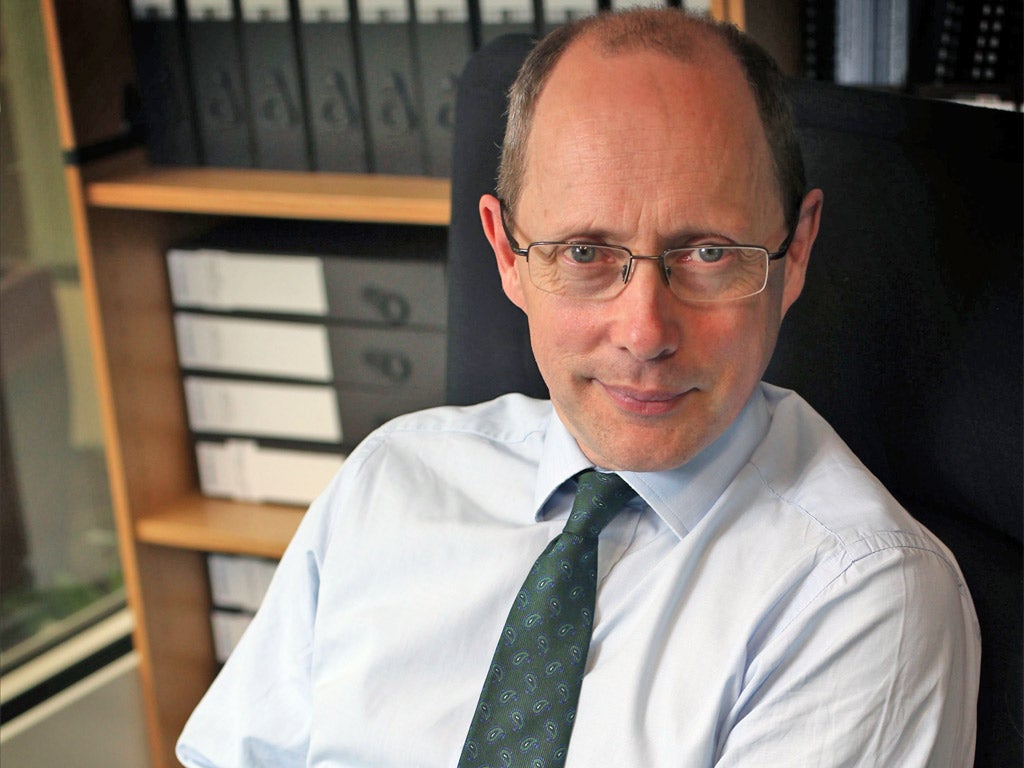
Is the ONS in crisis? Andrew Dilnot, the new chair of the UK Statistics Authority – which is charged with overseeing the work of the ONS – dismisses the idea.
"The stuff that's produced by the ONS, it's really great" he insisted. "I think GDP figures in the UK are remarkably good. If you look across the world you'll see first estimates of GDP systematically come out early and are revised. I don't feel anxiety about that".
He says that part of his job is to explain to the public – even moaning economists – just how difficult it is to measure GDP.
"It's fairly remarkable that 35 days after the end of the period we have an estimate of the size of something which is as complicated as diverse and rapidly changing as the national economy. If we can get more understanding of that complexity we'll also get more understanding of things like the fact that estimates change. It shouldn't be a surprise at all that the estimate of the size of GDP changes in the month or so following the first estimate comes out."
He says politicians and the media could help by playing less attention to single sets of figures, including today's much anticipated GDP estimate, and look at the longer-term trends.
"Precisely what the rate of change of GDP in the latest quarter is, might be less interesting than the fact that it's been roughly flat for the last few years," he said.
What about last year's cock-ups?
"There's always room for improvement. Mistakes will happen with a volume of output on that scale. The Blue Book delay, of course, was frustrating for some users. We'll try hard to make sure that kind of thing doesn't happen."
Those words in the mouths of most civil servants would sound like complacency. But Mr Dilnot, a former head of the Institute for Fiscal Studies, is a statistical heavyweight.
His appointment was greeted with something close to jubilation by the number-crunching community.
If anyone can rescue the reputation of UK official statistics – and also restore some morale among its staff – it is, one suspects, Mr Dilnot.
One of his first jobs will be to determine if the ONS has the resources to do its job properly.
Mr Dilnot says that he hasn't made his mind up yet on the issue, but he doesn't sound particularly convinced.
"The ONS budget is a bit more than 0.2 of a billion pounds [£200m]" he said. "Public spending is £700bn, private spending £900bn. So the ONS budget is not much more than 1/3,500th of public spending. Something that represents 1/3,500th is generating the data used to allocate most of the rest of it both in the public sector and the private sector. So I think the resources are relatively small and there's an awful lot being produced".
One area where statisticians hope Mr Dilnot will take a lead is in helping to resolve a debate about inflation, or rather how best to measure it.
Some argue that the Consumer Prices Index (CPI) underestimates the true inflation rate, by excluding housing costs and calculating price rise with a "geometric mean" rather than an "arithmetic mean".
Arcane as this debate might sound, it has a direct impact on the personal finances of millions of Britons. Chancellor George Osborne's biggest saving from the welfare budget has been his decision to link benefits to CPI, rather than the old Retail Prices Index.
Mr Dilnot accepts this is an important issue and the ONS is presently reviewing it. But, ultimately, he says, it is up to politicians, rather than statisticians, to decide which index should be used to set benefits.
"I don't think it can be the responsibility of the authority to specify in what cases a particular index should be used. What we can insist on is that an index is appropriately calculated."
His enthusiasm is palpable. He says he is "loving" the new job and talks passionately about how good statistics can make for better policy making.
"The thing I yearn for," he said, "is that whenever an issue comes up for a politician, a civil servant a businesswoman, the first question is 'what do we know, what's the data'? Because whenever I look at the data I find something that interests me – and you might say that's because I'm a sad statistics nerd – but also surprises me and adds to my understanding."
Yet Mr Dilnot comes across not so much as nerdish, as idealistic. By expressing hopes that politicians will suddenly acquire a taste for evidence-based policymaking he betrays his think-tank roots. But he is no longer the head of a think tank. His job is not to produce the analysis that informs the debate, but actively to protect the integrity of official data.
We will soon discover if he has the capability not only to crunch the numbers, but also to crunch their abusers.
Naming and shaming is all part of the job
Relations between politicians and official statisticians have acquired an edge.
Last month Vince Cable complained about the Office for National Statistic's "God-like role" in deciding what constitutes public debt, which he said left politicians economically "hemmed in".
But Mr Dilnot says that the Business Secretary isn't seeing the bigger picture.
He says: "Imagine there was a case when the ONS decided that a particular activity shouldn't be treated as part of the public debt. That means the public and parliament can be confident that's an appropriate change".
Part of his job, like that of his predecessor, Sir Michael Scholar, will be to stand up to ministers, and he said he will "name and shame" politicians who abuse statistics.
Boris Johnson called Sir Michael a "Labour stooge" after he criticised the London Mayor's use of crime statistics.
Mr Dilnot may need to prepare himself for similar abuse.
Andrew Dilnot CV
Age 51.
Job Chairman, Statistics Authority.
Education Olchfa Comprehensive, Swansea; PPE at St John's College, Oxford.
1991-2002 Director, Institute for Fiscal Studies.
2002-2012 Principal, St Hugh's College, Oxford.
2010-2011 Chair of the Commission on Funding of Care and Support.
Additional Former presenter of More or Less on Radio 4.Appointed CBE in 2000.
Join our commenting forum
Join thought-provoking conversations, follow other Independent readers and see their replies
Comments