Clarence Mitchell: 'I am a decent human being. If I can help them, I will'
The ex-BBC journalist built a career on professional detachment. Then, he went to work for the McCanns

For free real time breaking news alerts sent straight to your inbox sign up to our breaking news emails
Sign up to our free breaking news emails
The search goes on. "There is absolutely no evidence whatsoever, nothing, to suggest that Madeleine has been harmed, let alone killed," insists Clarence Mitchell, the former television reporter who speaks for the family of the most famous missing girl in the world. Her face is instantly recognisable. There is no longer any need to use her surname, McCann. And yet, nearly two years since she vanished from the Algarve, there is still no trace.
This is hard to say to Mitchell – who began as a dispassionate adviser and then became a close personal friend of her parents – but there seems no evidence to suggest the three-year-old is still living. "Obviously," he says, "as time goes on, Kate and Gerry are finding it harder and harder. But they are still firmly of the view that Madeleine is alive and out there to be found."
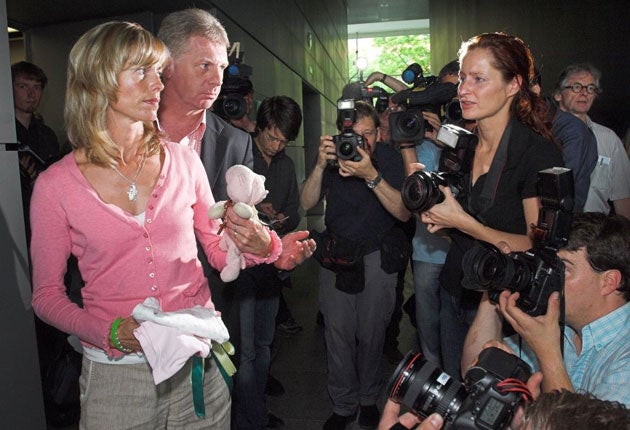
For months now they have turned down interviews, preferring to go through the many files handed over by the Portuguese police. There is another reason for their silence, too. "You reach a saturation point," their spokesman admits. "People would say to us, 'Oh, it's tragic, but we've almost had enough of Madeleine.' That was appalling to hear."
In their silence, Clarence Mitchell is re-emerging as a public figure in his own right. On Friday he will speak at the Oxford Union, following in the footsteps of Desmond Tutu, Mother Teresa and Kermit the Frog. Now he is giving his first personal interview since the days when he was a familiar face on the BBC. He is doing it at the West End offices of Freud Communications, which has hired him as a consultant. Dressed as if to broadcast, in a light brown suit and dark blue shirt, he has two BlackBerrys on his desk: one for Kate and Gerry, the other for everyone else.
Lately, he seems to be setting himself up as a public relations guru for families in distress, including that of 16-year-old Jimmy Mizen, who was stabbed to death in south London last year. The trial of Jimmy's alleged killer begins at the Old Bailey a week tomorrow, and Mitchell will be outside, representing the bereaved parents. Once again, he will be on our screens. But despite seeming so familiar, Clarence Mitchell has never really given anything away about himself. Why did he stop reporting and reading the news? What then drove this 46-year-old man to campaign on behalf of the McCanns, a couple he barely knew and who were suspected of murdering their daughter?
"Everything I have seen of them, in all of the pressurised situations, shows me a family who are suffering the loss of their child," he says. "Everything they are doing, behind the scenes, convinces me of that."
So far, so on message for a man who was hired in September 2007 to "salvage their reputations" in the wake of the McCanns being named as arguidos, or suspects, by the Portuguese police. Mitchell had already been with them for a month, as a civil service media expert sent to help the couple to cope with all the attention. But he returned in the pay of a millionaire supporter of the McCanns, leading a publicity campaign "to correct and balance the inaccurate coverage that was coming out and try to get everything back on an even keel ... with a view to helping to get arguido lifted".
It worked, of course: they won £550,000 damages and a front-page apology from the Daily Express, and last summer the police cleared them of all suspicion. But Mitchell could not have known it would turn out that way. "It was," he says, "gut instinct."
It was a life-changing moment. Until then, his entire career had been built on remaining calm and uninvolved in the most trying circumstances: reporting for the Hendon and Finchley Times with the local MP, Margaret Thatcher, bursting into the office; broadcasting from the M1 with the wreckage of the Kegworth air disaster strewn in front of him; covering wars in Northern Ireland, Kuwait, Iraq and the Balkans alongside the likes of Kate Adie. "You see a lot of distressing things, whether that's a war zone or a murder scene, but I have always found it relatively easy to be dispassionate."
He needed that skill most when sent on a story in Fulham in 1999. "There was a rumour that Jill Dando had been in some sort of accident. The area was taped off. There were detectives walking up from the house who told us to ring the press bureau. I said, 'Look, I know Jill.' We were friends. She used to called me Clarenzio. They said, 'She's dead, I'm afraid.' It was dreadful." But he still filed reports from the scene. "You just have to get on with it."
He did breakfast TV and the odd Six O'Clock News – "which nobody remembers" – but by the time he left the BBC in 2005, his career had reached a plateau. "I felt I had more to offer." Recruited by the Cabinet Office to run the Media Monitoring Unit, he had a hard first week. "The Monday was the G8 at Gleneagles. I was just about getting my head round the job on Tuesday, then Wednesday we won the Olympics. Thursday was 7/7." When the Foreign Office sent him to assist the McCanns – as he insists it would have helped any family in that situation – he asked difficult questions. "I was assured that from the perspective of the British authorities, this was a rare case of stranger abduction."
They had left their very young children alone in a holiday apartment while they went to a tapas bar. He doesn't duck that, even if the response has been smoothed by repetition. "They made a mistake at the time; they weren't with her when it happened. They will always regret that, God forbid, possibly for the rest of their lives."
In media terms, he says, Madeleine was "a perfect storm: her age, her appearance, the location, the parents..." Columnists wrote about "people like us". Picture editors loved Kate, to an extraordinary degree. "It would be sad if it wasn't laughable: Kate was finding herself in Nuts or whatever lads' magazine's top 10. You think, 'This is ridiculous.' But they can't help how they look."
There's no truth, then, in the report that he tried to get Kate to be photographed in a swimsuit? "Utter bollocks." Gerry suggested it without realising the implications, he says, and was then persuaded otherwise. "A good example of facts being distorted. Completely, 180-degree wrong."
Mitchell had a home in Bath with his wife and children, two girls and a boy who were aged 10, eight and one at the time. Why go back to Portugal? "We had become friends. There was an emotional drive. I felt they had been the victims of a heinous crime and very badly wronged in the way stories had appeared."
There was also his response as a father. "I have never had to analyse it like this before ... but yes, this was every parent's nightmare, my own included." Didn't he miss his own children? "At night, when I had a few hours to myself, you did miss them more acutely, perhaps, than if it had been a job of a different nature."
These days Mitchell gets 40 per cent of his former salary as a retainer from the Find Madeleine Fund. Kate is said by relatives to spend hours with the files at home in Rothley, Leicestershire, while her twins are at nursery. Gerry, devotes evenings to the case, after days as a consultant at Glenfield Hospital.
"Sadly, the files have not revealed any substantial new leads," says Mitchell. "And sadly, they have confirmed a lot of what Kate and Gerry feared: that things haven't been done properly in certain areas, and certain things hadn't been followed up." The detective agencies they hired are no longer on the case. Have a dozen British former detectives and security service agents been employed instead, as reported? "I can't go into details, because the investigators don't wish me to. The investigation is on a smaller scale, but just as relevant."
There is still a huge amount of material to work through: such as more than 3,000 "psychic tip-offs. Any verifiable fact in them – and some are very detailed – has to be checked".
Meanwhile, his new life involves media training for corporations as well as advising people such as the mother of Scarlett Keeling, who was murdered in Goa, and the Mizens. "I do it pro bono, for free." Why? "Because these people came to me in the direst of situations, with their children dead. I'm not going to say no. Nor am I going to say, 'I'm sorry about your loss. Here's my fee.'" Others would. "It's a non-starter. I am a decent, caring human being. If I can help them, I will."
Yes, but isn't he using this free work to build the kind of reputation that made him attractive to Freud? "Not deliberately so. Honestly." Others have compared the new Clarence Mitchell to a more obviously compassionate Max Clifford, with whom he says he gets on well. "People are entitled to their point of view," he says, as calmly as he says everything, on and off camera. "But I am doing this for what I believe to be honest, genuine, compassionate reasons."
The making of a media expert
From TV to Madeleine, and beyond
1962 Born and educated in north-west London. Tries working in a bank after school but hates it.
1982 Joins Hendon and Finchley Times as a trainee reporter, which brings him into contact with the local MP, Margaret Thatcher. "To see the Prime Minister sweep into the office with Special Branch while you are writing up the latest golden wedding is quite an experience."
1985 Shift work on Sunday Express.
1986 Joins the BBC in Sheffield as a radio reporter, before going on to television in Leeds with Look North.
1989 Breakfast News in London, then "fireman" sent where needed, including extensive war reporting.
1999 Made a BBC News presenter.
2005 Joins Civil Service as director of Downing St Media Monitoring Unit.
May 2007 Sent to Portugal to help with press attention in the McCann case.
September 2007 Quits the Civil Service to become spokesman for McCanns.
2008 Extends help to other families.
Subscribe to Independent Premium to bookmark this article
Want to bookmark your favourite articles and stories to read or reference later? Start your Independent Premium subscription today.
Join our commenting forum
Join thought-provoking conversations, follow other Independent readers and see their replies