Cristina Fernandez de Kirchner: The iron lady of the Malvinas
As tension mounts 30 years on from the Falklands War, Argentina's leader is seizing the moment
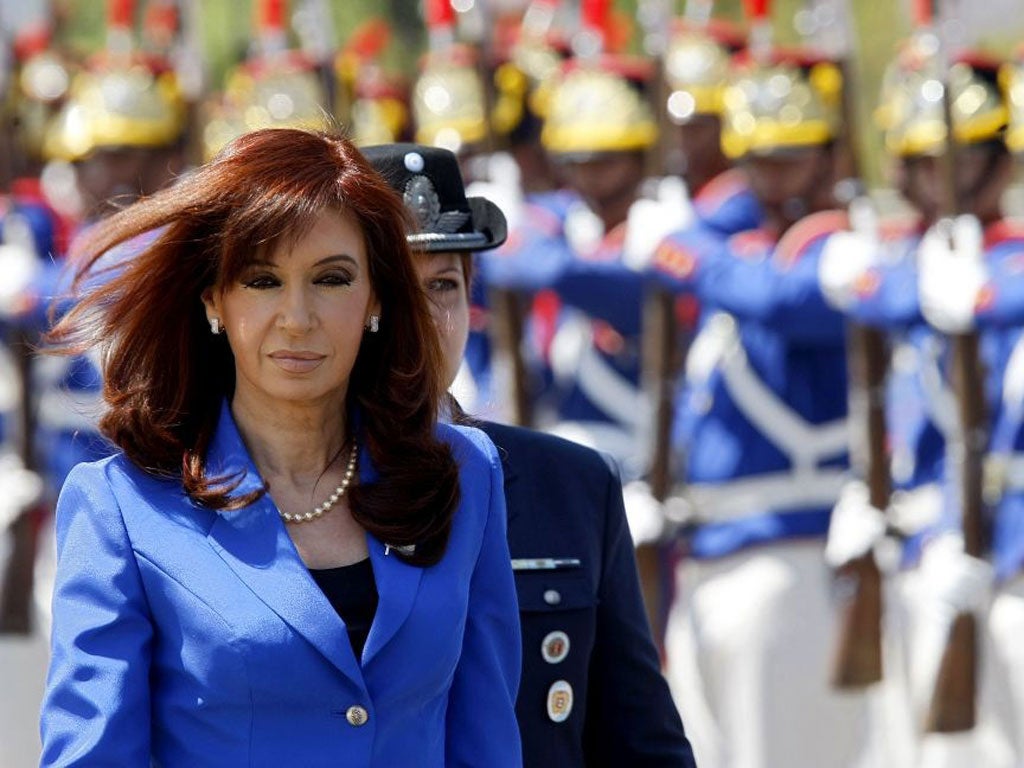
Don't cry for Cristina Fernandez de Kirchner because a Falkland Islands news site, the Penguin News, called her a "bitch" this week.
Hearing of the slight in her apartments at the Casa Rosada palace in Buenos Aires, she surely allowed herself a sly smile. A wily politician and populist to her core, she knows nothing stirs sympathy at home more than an insult from abroad, especially one with a Union flag on it.
The unfortunate epithet was never meant to be seen – it popped up as the file name on the picture if you clicked on it as many thousands of outraged Argentinians did. Mockery, anyway, has followed Ms Fernandez, the President of Argentina, ever since her late husband, former president Nestor Kirchner, decided to forgo running for a second term in 2007, handing her the leadership of the Front for Victory party. Critics pounced on what they saw as a ruse to circumvent term limits. She would win the Casa Rosada that year but he would remain the real power and four years later retake the reins.
Win she did and the nattering, wealthy classes of Buenos Aires and the pampas expected the worst. If not sheer sexism – she is not, after all, the country's first female figurehead – it was snobbery about her sometimes brassy and bejewelled looks. They called her "Bimbo" and "Botox Evita". Even recently, she was lampooned in the national media for buying Christian Louboutin shoes during a trade trip to Paris.
Born in 1953 to parents of Spanish and German descent in La Plata, the capital of the Buenos Aires province, Ms Fernandez's adult life was shaped while studying law at the National University. Activism in the Peronist Youth movement gave her a taste for politics, and it was on campus that she met her future husband. When democracy gave way to dictatorship in the mid-1970s, the couple abandoned politics and travelled to Mr Kirchner's native Rio Gallegos in Patagonia to practise law.
When Nestor pushed her forward in 2007, she was in fact by no means politically naïve. She had served since the late 1980s, after the return of democracy, both in the provincial legislature in Patagonia and in the national congress. From 2005 until her election as president, she represented Buenos province in the Senate, itself an office of national prominence.
Still, her first two years in office were marked by a cascade of crises, including a paralysing stand-off with farmers who blocked the capital for weeks after she imposed new taxes on soya bean exports. There was also a damaging row with the US in the "suitcase scandal" involving baggage found at Buenos Aires airport stuffed with $790,000 in cash that, according to American prosecutors, was destined illegally to fund Ms Fernandez's election campaign.
Repeated allegations of corruption and an economy that slowed in 2008 as the world recession struck also hurt her standing. Then and still now, private analysts accuse the government of cooking the numbers of inflation that theoretically stands at about 10 per cent, but in reality is probably at least twice that. Her approval rating slipped to 23 per cent and in 2009 midterm elections her party lost control of Congress.
But, following the example of her husband, she protected the middle class and the poor against the effects of inflation with ever more generous subsidies and pensions. Those welfare coffers are now running low, but the policies served her well. Most Argentines will give her the benefit of the doubt on economic policies anyway because of memories of 2001 when the country suffered a crippling default of the kind Greece is afraid of now. Nestor is credited with ushering in Argentina's near decade of economic stability.
For herself, Ms Fernandez has built a legacy of programmes for the working class, including a universal child benefit plan that has boosted school attendance and reduced poverty. She has increased pensions for the elderly and, in spite of the naysayers, mostly maintained Argentina's economic health through the storm of the world recession. She has also been a strong human rights leader, encouraging the prosecution of suspects from Argentina's "dirty war" accused in the "disappearing" of some 30,000 alleged dissidents during military rule.
Insults and crises, meanwhile, are not the worst Ms Fernandez has suffered. After Christmas, the Casa Rosada announced to a shocked nation that she had thyroid cancer. The gland was removed last month but then the doctors said it hadn't been cancer after all. (The Cristina haters say the scar on her neck is really from plastic surgery.) Her biggest blow, however, was the sudden death in October 2010 of Nestor from a heart attack. She was personally devastated and their game of keeping the presidency in the family was over. Yet, his death bought her public sympathy and appears to have liberated her politically.
"She profited from Nestor's death because she was freed from his shadow and was able to begin operating politically on her own," notes Carolina Barros, editor-in-chief of the Buenos Aires Herald. Among her first steps: bringing into her circle members of a younger Peronist faction of 30- to 40-year-olds headed by her son, Maximo Kirchner.
Her grief has allowed Ms Fernandez to tap into Argentina's sense of drama. "She is a very good stage woman," says Ms Barros, who notes that the President is still wearing black 15 months after her husband's death and means to sanctify him in the minds of the population. "Argentina is always trying to feel or follow a myth. We had Eva Peron and Juan Peron, and now she wants to add Nestor to that same list," she explains.
The new Falklands dispute is about theatre, too. Locals in Buenos Aires say the only thing she would mind more than being called a bitch is being likened to Margaret Thatcher, whose unwelcome presence has returned in the shape of Meryl Streep in The Iron Lady. The film opened in Argentina last month.
How far she intends to push the row over the Malvinas is not clear. A speech to veterans of the 1982 war at the Casa Rosada last Tuesday surprised many because she used it above all to explain that the nation had been "duped" by the military dictatorship into a war that ended in useless humiliation. That does not mean that there won't be more escalation. She is said to feel affronted by Britain, not least because she spent so many years in Santa Cruz in Patagonia which suffered the direct impact of the war much more acutely than the capital. And just as she has accused David Cameron of using the spat to distract voters from domestic problems, the same might be said of her as she instigates a round of cuts to the energy, housing and transport subsidies that the country has become so accustomed to.
It is in Patagonia that Ms Fernandez will preside over grand commemorations in early April to mark the 30th anniversary of the British naval strike against Argentina. She will allow her emotions and those of the country to run free without allowing things to get out of control. Argentina's strength on the international stage is in football, not warfare. And no one – really no one – wants another war anyway.
By early summer, if she has also imposed the new economic strictures skilfully, Ms Fernandez, or CFK as her supporters prefer, may be at the height of her powers. There is no unified opposition to stand up to her and there is already talk of changing the constitution to end presidential term limits and find a way to keep her in the pink palace for a third term after 2016. "We all know Peronism and she likes to talk these days about Kirchnerism," says Ms Barros. "But watch out for Cristina."
A life in brief
Born: Cristina Elisabet Fernandez, 19 February 1953, La Plata, Argentina.
Family: Parents are Eduardo Fernandez and Ofelia Esther Wilhelm. Widow of former President Nestor Kirchner; they have two children, Maximo and Florencia.
Career: She met her husband at the National University of La Plata and moved to Santa Cruz with him to practise law. Elected into the Santa Cruz provincial legislature in 1989, elected to the senate in 1995. She was elected as Senator for Buenos Aires in 2005 and became the country's first elected female President in 2007, before being re-elected in 2011.
She says: "I want to ask the British prime minister to give peace a chance, not war."
They say: "She is the most powerful president in the history of Argentina." Carlos Corach, Argentina's former interior minister.
Join our commenting forum
Join thought-provoking conversations, follow other Independent readers and see their replies
Comments