Dominique de Villepin: Top of the fops
He is handsome, intellectual and aristocratic. So could Nicolas Sarkozy's bitterest opponent yet fulfil his mission as France's self-appointed saviour?
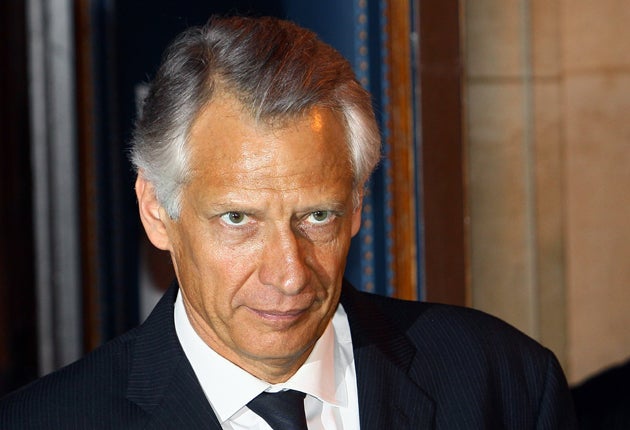
A few years ago, a French minister gave a eulogy at his mother's funeral. It was a fine speech, full of the grandest and most sonorous cadences of the French language. The bereaved minister spoke of his mother's passionate belief in the greatness and the destiny of France, and, implicitly, the greatness and destiny of her son.
"It was as if he spoke of France and of himself as being the same thing," said one mourner. "What was entirely missing, until quite near to the end, was any sense of warmth, of any emotion about his mother's death."
The minister concerned was Dominique de Villepin, a man who has spent a lifetime in politics, rose to be Prime Minister, but has never stood in an election. This week he won the first great, personal victory of his political career, still without troubling the voters. A French court acquitted him of conspiring in 2004, when he was foreign minister, to destroy the career of a rival man of destiny, Nicolas Sarkozy.
Villepin, 56, poet, historian, philosopher, diplomat and politician, greeted the victory with another sonorous declaration. "I now turn to the future," he said, "to serve the French people and to contribute, in a new spirit of unity, to the recovery of France."
Dominique de Villepin's belief in his own destiny – his preordained rise to greatness as the saviour of France – remains intact. During his two years as a suspect and defendant in the so-called Clearstream affair, Villepin had, according to friends, moments of depression and despair. He would cheer himself up by thinking of one of his great heroes, Charles de Gaulle, and saying that, he too had become the "leader of a Resistance group, like in 1940-44".
In other words, Dominique de Villepin regards Sarkozy (aka "the dwarf") as an invader, an occupier, someone who wants to impose an alien Anglo-Saxon, materialistic, inglorious culture on his beloved France. He will challenge Sarkozy for the presidency in 2012 and, although unlikely to win, could destabilise the centre-right enough to present a victory to the Left (assuming that they find a credible candidate).
The Paris public prosecutor announced yesterday that he would appeal against Villepin's acquittal, forcing a new trial later this year. This is a double or quits gamble, which is presumed to have been approved, or even inspired, by the Elysée Palace.
If Villepin is cleared a second time, it will seem to many French voters – few of whom have ever understood what Clearstream was all about – that the real conspiratorial villain of the affair is Sarkozy.
There is an almost physical hatred between the two men. They are caricature opposites to the point of absurdity. Villepin is a tall, drop-dead-handsome, foppish, aristocratic intellectual: a classic product of the Old France and its administrative-political elite. Sarkozy is a short, partly foreign, nervy, anti-intellectual, bling-bling product of a can-do New France of enterprise, advertising, the media and the law.
Villepin is an outsider who thinks that he is an insider. He has the over-idealised vision of the patrie of a man who was born, and spent most of his early life, in conservative, high-Catholic French business communities abroad. He has a grandiose idea of "the French" but is, famously, contemptuous of almost every other French person that he meets. He habitually refers to friends and enemies, in private, as connards (arseholes). Sarkozy says of him: "He goes on about 'the people' but he has never travelled second class in his life".
Sarkozy, by contrast, is an insider who thinks partly like an outsider. He has the more pragmatic, sometimes brutal, vision of a man who made his own luck and wants France to compete, and sometimes cooperate, in the "real world". Villepin calls him the nain or "dwarf" – and many worse things. He has convinced himself that Sarkozy is a kind of national anti-Christ: someone who pretends to champion France but has actually sold out to the alien values of big-business and "les Anglo-Saxons".
Dominique Marie François René Galouzeau de Villepin was born in Rabat in Morocco on 14 November 1953. He spent much of his early life in Latin America. His father, Xavier, who is still alive, is a devout Catholic businessman turned centrist senator.
As a result of his formative years abroad, Villepin speaks perfect English and Spanish. He has, according to his detractors, no instinctive feeling for the real France, which he discovered only in his late teens.
In 1979-80 Villepin attended the finishing school of the French political elite, the Ecole Nationale d'Administration. His classmates included Ségolène Royal. She finished 95th in their year and he finished 25th.
From 1980 to 1993, Villepin appeared to have a respectable but unremarkable career in the French diplomatic service, rising to the undizzying rank of press officer in the Washington embassy and senior African desk officer at the Quai d'Orsay. Below the stately, unhurried surface, Villepin was pedalling furiously.
He was an unofficial diplomatic adviser to Jacques Chirac and organised, secretly, meetings for the then mayor of Paris in the US. Villepin made the jump to chief of staff in the Elysée, when Chirac became President in 1995.
It was at the Elysée that two key elements of Villepin's character emerged for the first time: his love of undercover intrigue and his tendency to make catastrophic political judgements. It was Villepin who wheeled and dealed to keep corruption allegations against Chirac at bay. It was also Villepin who influenced the disastrous decision to call an early parliamentary election, which Chirac and the centre-right lost, in 1997.
When Chirac was re-elected in 2002, Villepin became foreign minister (later finance minister and a calamitous prime minister). He became a hero to some, and a figure of hatred to others, by making eloquent attacks on US invasion plans for Iraq in a speech, and then a press conference, at the UN in February and March 2003. Villepin's sentiments proved to be well founded but his timing and some of his pompous language were unfortunate. The US secretary of state, Colin Powell, still fighting a moderate corner within the Bush administration, felt betrayed.
Villepin's anti-Americanism was legendary when he was press officer in the Washington embassy in 1987-88. In 2004, he wrote an insufferably aetherial defence of European (and especially French) subtlety against American naivety and selfishness, "The Shark and the Seagull".
The shark (America) is "a symbol of power, strength ... cutting through the sea and pouncing on its prey". The seagull (France) "is intoxicated by the sky. She turns, carried by the winds ... The straight line is rarely her course. She listens to the world".
It was while writing this high-flown stuff that Villepin was – it was alleged – conspiring to smear Sarkozy as financially corrupt. Faked bank listings were circulated in late 2003 and early 2004, suggesting that dozens of senior figures in France were receiving illegal payments in accounts managed by Clearstream International bank in Luxembourg.
The first lists did not include Sarkozy's name; later ones did. A court decided on Thursday that there was insufficient evidence to prove that Villepin had been involved, actively or passively, in handing the false lists to an investigating judge. An old friend of Villepin's, Jean-Louis Gergorin, was found guilty of doing so. As Villepin is innocent, Gergorin's motives are utterly obscure. The widespread assumption in France is that the real puppet-master was Jacques Chirac.
Another trial is now inevitable. But the patience of the French public with the whole business has long ago worn thin. Win or lose, Villepin could emerge as the political victor from a second trial.
He will then stoop in 2012 to something which he has always felt to be beneath his dignity before. He will ask the ordinary people of France (aka les connards) to vote for him.
A life in brief
Born: 14 November 1953 in Rabat, Morocco.
Education: He spent much of his childhood abroad but returned to France in 1968 to attend a private Jesuit school in Toulouse. He studied at Sciences-Po in Paris and the Ecole Nationale d'Adminstration. He also holds degrees in civil law and French literature.
Family: Married Marie-Laure Le Guay in 1985 after meeting her on a Paris bus. They have two daughters and one son.
Career: Villepin was a career diplomat, including press officer in the French embassy in Washington, before being chosen as President Jacques Chirac's chief of staff in 1995. In 2002 Chirac appointed him foreign minister and in 2004 interior minister. From 2005-7, he was Prime Minister.
He says: "Nicolas Sarkozy has promised to hang me from a butcher's hook. I see this promise has been kept." On the Clearstream trial.
They say: "He goes on about 'the people' but he has never travelled second class in his life. He goes on about the grass roots, but he has never stood for election." Nicolas Sarkozy
Join our commenting forum
Join thought-provoking conversations, follow other Independent readers and see their replies
Comments