Fadwa Barghouti: 'For peace to come, Israel must release my husband'
Donald Macintyre meets the wife of the jailed Palestinian nationalist tipped to succeed Mahmoud Abbas
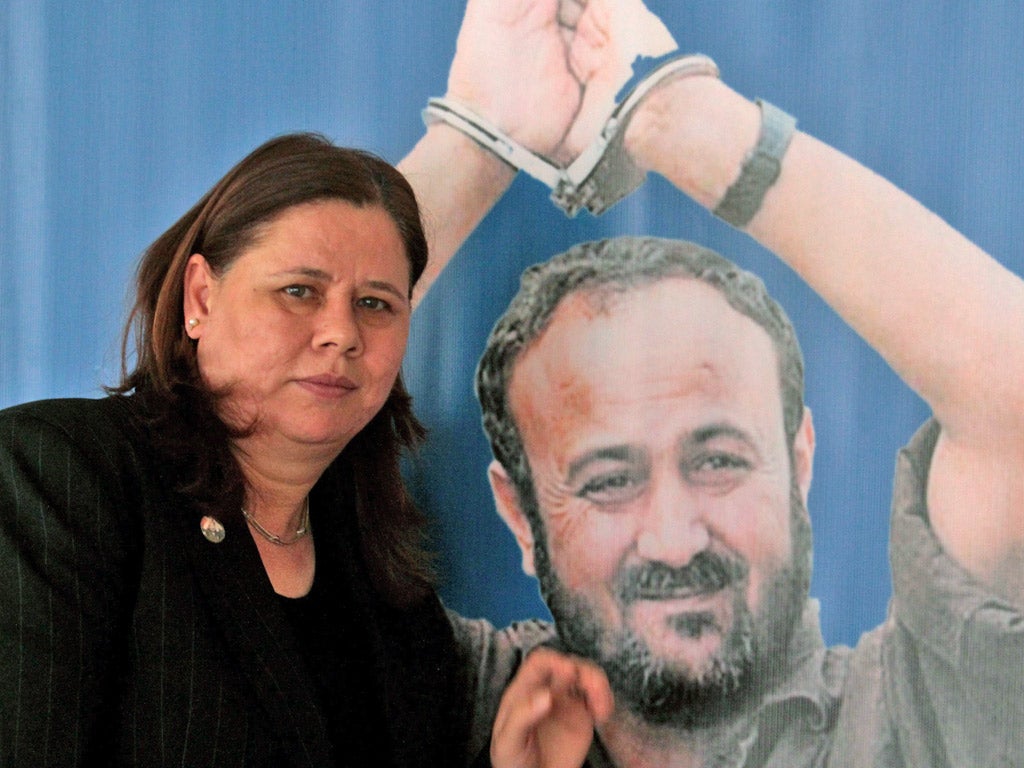
As a long-term Fatah activist, staunch nationalist and qualified lawyer married to the most famous and popular Palestinian prisoner in an Israeli jail, Fadwa Barghouti's reaction to the release of the Israeli soldier Gilad Shalit by Hamas last week was perhaps surprising. "I was very happy that the mother of Shalit saw her son after five years," she says, before adding that she is speaking as a mother, not as a politician. "You cannot define motherhood in one place and redefine it in another – it's indivisible. When I saw the mother of Shalit hug her son, I was very happy." Her oldest sons, Qassam, was himself imprisoned for four years.
What makes her reaction more interesting is that Shalit's release and the freeing, on the same day, of the first 450 prisoners to be exchanged in the Hamas-Israel deal was in some respects a bitter blow to the family of her husband, Marwan Barghouti.
The 53-year-old Fatah leader, who strongly supported the Oslo peace accords and who many – in Israel as well as elsewhere – believe could reunite the Palestinians and forge a peace deal based on a two-state solution, is still in Hadarim prison after serving 10 years of five consecutive life sentences. "I felt disappointed because of the promises that Marwan would be released. Hamas and the Egyptians promised me they would not accept any deal without releasing Marwan Barghouti."
While pointing out that 5,500 Palestinian prisoners remain in jail, she welcomes the release of so many long-term inmates. "They broke the barrier Israel set never to release people with blood on their hands," she says, emphasising that the formulation is an Israeli one and not hers. But then she asks: "Why is Israel not releasing people who [also] spent many years in prison, leaders who can contribute to peace?"
The breaking of that "barrier" undermines a key objection to the long-standing calls, some of them from prominent Israeli politicians, for her husband's release – especially as Israel is required under the terms of the Hamas deal to release another 550 prisoners, this time of its own choosing.
As a charismatic Fatah leader during the second intifada, Marwan Barghouti was convicted in 2004, in a two-year trial whose legitimacy he refused to accept, of involvement in four attacks, which left five Israelis dead. Mr Barghouti denied taking part in military operations and had long claimed to be against targeting civilians inside Israel. But the verdict was that he had funded and armed the units behind the attacks, two of which were in Israel.
The prisoners released last week included unrepentant Hamas veterans convicted of attempting or organising suicide bombings; one was serving 18 life sentences and most refused to sign declarations that they would not take part in further attacks. "Israel paid a heavy price for the release of one single prisoner," Mrs Barghouti says. "But it refused to pay any price for the peace that would save the lives of many soldiers. Palestinians will understand this as meaning that Israel cannot be brought to peace by negotiations but [only] by force."
When asked whether she – like many others – sees her husband as a potential successor to Mahmoud Abbas, the President of the Palestinian Authority, she deflects the question: "I really want him to come home," she says. Mr Barghouti courted her, when she was still a teenager, by letter from prison after being arrested in the late Seventies; he missed the birth of their three sons because he was in jail and then deported to Jordan for his activities as a field leader of the first intifada. She says that when her second son, Sharaf, was about to leave for Britain this year to do a Master's in financial administration, "he wanted to meet his father to get his advice." But as he was forbidden to see his father, as he has been for two years, Mr Barghouti sent him a letter.
"I am proud of that letter and some day I will publish it so you can understand his mentality," she says. One message was that, as well as focusing on his degree, Sharaf should "learn the values of the society he will be in, and not hang out only with Arabs and Palestinians".
Insofar as he can from jail, Marwan Barghouti has set his son an example. His wife, who now visits him every fortnight, says he smuggled out of Hadarim, page by page, the now-printed PhD thesis he wrote in his cell on the history of the Palestinian Legislative Council from 1966 to2000.
And thanks to the fluency in Hebrew and English he has acquired during his prison terms, he reads four Israeli newspapers every day as well as the Palestinian al-Quds. He also reads widely history, politics, philosophy and literature, including some of the latest books published in Israel; among the latter is A Tale of Love and Darkness by Amos Oz, sent to him by the author himself. He has a radio and access to 10 television channels, including the Israeli ones and al-Arabiya though not al-Jazeera. He has no access to the the internet. His voracious reading – punctuated by 90 minutes running or walking in the prison yard – has "deepened" her husband, Mrs Barghouti says. His vision, she adds, is for an independent Palestinian state that would enjoy normal relations with its neighbours "including Israel".
Until then he believes in "popular struggle" – including demonstrations and protecting Palestinians from attacks by settlers. Asked if Hamas might have been less than zealous in seeking the release of her husband because he would strengthen the appeal of its rival, Fatah, she is tactful: "It's better to ask this question to a political leader or a Fatah leader. I am his wife." But she says that both Hamas and the Egyptians told her that Israel had refused to release him because his was a "political case". Hamas, she adds, "accepted the criteria that Israel imposed".
She has been overwhelmed by the support she has received since the Shalit exchange; but she also believes that "because of [her husband's] popularity Israel keeps him in jail. It is clear Israel is not concerned about making peace because if it really wants to make peace it is time to release him to help Abu Mazen [Mahmoud Abbas]."
Instead, she says, Israel wants to "punish" Mr Abbas for taking his statehood case to the UN. And she is convinced that a recent three-week spell of solitary confinement – one of many that her husband has had to endure – was imposed because he issued a statement from jail supporting the UN move. "Israel wants to use Marwan Barghouti as a political card," she says, "and to keep this card to use it as leverage."
While critical of the Palestinian leadership for not having insisted in previous agreements that thousands of political prisoners should be released, she believes Mr Abbas is now trying hard to get her husband out.
"I hope Abu Mazen will demand Marwan's release as a precondition of negotiations, as he did with the settlements," she says. "If Israel wants to release Marwan Barghouti it will support Abu Mazen. He is a force in Fatah and Fatah is supporting peace. If he is released it will mean that Israel is on the road to making real peace."
No progress in quartet peace talks
International diplomats led by Tony Blair yesterday held separate meetings with Israeli and Palestinian officials amid serious pessimism about the chances of reviving any negotiations between them.
As widely expected, a meeting of the international Quartet of the US, EU, UN and Russia broke up in Jerusalem without any signs of a breakthrough towards direct talks between the moderate Palestinian leadership and Benjamin Netanyahu’s Israeli government.
Israel says it is ready to start talks at any time without preconditions. But the Palestinians are seeking prior agreement that a future two state solution would be based on 1967 borders, and a settlement freeze, as an earnest of good faith in any talks.
The stalemate has exposed a sharp divergence between the Israeli government and some of its Israeli critics, with Yuval Diskin, who was head of the domestic intelligence agency Shin Bet until April this year, becoming the latest public figure to blame the government for the impasse.
Avigdor Lieberman, Israel’s ultra-nationalist foreign minister resumed his unbridled attack on the Palestinian President Mahmoud Abbas yesterday with a claim that he is seeking to “delegitimise” Israel, apparently by taking his case for statehood to the UN. In a letter to Israel’s embassies abroad he added that Mr Abbas was simply, “furthering [his] own personal agenda, particularly with regard to ensuring his historical legacy".
But Mr Diskin said that the Palestinian president had taken unprecedented steps to “fight terrorism” and added: “Not holding talks – I believe it's Israel's fault. It's losing its legitimacy, even internationally, and losing global support." Mr Diskin also said that prisoner exchanges, like the one which freed Israeli solder Gilad Shalit—and is said by some critics to have boosted Hamas at the expense of Mr Abbas - were “bad for Israel”.
The opposition leader Tzipi Livni, another critic of the prisoner exchange, is believed to be in favour of a fresh settlement freeze if necessary to restart talks.
Donald Macintyre
Join our commenting forum
Join thought-provoking conversations, follow other Independent readers and see their replies
Comments