Fred Marafono: South Pacific warrior whose heart belongs in Sierra Leone
The fearless SAS veteran is still angry about what happened in the blood diamond wars. Now, he's putting the record straight. Jonathan Owen meets Fred Marafono
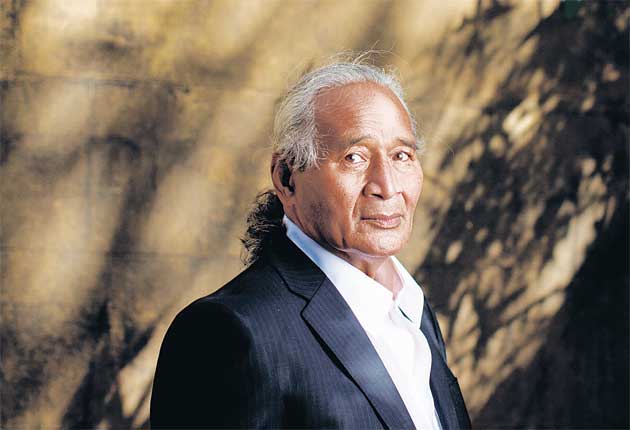
Fred Marafono makes an unlikely African warrior. For a start, the accent is South Pacific, not Sierra Leonean. The skin, though tanned, is not black. And the long white hair tied in a ponytail is more eco-campaigner than militia fighter. But there around his neck is the lion's tooth that confirms his status as an honorary member of the Kamajor – a militia made up of local hunters of the Mende tribe in Sierra Leone.
And then there are the eyes – those of someone who has spent a life leading men and being obeyed without question. The eyes of a man who has witnessed victory and horror.
The softly spoken Rotuman, from a tiny island in the Pacific, is a legend within SAS circles. He has fought all over the world, from Northern Ireland to the Falklands.
And he has suffered the loss of some of his "blood brothers" along the way. One was the best man at his wedding: Sergeant Talaiasi Labalaba died in the battle of Mirbat in Oman in 1972 – when nine SAS men fought for their lives against an attack by some 250 Adoo guerrillas.
Most of his missions he can't, or won't, talk about. And he is vague about the reason for his MBE, brushing it off as something to do with leading 200 fighters in Yemen. It is clear he regards the lion's tooth as his real medal. "It was given to me by the Kamajors. It's the sign of a fighter," he says quietly.
Fred spent years fighting in the bitter blood diamond wars that engulfed Sierra Leone in the 1990s – characterised by drugged child soldiers and women and children whose limbs had been hacked off.
He's now 70, but could easily pass for a man far younger. Yet he has spent a lifetime fighting, and surviving, violent conflict. And there is no mistaking the casual yet steely grip when we shake hands. I attempt a squeeze and cannot help glancing at his gnarled fingers that feel like stone. I'm relieved that he hasn't followed suit, and we begin.
As we talk, in the Victory Services Club in London, where he is launching a book about his experiences, From SAS to Blood Diamond Wars, he is wary about revealing too much detail. Pouring scorn on former SAS men turned authors such as Andy McNab and Chris Ryan, he says: "To be honest with you, it's tragic ... They expose so much that shouldn't be discussed."
I am struck by his unfaltering gaze. It is the casual watchfulness of a man who has spent more than 20 years as an independent security contractor since leaving what he calls the regiment in the mid-1980s. Some would describe him as a dog of war, or mercenary. The very mention of the word makes Fred bristle.
"You thought of yourself as a security consultant," he says. "At the time we were the bad guys, untouchable ... but now it is acceptable. I cannot stop people calling me a mercenary, but I'm not one." Conscious that it is rare for a former SAS man to break cover, and rarer still for one who has become a freelance operative to grant an audience to a civilian, I go back to the beginning.
He didn't grow up wanting to be a soldier. Instead, Fred wanted to be a vet. But the young Rotuman fell for the lure of an army recruitment poster. "I was young and that was it. I was told I'd be leaving the next day, so I called my parents – my mother cried and then I talked to my father. The next day we were en route to the UK. It was an impulse."
He joined the SAS in 1964, one of just six who passed the gruelling selection course out of an intake of more than 90. After 21 years, mostly in B Squadron, he left and was recruited by the SAS founder David Stirling for his private security company.
Later, Fred became a freelance security consultant and found himself in the middle of Sierra Leone's blood diamond wars. He was recruited by Simon Mann for his private military company, Executive Outcomes, where he developed a reputation as a man with no fear. Over the next two years Mann's mercenaries defeated the rebels, and Fred formed a close friendship with a local chief, Sam Hinga Norman, who was to lead the Civil Defence Forces, largely made up of Kamajor militia, against the Revolutionary United Front.
"We became very good friends because he was there for his people. He said to me once 'Why don't you leave?' and I said 'Chief, if I was to leave you when you most needed me ... I'd carry that burden for the rest of my life and I'd rather not carry that burden.' He looked at me and we laughed and never talked about it again."
When I speculate that he must have accounted for a lot of people, he nearly falls off his chair laughing. He says: "I think I'll leave that to your imagination. I'm not going to boast and brag about killing people. But I never lose a night's sleep about it."
By 1997, Executive Outcomes had left. But Fred stayed, fighting again just months later when a coup was staged against the government. An anger fuelled by the sheer brutality of the conflict had made it a personal crusade.
"When you see what was happening in Sierra Leone, to be honest with you, you're looking forward to killing these people. Animals are better than these people; animals have a code of conduct. But these people had no code of conduct. Putting people in houses and burning them ... the first people that suffer are the old, and then the children and women."
He was able to take the fight to the rebels, as the gunner of a helicopter gunship resupplying pro-government forces. "We were not doing it because of money; we were doing it because it was a mission. If we don't do it, people will die – and die terribly."
I remind him that atrocities were committed on both sides, with Kamajor fighters condemned over torture, killing and even cannibalism.
Fred calmly admits that bad things were done on both sides, but describes the trial in Sierra Leone of his old friend Chief Norman for war crimes as a "betrayal" by former president Ahmad Tejan Kabbah. "They were afraid of him – he would have been the next president."
Dismissing the accusations against his old friend as "a load of nonsense", he claims that Chief Norman warned his commanders: "The chief told them, make sure that your people behave because one day it will come back to haunt you. They blamed him and said he instructed them. That's rubbish."
Chief Norman was flown to a military hospital in Senegal for hip surgery in 2007 but died after complications resulted in a heart attack weeks before the verdict was due.
Yet it was no accident, according to Fred. Eyes blazing, voice raised, he claims: "They killed the chief and do you know how they killed him? Hydroperoxide – it opens up the blood vessels and causes a heart attack."
He pauses for breath before recovering his composure, and saying sadly: "Why wasn't the chief on trial in The Hague? Because they had no plans for the chief to survive."
Fred left Sierra Leone in December 2006. Now based in Hereford, he plans to spend several months working in Latin America – he refuses to expand on the detail – before visiting Fiji at the end of the year.
The years of fighting came at a cost. His first marriage broke down, and he missed a large part of his three sons growing up. He has a 14-year-old daughter from a second marriage, which has also failed. With an iron will to match his handshake, he makes it clear he does not want to discuss his personal life.
At 70 years old, he is now fighting age itself. "I've seen some of my friends that are much younger than me and when I look at the state of them doing nothing, I think, God, no."
Not a man for regrets, Fred adds: "I was lucky. I had the opportunity that many people would have loved but never had the chance."
Curriculum Vitae
1940 Kauata "Fred" Marafono born 13 December on the tiny Pacific island of Rotuma, 350 miles north of Fiji. One of five children. His father was a farmer after fighting for the British during the Second World War.
1957 Leaves Rotuma to study at agricultural college in Navuso, Fiji.
1961 Drops out of college to join the British Army. Serves in the King's Shropshire Light Infantry, where he becomes a corporal.
1963 Posted to Plymouth, where he applies to join the SAS.
1964 Begins a 21-year stint in the SAS.
1986 SAS founder Sir David Stirling recruits him to join his private security company.
1990 Stirling dies. Fred goes freelance.
1991 Begins a two-year stint providing security for a gold mine in Guyana.
1994 Arrives in Sierra Leone to help with a mining venture.
1995 Simon Mann recruits him to join Executive Outcomes.
1997 Joins Tim Spicer's private military company, Sandline International.
1998 Forms his own security company, Vanguard International, which works to support the Sierra Leonean government forces against the RUF rebels .
2006 Returns to the UK.
2011 Publishes From SAS to Blood Diamond Wars, co-written with Hamish Ross.
Join our commenting forum
Join thought-provoking conversations, follow other Independent readers and see their replies
Comments