John Lydon: 'I'm not a leader, bully or dictator'
Agitator, innovator, naturist: more than thirty years after crashing into the public sphere, John Lydon is still as hard to define as ever
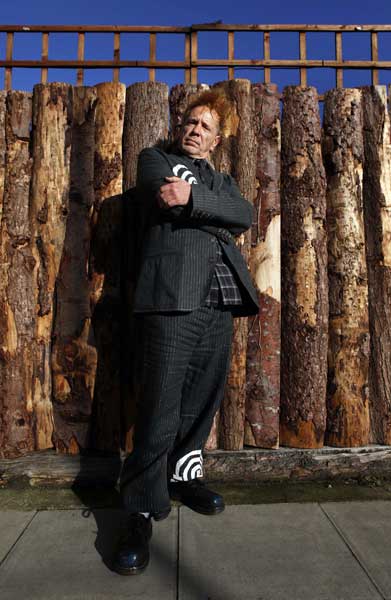
I can't," says John Lydon, "drink out of a cup that's chipped." Er, sorry? The man who snarled and spat his way through my early adolescence, the spiky-haired scrap of flesh who looked like he'd crawled out of a gutter, and screamed the language of the gutter, and had mothers across the nation tutting over their ironing boards, and politicians fulminating, and church groups demonstrating, and members of the public fighting to beat him up, can't drink out of a cup that's chipped?. Why not? Because his mother wouldn't approve? "No," says Lydon matter-of-factly, "because that's where all the infections come from."
He has just realised that he's left his anti-histamines at home. Not, it has to be said, the drugs that instantly spring to mind when you think of the Sex Pistols, or its former lead singer, but I've already had the shock of discovering that that scrawny, shrieking, spitting creature now looks, in his smart grey suit and black tie, a bit avuncular. A flamboyant uncle, certainly, the kind who'd get everyone on their feet after the Christmas dinner for a bit of a boogie, but most definitely benign. The smile – no longer the dental horror that earned him the sobriquet "Rotten", but still with a big gap where a tooth should be – is warm. The studio in south London where he's rehearsing with his old band Public Image Ltd, and where I'm sipping tea by a fan heater, isn't.
"I was a sickly child," he says. "The other day we went back to visit one of the council flats where I was raised. Not a great deal of washing took place in my early life, and it occurred to me that that might be why I was so ill." Well, maybe it was. The son of Irish immigrants, Lydon was brought up in what would now be classified as a slum in Finsbury Park. It was, according to his autobiography, Rotten, just two rooms: a bedroom, shared by the entire family, and a kitchen shared with giant rats. Baths, with cold water and Dettol, were once a month. If punk was later appropriated by the disaffected middle classes, there was certainly no affectation in Lydon's own claims to poverty. The "holidays in the sun" he sang about in the Sex Pistols were about as likely as a trip to Mars.
Perhaps it was the rats that caused the spinal meningitis Lydon caught when he was seven. He was in hospital for a year and when he came out he had lost his memory. He didn't recognise his parents, or his brothers, but his mother sat by his bedside and tried to re-teach him everything he'd lost. It was the meningitis that gave him the slight hunchback, and the manic stare. It was the meningitis, too, that gave him the fear he still has of going to sleep at night, and maybe even the headaches. "I get terrible headaches after reading for a long period of time," he says, in that inimitable accent that will be forever London. "Books are like my one and only joy." What?! Lead singer of a band that changed a culture, and of another band so radical that it's still influencing bands now, says that books are more important than music? "Yeah," says Lydon, "I think the written word is more powerful. Music is a simulation of something, but language is the greatest thing we possess."
It's certainly true that Lydon's key contribution to the phenomenon that was the Sex Pistols was not musical. He screamed rather than sang the lyrics, and he didn't play an instrument, but it's also true that, 33 years since they exploded onto the British stage, and 31 years since they drizzled out in a puddle of acrimony and feuds, they still sound amazingly fresh. It's true, too, that Public Image Ltd, which Lydon started after the Pistols died in 1978, managed that rare feat of genuine musical innovation. It was hit and miss, but some of it's still mesmerising stuff.
"A poetry background," says Lydon, "does help." I've just told him that while he was screaming about anarchy in the UK, I was sighing over Keats in a nice house in Guildford, and he has countered that he was reading Keats in a council flat in Finsbury Park. "I can count metric beats," he adds, "so I'm already there." It was Lydon, of course, who wrote the lyrics for the songs that became anthems for a generation, songs perhaps best summed up by the title of one of them, "I Wanna Be Me". He started writing the lyrics for what would become Public Image Ltd while still with the Sex Pistols, on that final, fatal American tour. "I approach music the same way I do books," he says. "I want to get the best out of it. I want to get it right. It can lead into 'difficult to work with' expressions." Indeed it can.
It's 16 years since PiL (as he calls it) last performed. Its current incarnation, brought together for a brief tour, is, apart from Lydon, an entirely new line-up. He has said in the past that it was closer to his heart than the Sex Pistols. Does he still think this? Lydon takes a deep drag of his cigarette (he has also, I'm slightly relieved to see, cracked open a can of beer) and pauses. "It's a really hard one, because people from the Pistols are in here," he says, tapping his heart, "and the songs are there too, but there's so many tragic elements in it. And the restrictions of the band; we couldn't really go much further. The management was definitely a dead weight around our necks. Actually, I felt a bit like an albatross. This is where I've got to say I'm not a leader, bully or dictator, because I need other people to understand what I'm doing and contribute for it to be truly successful. If I'm left to my own devices, I will be tempted to make the most unlistenable music possible."
Maybe he would, but if some of the music in PiL is weird at first, it has also been fantastically influential. It's hard to imagine Red Hot Chili Peppers, Massive Attack or the Prodigy without it. Lydon nods. "I'm still hearing records coming out that mimic our style," he says, "but they don't give us credit." Doesn't that make him proud? "No! I'm a bit annoyed, because I've never done anything in my life to be like somebody else. Oasis annoy me, you know? The voice annoys me. He could've come up with his own thing." But not everyone can be original, can they? "There are," says Lydon sternly, "no limits to where our brains can take us. We are, if there be a God, God's gracious creation."
If there be a God! Earlier, I heard Lydon say "God bless you" to someone. Does the man who tried to smash the British establishment (not to mention the monarchy) believe in God? "Well," he says, "we've yet to design him correctly." And then he launches into a great diatribe about how religions are "political structures to maintain and contain society" and how there's a "definite energy" behind us, and how he's fascinated by insects and animals (he has made several programmes about wildlife, not to mention a little programme called I'm a Celebrity, Get Me Out of Here!) and how he has "so many thoughts all running at once", which is clearly true. He is still, at 53, clearly so energetic, and so curious, and such a life force, that it seems tragic, in retrospect, that the Sex Pistols came to be associated with so much misery and, of course, death. Doesn't it?
"Poor Sid," says Lydon. From the way his body slumps, it's clear that the death of his friend and fellow band-mate, Sid Vicious, from a drug overdose after the violent death of his girl-friend, Nancy, still haunts him. "Once you start on that heroin trail of self pity," he says, "it's gone. I'm sorry, God, for the day I brought Sid into the band. He felt so isolated, poor old Sid, because he wasn't the sharpest knife on the block. The best aspect of his character, which was his humour, just vanished the day he joined the Pistols."
In Rotten, and in The Filth and the Fury, the documentary that Julien Temple made about the Sex Pistols, Lydon talks about the humour in the band, the fact that it was influenced by British comics ranging from Ken Dodd to Tommy Cooper, and the English sense that "even in your grimmest moments, laugh". He talks, in fact, about the Sex Pistols as a form of music hall, which might surprise some of those who took its anti-establishment invective literally. So was the anger genuine or not?
"It wasn't forced," says Lydon. "Malcolm [McLaren] would assume that this was some fabulously vacuous poetry. He thought it was arty. No, Malcolm, you need to come back and see what us people really live in." Sure, but Lydon has talked about his background as being loving, and he, in spite of being chucked out of school, was thinking about becoming a teacher, and has talked about the virtues of a working-class community that has now gone, so what was he so angry about? There's a pause. "Erm, I suppose the school system," he says. You suppose? "I'll add priests in here too," he says. "More or less the same. Quite a lot of authoritarian figures." Er, yes. Well, he was only 19.
Johnny Rotten was, of course, a persona. He was a character who drew, Lydon has admitted, rather heavily on Shakespeare's Richard III. He was a character who was also in serious danger of becoming a caricature. Rotten died when the Sex Pistols died, and when McLaren refused to allow Lydon to use the name, but a version of him has lived on. He has lived in LA, with his wife Nora, for nearly 30 years. He has done films and telly. He has done I'm a Celebrity (for charity, apparently) and ads for butter ("Not huge money, but hilarious" because it was "such a politically incorrect product"). He has pontificated about the establishment. He has pontificated with me, now, for about an hour and a half, occasionally contradicting himself, and barely pausing for breath.
"I'm a spiteful bastard, always have been," he says in Rotten. I think he's wrong. I think he's rather a sweet man who was thrust into the limelight as a teenager, and who has spent his life recovering from that, and has managed to do it with a degree of domestic stability rare even outside showbiz, and who may, in recent years, have lacked a certain focus, and whose conversation can, at times, lack a certain coherence, but who, when all's said and done, actually helped to change – to really change – a culture. And how many people can say that?
Public Image Ltd are on tour from 15 to 23 December; a remastered version of Metal Box is released on 14 December
Join our commenting forum
Join thought-provoking conversations, follow other Independent readers and see their replies
Comments
Bookmark popover
Removed from bookmarks