Nouriel Roubini: 'We haven't seen the last of financial crises'
He is the economist they call 'Dr Doom'. But if Nouriel Roubini is pessimistic, it's for good reason. Sean O'Grady meets him
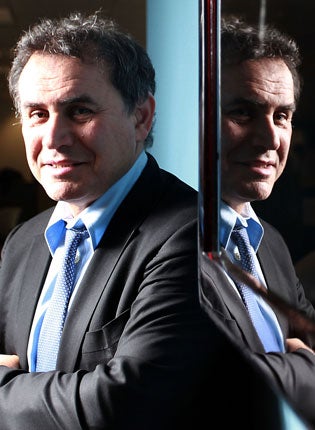
Opposite the suite of offices held by Roubini Global Economics in London is the Shaftesbury Theatre, currently host to the illusionist and "mind reader" Derren Brown's stage spectacular Svengali. So it seems appropriate I should meet the supposedly sinister and manipulative Nouriel Roubini, the "Dr Doom" of global economics, in such surroundings.
Dr Roubini's heavily-accented English makes him sound not so much like Derren Brown, but Henry Kissinger – and it carries with it the same vaguely Dr Strangelove (if I can introduce another, though fictional, PhD scholar) overtones. Roubini, born in Turkey to Jewish parents, lived in Iran, Israel and Italy, before becoming a typically sophisticated Manhattanite. His accent is an unpredictable outcome of these influences, so the world recovery is "anaymic" and when he quotes the former US defence secretary's famous "unknown unknowns", he talks about "Donald Rums-feeled".
Like Dr Kissinger, Dr Roubini is a regular on the international circuit, popping up with all the other docs and profs at the IMF, the annual Davos economic conference in Switzerland and as an adviser to governments the world over. He has flown in from Portugal today and you don't need to be professor of economics at New York University, as he is, to guess what he's been talking about in the capital of that financially-stricken country. Having counselled the Clinton White House, nowadays his consultancy is open to paying customers. To have Derren Brown read your mind at the Shaftesbury Theatre costs from £42.50; if you would like to personally read Dr Roubini's mind it will set you back rather more, though his book Crisis Economics, just out in paperback, represents excellent value at £10.99.
Though forbidding-looking in most of his pictures and not an easy man to push into a chuckle, my overriding impression of Dr Roubini was of no illusionist or Svengali, but a fairly laid-back character, at ease with the weight of the world's economic problems resting on his shoulders.
He is sadly, not as manipulative as he ought to be, all things considered. Had the world allowed itself to be manipulated by him a few years ago, we might not be quite the mess we are in now. Dr Roubini won his considerable reputation and, it has to be admitted, fashionability as a thinker, as "the man who predicted the Crash", the result of a seminal presentation to the IMF in 2006, at which he outlined in reasonably accurate terms what was about to overtake the American housing market, the sub-prime mortgage securities that rode on it, the banks that lent on it and the world economy that relied on it. If anything, "Dr Doom" was wasn't pessimistic enough; he did not foresee the worst slump in three quarters of a century. "In my business you're only as good as your last move, like an actor in his last movie. Just because I got one thing right four years ago doesn't mean I get everything right now. The most important thing is to be right... your reputation depends on being right day by day."
So not a Svengali at all, in fact. Not diffident, he knows his stuff and can talk his way though it persuasively and powerfully; but he is deliberative, analytical and measured. He talks aloud, basically. He's clever and, much more valuable to the clients who value his advice, adds intuition and insight to the economic aggregates he juggles with. He is a force for good, so far as I can judge.
"I have got a team of 50 people who follow every aspect of the world economy, not just in advanced and emerging economies, but in exotic markets in Africa and central Asia and the Middle East. Most banks don't have a single person looking at the Middle East. We have no conflict of interest because we don't manage money... we don't invest ourselves". As for the Dr Doom thing he responds: "I'm not Dr Doom – I'm Dr Realist".
He did, though, he tells me, move his own funds into cash a few years ago because, although it wasn't paying much interest, "it was better than losing 50 or 60 per cent", which is what happened to others who took the likes of Lehman Brothers and Goldman Sachs at their word and plunged into sub-prime. Which leads me to ask, in a not-disinterested way, where "one" should put one's money right now: not the sort of question I'd direct to Derren Brown, you understand. "It now makes sense to have a more diversified portfolio. In some equity mallets [shares] in the advanced economies they have reached their peaks, commodity prices look frothy, even emerging markets might have a correction". The British housing market might undergo a small scale "double dip" in prices, though "London is London" and attracts enough foreign money to hold it up.
Dr Roubini then lists a series of things that could possibly go wrong in the world economy; a list far more terrifying than anything Derren Brown and his ilk could ever conjure up. The crises in the eurozone he believes will persist and it is a matter of "if, rather than when" there is a Greek default. Greece has, he believes, "crossed the threshold". In the next year or two, he thinks the eurozone will probably hold together and the issue will be of orderly restructuring of unaffordable debts – Greece first, then perhaps Ireland and Portugal, if their Plan As fail. On a five-year time frame, he thinks it perfectly possible that political pressure in some peripheral economies: Greece, Ireland, Portugal, could see them exit the eurozone rather than endure "permanent stagnation or recession". He is more pessimistic about Spain than the markets generally, thinking them "probably complacent" about the chances of her falling into trouble.
Meanwhile, America has failed to come up with a credible plan to address her $1tr-a-year budget deficit and he believes that, with gridlock now, deeply-divided parties and an election next year, the next US president – "he or she", intriguingly – won't be able to do so until 2014. Whether what he calls the "bond vigilantes" will allow the US to delay that long is debatable: "I think it was Winston Churchill who said the United States ends up doing the right thing after she has tried every other alternative. So the US will do the right thing, the question is whether it is too late," he said.
And what about Britain? Is Ed Balls right to say the coalition is cutting too deep and to fast? Or has the Chancellor, George Osborne, got it right? Balls, is the short answer.
"Well, my advice – and I spoke with him [Osborne] on a couple of occasions – has been about too much fiscal austerity – though it was necessary, too much of it was front-loaded. He was making the argument that, if the austerity is too front-loaded and it was going to have a negative effect on demand, then it would be the job of the Bank of England to stimulate growth through monetary policy.
"I don't know whether that was the official, explicit view, but it made some sense.
"That was a few months ago. But since then, what has happened is that even before the fiscal austerity, you had a contraction of output in the last three months of 2010 and the Bank of England has not been able to do another round of quantitative easing because inflation has been high and they may have to tighten up in the months ahead. So that combination of fiscal austerity and monetary tightening down the line implies significant downside risks to economic growth.
"The fiscal austerity should have been front-loaded, as the Government had the credibility of potentially being in power for five years. If you had front-loaded the austerity less, the markets would not have punished you."
He told Osborne, he says: "'You guys should look at Plan B. Even within the year do more in the second half of the year'. Their reply was: 'No, we'd lose our credibility if we don't implement the plan as announced', so there was an unwillingness to consider a Plan B. So we'll see. Some data has been positive; others suggest economic softness."
He warns the British economy is vulnerable to a "triple whammy" – the tax hikes and spending cuts of the fiscal tightening, plus the Bank of England eventually raising rates to control inflation, plus the oil shock – "a challenging policy framework". Chillingly – and at times he can have that Derren Brown-style affect on his audiences – he predicts that: "We'll see more financial crises – we cannot avoid them until there is a more radical reform of the banking system." In the arcane but existentially-important debate about the "too big to fail banks" that blackmailed the world into rescuing them in the financial crisis, Dr Roubini still stands on the side of those who want to break them up and separate commercial or "high street" banking form the so-called "casino" activities of the investment banks. Thus far our Independent Banking Commission has rejected that, which may give some cause for concern.
Dr Roubini, for better or worse, gives the impression of man who thinks like an economist, even when he isn't thinking about economics. He enjoyed the film The King's Speech but "on the margin" preferred The Social Network, an expression of preference that could only come from an economist's lips.
He also enjoys London's "cosmopolitan" atmosphere and its cultural riches. Whether that encompasses a trip across the street to see the Derren Brown Svengali show, I'm not so sure.
Nouriel Roubini and Stephen Mihm's 'Crisis Economics' is out now, published by Penguin
Life in brief
* Born in Istanbul, on 29 March 1959
The child of Iranian Jews, his family ended up in Italy via Tehran and Tel Aviv
* Singled out as a Harvard graduate as an "unusual talent" by his adviser, eminent economist, Jeffrey Sachs
* In 1998 he joined the Clinton team as a senior economist
Join our commenting forum
Join thought-provoking conversations, follow other Independent readers and see their replies
Comments