Sebastian Coe: Lord of the rings
London 2012 is less than a week away. Will it prove to be its mastermind's finest hour?
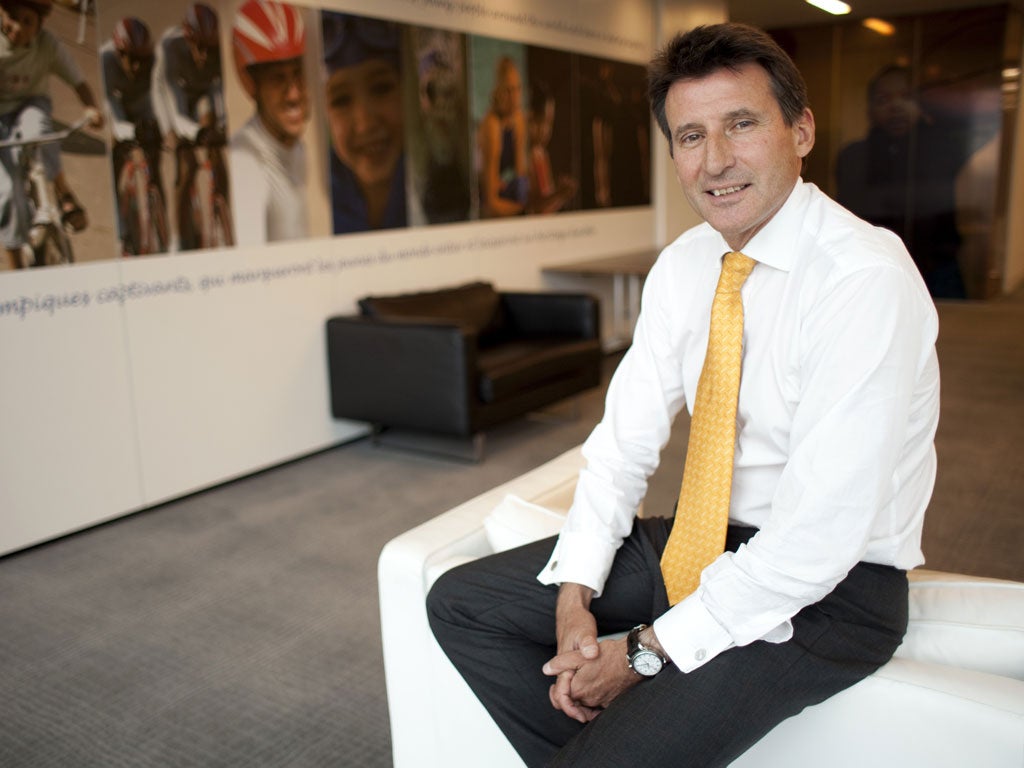
In this week's episode of the javelin-sharp Twenty Twelve, the spoof documentary about the preparation for the 2012 Olympic Games, the head of the Olympic Deliverance Commission, Ian Fletcher (Hugh Bonneville), had to wrestle with the unfortunate clash of his organisation's Inclusivity Day in London, and a Diversity Day being run in Oldham, by Seb Coe.
This was merely the latest muddle in a series that has been a consistent delight, and all credit to Coe for taking a small cameo, because it plays beautifully to the peculiar relish – a kind of pleasurable exasperation – we British take in our capacity for cocking certain things up. But Twenty Twelve is fiction, more or less.
It is the same national character trait that explains the widespread relish taken in this week's reporting of the G4S Olympic security fiasco, a "humiliating shambles" even according to the company's own chief executive, Nick Buckles. And almost more painfully welcome were reports that some of the drivers conveying athletes from Heathrow to the Olympic Village had got hopelessly lost.
Just when the real countdown to the real Olympics seemed to be going suspiciously smoothly, here was some reassuringly familiar chaos.
It is this faintly masochistic character trait, too, that explains our rather odd collective attitude towards Lord Coe of Ranmore, chairman of the London Organising Committee for the Olympic Games, and now less than a week from his seeing his vision come to pass.
He was, unarguably, one of the greatest middle-distance runners of all time. He has, without the slightest doubt, done an extraordinary job first in helping to secure the Olympic Games for London, and subsequently in helping to plan them. The blame for the G4S nonsense, and for the errant bus drivers, cannot be attached to him. He works tirelessly, speaks eloquently, delegates shrewdly, charms everyone he meets and, as an ambassador for Britain on the world stage, generally looks about as presentable as anyone could, in which respect he is the absolute antithesis of Boris Johnson.
Yet where the shambling London Mayor inspires affection, even from some of his political enemies, Coe inspires only respect. He is widely admired by the public, but not widely loved. He is just a bit too slick and successful for our common liking. He would, in many ways, make a better American than he does a Brit. After all, when we say here that such-and-such could happen only in England, it is with a tut, because something has gone wrong. Yet there, when they say "only in America", it is with pride because something marvellous has happened. Coe is instinctively more in tune with their attitude than ours. Indeed, had he been born 55 years ago in West Virginia, rather than west London, he would probably be running for president now, as a moderate Republican. And he would probably win.
Instead, he is about to enjoy the fruition of eight years of passionate dedication to a single cause. When Barbara Cassani resigned as chairman of the London bid committee in May 2004, the campaign's chief executive, Keith Mills, was uneasy at the prospect of Coe taking over. He didn't doubt the great Olympian's commitment to wanting the Games in London, but he felt that Coe had too many irons in the fire, that he would not be able to direct his undoubtedly prodigious energy at a solitary target.
What Mills didn't reckon on was Coe's ability to breathe life back into his old athletic impulse for tunnel vision, not just keeping his eyes on the prize but working out exactly how to get it, to the exclusion of pretty much everything else. It was Coe who, aware that British bids for great sporting events had in the past been made with a certain swagger of entitlement, and aware too that we were up against the French, never knowingly humble, chose to bid with what turned out to be a winning humility. There were many factors responsible for London being awarded the Games on that momentous day in Singapore in July 2005, but chief among them was Sebastian Coe.
He made a great deal in his final presentation to IOC members of the way in which the Olympics inspire young people around the world to take up sport, and he had himself in mind. In 1968, as a 12-year-old schoolboy at a secondary modern in Sheffield, he watched utterly transfixed in the school hall as Britain's David Hemery won gold in the 400m hurdles, in Mexico City. It was that spectacle which persuaded him to join an athletics club, and the rest is athletics history: he broke eight outdoor and three indoor world records, and he is still the only Olympic champion to defend successfully a men's 1,500m title, in 1984 in Los Angeles.
Yet it is Moscow 1980 that those of us old enough think of when we think of Coe the athlete. He dramatically lost the 800m he was expected to win and even more dramatically won the 1,500m he was expected to lose. In both races, his main rival was his compatriot Steve Ovett, and so much was made of their contrasting personalities that a kind of mythology lives on. Ovett was the everyman, Coe the son of privilege. It wasn't true, but it stuck.
In fact, Coe was the son of the formidable Peter Coe, a design engineer for a cutlery manufacturer (hence the family's move from London to Sheffield), who became his fierce, idiosyncratic but highly effective coach. It is impossible to understand the son without knowing something of the father, who went missing for 18 months during the Second World War and was believed to have perished at sea. In fact, he had been captured by the Germans, but he escaped by jumping off a train taking him to a PoW camp. Walking by night and sleeping by day, he eventually made it across the Pyrenees to neutral Spain.
Last year, in an interview, I asked Coe whether it was fanciful to try to find in him something of his father's remarkable fortitude. His reply was telling. "Well, nothing I've done is comparable," he said, "but I guess we both had a streak of belligerence, though I like to think I have a few more people skills. I remember him having an absolute up-and-downer with the [athletics] federation. I blanched at some of the things he said. But afterwards he said: 'I don't give a shit... the last 43 years have been a bonus.' That was one of the few times he referred to the war. Not a day goes by without me missing him intensely. He was a very smart guy."
Peter Coe died four years ago, aged 88, and if the television cameras find Coe looking remotely emotional at the Opening Ceremony on Friday, it will surely be because he is thinking of him.
As for the Closing Ceremony, it is tempting to wonder what Coe will be thinking about then, with his Locog job officially over. Might the next prize be the presidency of the IOC, perhaps? He certainly has the political skills, even though, as a working politician – he was Conservative MP for Falmouth and Camborne from 1992 to 1997 – he never really glittered as he was expected to. And his subsequent time as William Hague's chief of staff is probably best remembered for the energetic judo sessions they had, to which some commentators mischievously tried to give a homoerotic charge.
We know there wasn't one, not just because Coe has four children, and last year embarked on his second marriage, to a daughter of the former England cricket captain MJK Smith, but because Hague, in a BBC interview, was hilariously insistent that, while torsos had occasionally been bare, they had not been oiled.
More pertinently, in terms of our understanding of his old judo partner, Hague suggested that Coe relished taking something on against the odds, and winning not by chance but by changing the odds, so that, in the end, he was more likely to win than to lose. It was well put, and, although Hague was thinking primarily of London's successful Olympic bid, perhaps it is by changing the odds that Coe will, in the end, make the British love him.
A life in brief
Born Sebastian Newbold Coe, 29 September 1956, Chiswick, London.
Family Son of Tina and Peter, an engineer who coached his son. Was married to Nicky McIrvine from 1990 to 2002, with whom he has four children. He married Carole Annett last summer.
Education Attended school in Sheffield before studying economics and social history at Loughborough University. Joined Hallamshire Harriers athletics team when he was 12.
Career As a middle-distance runner won two Olympic gold medals for 1,500m in 1980 and 1984 as well as two further Olympic medals. In 1992, he became the Conservative MP for Falmouth and Camborne before being made a life peer in 2000. He was the head of the London bid to host the 2012 Olympics. Appointed a knight in 2006.
He says "It would be naive of me to sit here and say that nothing could go wrong."
They say "Coe is one of life's great overachievers." Clare Balding, BBC sports presenter
Join our commenting forum
Join thought-provoking conversations, follow other Independent readers and see their replies
Comments