Spencer Dale: The Bank's man keeps a hawkish eye on the 'evils' of inflation
Exclusive Business Interview: The Bank of England's chief economist is wary of complacency when it comes to the upside risks
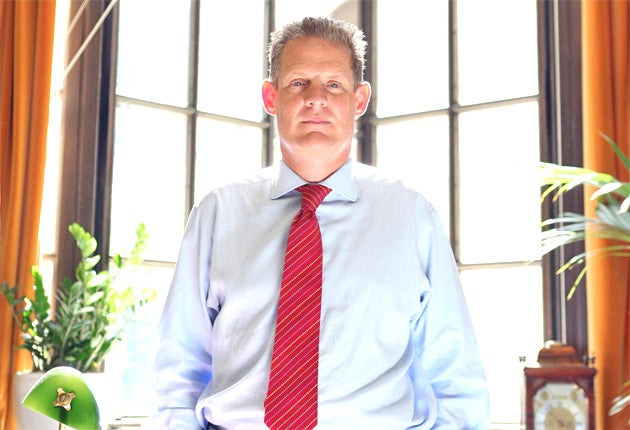
Life is full of surprises for the chief economist of the Bank of England, and not all of them nice. Since he was appointed just over two years ago, Britain has endured the worst downturn in three-quarters of a century, and his first full-year in post, 2009, represented the worst single year for GDP since 1921. Spencer Dale succeeded the well-regarded Charlie Bean, who became a Deputy Governor, while Mervyn King served in the role from 1991 to 1998. Unlike his illustrious predecessors, Mr Dale has not benefited from the "nice" decade of "non-inflationary continuous expansion"; he and the Bank, he says, have had a great deal of learning to do.
Mr Dale is, for example, surprised about how well employment held up in the recession and, less happily, how quickly sentiment in financial markets can switch back and inflict real damage. Like everyone else on the Monetary Policy Committee, he is surprised at how high inflation is, and how the outlook for growth has "deteriorated" recently.
"The near-term outlook for both growth and inflation has deteriorated over the past couple of months," he says. "Inflation has come out a little higher than expected, and the news on VAT in the June Budget means that the time it will take inflation to get back to target will be pushed out, and I expect it will be above target until the end of next year." Previously, the Bank thought it would get back to target by the start of 2011.
"Likewise, there are some signs that growth may be softening, again partly reflecting the June Budget. We've also seen tensions in the financial markets increase, related to concerns about sovereign debt issues in Europe. That has also affected the ability of banks and companies to raise cash. There's also the greater question of how things develop as countries around the world accelerate their fiscal consolidation plans."
The economy, he says, will not be back to normal "for an awfully long time" and he puts the loss of output at broadly 10 per cent, relative to where the UK would have been if normal growth had persisted.
Mr Dale says that both his central view of growth and his view of the downside risks to growth are weaker than before. The good news is that the "very substantial" threat to growth from a UK sovereign debt crisis appear to have "gone away", at least for the time being. The authorities, he says, have done what they can to "mitigate" that risk, mainly through the emergency Budget.
When I mention the International Monetary Fund's savage slashing of its UK forecast for growth for next year, from 2.5 per cent to 2.1 per cent, he says that "we haven't worked through that yet", but seems disinclined to rubbish the IMF view.
Export growth has been "disappointing" but fatter profit margins for exporters do mean more jobs, Mr Dale says, so the sterling deprecation has still been a plus. So is an already tricky job is getting trickier?
It seems so: "More generally, my view at the moment is that the traditional balancing act has become much more acute. It has the flavour of the challenges we faced in 2008 – substantial downside risks to growth but also upside risks to inflation staying above target and feeding through into wages and price setting."
But a poorer outlook for growth and, therefore, for spare capacity does not necessarily mean entirely effective downward pressure on inflation. This is new thinking. The Bank has stressed throughout the recession that the (undoubted) margin of spare capacity in the economy would bear down on inflation, even risking deflation, which seems common sense.
Yet Mr Dale offers another explanation as to why inflation is staying so stubbornly high – businesses having to protect their cashflow. He says that he has learned from getting out and meeting firms that the thing that drives companies out of business is cashflow, and hence the need to protect it at a time of rising input costs and sluggish demand at home and in key export markets has meant firms are less willing to cut prices than the traditional view would suggest.
Also, they cannot easily borrow from the banks to cover any shortfall. The fact, in other words, that businesses have lots of spare capacity does not mean they are restraining prices, as the Bank might have expected and which has happened in previous recessions. Firms have been unable or unwilling to absorb higher energy costs and import prices. Thus, "the pass through from the deprecation in the exchange rate has been greater than expected... Firms are less able to take slippage in margins". Mr Dale professes that he is still learning "how this recession is different" by getting out of Threadneedle Street. So much for the Bank's image as an ivory tower.
What's more, the previous failure by the Bank to foresee how the relationship between inflation and spare capacity was changing contributed to the forecast "error". I almost feel like a priest in confessional as he goes on to list in painful detail the Monetary Policy Committee's failings, albeit with hindsight. "There is a risk that expectations will become de-anchored, and it is that risk that underpins the upside risks to inflation. Since the spring of 2006 inflation has been above target for 41 out of 50 months and for two years it has averaged over 3 per cent."
"Last year, in the May 2009 Inflation Report, our central view was that inflation would be below 1 per cent, and, as you know, inflation is above 3 per cent. We've been very surprised about that and we need to understand the factors behind it."
"Now, we can come up with all sorts of clever and legitimate reasons to explain our view but at some point people will say 'inflation just seems higher than it used to be' and that is a very substantial risk. We're aware of that." The Bank's chief economist is also the first MPC member in some time to refer to the "evils" of inflation, and he professes himself disturbed by evidence of complacency and what he calls "dangerous talk".
"I read a newspaper article the other day suggesting that a little more inflation might be a good idea because it would dissolve away mortgage debt. And a very senior executive said to me: 'Aren't we going back to the bad old days when we just devalued and inflated our way out of trouble?' We know the evils of inflation. We have to be incredibly vigilant." Although Mr Dale did not argue in favour of a hike in interest rates last time round – unlike his fellow MPC member Andrew Sentance, who has taken that view for two months running – he has in the past been judged to be at the "hawkish" end of the committee's spectrum, having opposed an extension of quantitative easing last November, for example. And he seems to be in no immediate hurry to add to the £200bn of quantitative easing the Bank has already undertaken, a direct injection of money into the economy equivalent to about 14 per cent of GDP.
Balancing Mr Sentance on the more dovish wing of the committee is David Miles, who seems to have argued for more stimulus at the last MPC meeting. Mr Dale's tone to me suggests he thinks the Bank is doing enough. "The huge monetary stimulus remains there. We still have our foot firmly on the accelerator," he notes. He claims that QE has "worked", and lopped 1 percentage point off gilt yields and reduced three-month Libor interbank lending rates – which is crucial, given that half of all corporate loans are linked to that benchmark rate. It also needs more time to feed through fully. The Bank "stands ready" to deploy QE again if needs be. It would be a surprise if he was the first to suggest it.
A Threadneedle Street lifer: Spencer Dale – CV
2008 Appointed Chief Economist
2006-07 Seconded to the US Fed
2000-06 Head of Projections division
1989 Joins Bank of England, aged 22. Degrees from Universities of Wales and Warwick.
Apart from economics Mr Dale likes running, the theatre and tennis.
Join our commenting forum
Join thought-provoking conversations, follow other Independent readers and see their replies
Comments