Tariq Jahan: Overcome by the kindness of strangers
The man whose son was run down during the August riots has been inundated with letters of condolence from all over the world. Paul Bignell meets Tariq Jahan
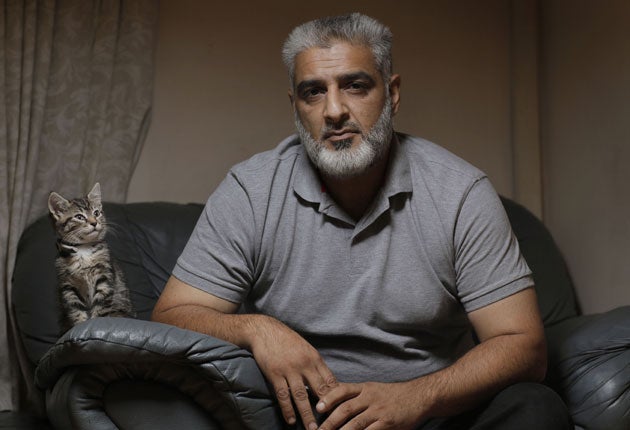
Tariq Jahan shows me a photograph of his son Haroon. A handsome young man, enjoying himself at a wedding, standing next to his proud, happy mother. The picture, a gift from a friend taken on a mobile phone just months before Haroon was run down by a car during August's lootings, is a source of pride – but also of regret. For there is no corresponding picture of father and son; no memento for Mr Jahan of the two of them together.
The Jahans have received so many gifts over the weeks since Haroon's death, the kindness has left the bereaved father dazed. "The kind of reaction I got from people... I'm not used to it," he admits. "The amount of good people in this country is amazing. I didn't know, until this tragedy happened."
There are still unopened mail bags in his shed, he tells me. Letters of condolence sent from as far away as Australia, Mongolia and South America. Many of them have come thousands of miles, bearing just the address: "To the Man Who Lost His Son in the Birmingham Riots, Birmingham, UK".
When Haroon, 20, and his two friends, Shazad Ali, 30, and Abdul Musavir, 31, were killed on 10 August in a hit-and-run incident, it ripped apart a close-knit community. Not only has Mr Jahan had to grieve for his son, he's had to do so in public.
His speech and appeals for calm just hours after his son was killed were beamed around the world. Suddenly, amid the violence, anarchy and chaos of the riots, people stopped in their tracks to listen. The words: "Why do we have to kill one another? Why are we doing this? Step forward if you want to lose your sons..." expressed a sentiment no politician or policeman had been able to convey.
"My intention was not to calm anything down. I didn't realise they [his words] would have this affect. I didn't think people would listen. I'm just another victim."
But people did listen. Politicians fell over themselves in a rush to praise him. Police officials congratulated him on diffusing a potential race riot. He was pictured standing next to a newlywed Prince William and Kate, and the image of him holding a photograph of his young son adorned papers around the world. A friend later told me he is to shortly be given a Pride of Britain Award. David Cameron is preparing a speech for him as part of the ceremony.
Mr Jahan was magnanimous then, in the face of such raw despair, but does he feel that way now?
"People have asked me, 'Is there anything you would like us to do in retaliation for what's happened?' But who do you take vengeance against? Whatever the law says, I'm happy with." Earlier this month police arrested a sixth man in connection with the incident.
Mr Jahan describes in vivid detail the moment he rushed to the aid of the three men, seconds after the incident. Much of what he describes, he asks to be left out, for the benefit of the other families. Not knowing, when he arrived on the scene, that his son was among the casualties, he began performing CPR on the first two men he came upon – Ali and Musavir. He had extensive first aid training from his days as a bouncer and a bodyguard. Unable to find a pulse on Musavir, he moved on to the third person.
"All I remember as I bent down, is his jacket looked familiar. At that moment I started to think 'please don't let this be Haroon'. I grabbed him and turned him over and I saw my son. I saw his face. The only thought that went through my mind was 'God, I'm sorry I worked on the other two first and didn't get to my son in time. Don't let him die because I didn't get to him first. I know that sounds selfish but the emotion swells up inside."
He now knows, despite initially finding a pulse, his son had broken his neck and died immediately. There was nothing he could have done to save him. When he speaks about "Harry", as he affectionately calls him, he frequently looks up at a photo of him above the mantelpiece.
Haroon was a mechanic. A very good one, according to his father: after only a year's training, he was stripping engines on Lamborghinis and BMWs. The events of that night are imprinted in his mind. It's clear he's replayed those agonising few hours over and over.
"People came to me and said, 'You're very strong, we haven't seen a tear in your eye.' But on that first night, me and my wife sat upstairs and put our foreheads together and we cried and we cried and we cried."
The police aren't telling him much until the investigation concludes, but he's adamant he wants to see the CCTV footage of the incident – to understand how it happened.
Of all his family, he says his wife has found it most difficult to cope. Haroon was "her baby". "She feels very close to Haroon," he says. "It's hard for her to accept that he died without her knowing or being there. She worshipped him."
He says that, over the years, his faith has been "up and down", but, if anything, his son's death has reaffirmed his belief: it was his "destiny".
Born to Indian and Pakistani immigrants in Slough, he moved to Birmingham with his work and decided to marry and settle there. Despite reports that he mixed in extremist circles, he says he only worked twice as a security guard for the leader of the Islamic group Hizb ut-Tahrir.
Despite everything that happened, he won't accept politicians' rhetoric that we live in a "broken society". He speaks of the sense of unity that drew 35,000 people to Haroon's funeral. "It was amazing," he says. "It was beautiful. It made me respect the public even more. There are a lot more good people than there are bad people... but unfortunately the bad people find a way into our lives a lot easier."
Join our commenting forum
Join thought-provoking conversations, follow other Independent readers and see their replies
Comments