Tom Bogdan: 'The sky at night stops me from sleeping'
The head of the world's only civilian operation to forecast solar storms is a worried man. Steve Connor reports
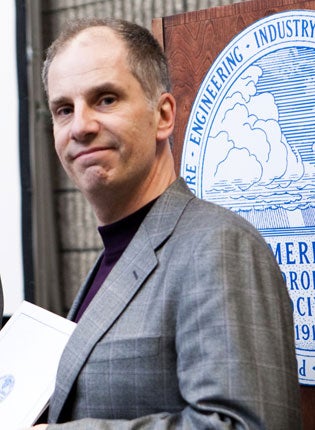
Tom Bogdan doesn't strike you as the nervous type but there is one thing that does keep him awake at night. His insomnia is caused by a 14-year-old satellite sitting between the Earth and the Sun some 1.5 million km away which he fears may one day suddenly die, so leaving the world without a vital early-warning system against a devastating solar storm.
Dr Bogdan is head of the US Space Weather Prediction Centre, the only civilian operation in the world dedicated to forecasting the size and timing of solar storms on a 24/7 basis. The satellite disturbing his sleep, the Advanced Composition Explorer, was designed with a lifetime of just two years – which is why, 14 years after its launch, Dr Bogdan gets worried.
Last week, the Earth was bombarded by millions of tons of solar particles travelling at a million miles an hour. Fortunately, this solar storm was a relatively minor affair. Dr Bogdan's centre gave it Category One status, the lowest of the five solar-storm categories. But there is always the risk that one day the Earth will be hit by a Category Five storm, which in space weather terms amounts to a cosmic hurricane capable of knocking out GPS satellites, power grids and critical telecommunications.
The Sun is now emerging from the lowest period of inactivity since the space age took off 50 years ago. Last week's event is almost certain to be just the start of a cycle that is expected to peak in 2013. It is during this rising activity that we can expect the Earth to be buffeted by some devastating solar storms.
Britain has now teamed up with the US to create a second solar weather prediction centre which, like its counterpart in Boulder, will operate 24/7 to make forecasts about an "imminent coronal mass ejection" – when the Sun spews out a billion or so tons of energetically charged particles travelling at a million miles an hour that can interact with electronic and magnetic devices, from satellites to electrical transformers.
The UK Met Office and Dr Bogdan's centre are now exchanging computer models and expertise in the hope that each can learn from one another about the vagaries of space weather prediction, which Dr Bogdan freely admits is still in its infancy: "Today, unfortunately, space weather is where meteorology was at the end of the 1950s."
His book-lined office overlooks the Rocky Mountains and is situated within the Boulder laboratories of the US National Oceanic and Atmospheric Administration, which is responsible for predicting terrestrial hurricanes, among other things. He is a mathematician by training and first got interested in the Sun when he met his academic supervisor, a scientist called Eugene Parker who predicted the existence of the solar wind before it was discovered.
One of Dr Bogdan's undoubted skills is what in America is called "public outreach". In other words, he is a good communicator, which he demonstrates in his verbal description of what actually happens when the Sun starts to get active.
"It usually starts with a solar flare, which is composed of a lot of ultraviolet and shortwave radiation travelling at the speed of light, so it takes eight minutes to get to us from the Sun," Dr Bogdan says.
"Down here at ground level we never see it or experience it but it gets absorbed in the atmosphere overhead by the ozone protective layer. It leads to an overactive ionosphere and that impacts people who operate GPS and any high-frequency radio communications," he says.
"Ten to 30 minutes later, if we are well connected to the flare site of the Sun where the event occurred, energetic particles will start bombarding the atmosphere," he explains.
This is when it gets dangerous for astronauts to be out there in space as these particles can penetrate their protective suits and damage their DNA. They can also cause "bit flips" in electronic devices controlled by computer. "In the past we've had satellites rendered inoperable because of severe radiation storms," Dr Bogdan says. "However, the big impacts we are concerned about are power grids, because those long wires connected to transformers can pick up currents that can cause power outages."
The biggest known solar storm occurred in 1859 and was documented by the British astronomer Richard Carrington, after whom the event is now known. More recently, in 2003, a solar storm caused the loss of an air navigation system across the United States that relied on GPS satellites.
Dr Bogdan says that the recent agreement between President Obama and the Prime Minister to build a second space weather predicton centre is predicated on the idea that society is now far more vulnerable than it was during previous peaks in solar activity.
"Advanced technology has crept into just about everything we do. GPS has entered so many parts of our lives," he says. But this dependence creates vulnerability, which is why you need a cool head to be the man who will warn the world of a Category 5 storm to rival the infamous Carrington Event of 1859.
"We know the Sun is capable of an 1859 event. It would be shortsighted to say that that's the worst the Sun could ever do. It can probably do worse than 1859," he says.
Route to the stars
* Born in 1957 in Buffalo, NY – the same year as the largest ever recorded sunspot.
* His father was an engineer on the Manhattan Project, while his mother was a writer and political advocate for local Native Americans.
* Graduated from the State University of New York in 1979 with highest honours and went on to earn a Masters and PhD in Physics from the University of Chicago.
* In 1993 he married Barb Cardell, a sexual health campaigner.
* For nearly 20 years he was a leading scientist at the National Centre for Atmospheric Research and was appointed director of the Space Weather Prediction Centre in 2006.
Join our commenting forum
Join thought-provoking conversations, follow other Independent readers and see their replies
Comments
Bookmark popover
Removed from bookmarks