Women of courage: Rachel Margolis
Former Prime Minister Gordon Brown continues his series on women of courage with the story of Jewish resistance hero Rachel Margolis
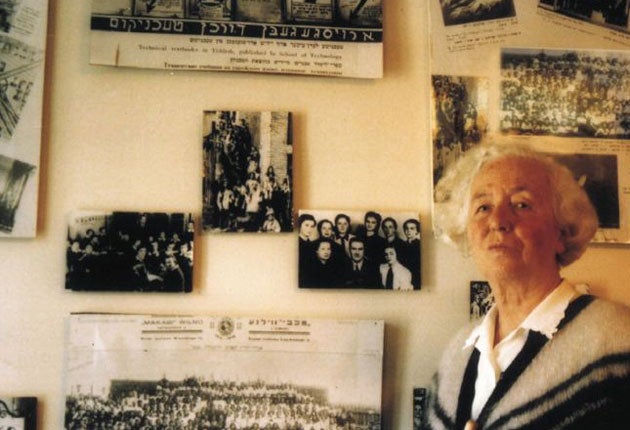
Lithuanian war hero Rachel Margolis is one of the most courageous women in her country's history. Yet amid the recent wave of anti-Semitism in the Baltic state, prosecutors are trying to implicate her in a case against a fellow partisan hero of the anti-Nazi forest war of the 1940s. Fearing harassment and arrest, she is in exile in Israel but those who hear her story will surely conclude that the Lithuanian authorities should grant this extraordinary woman – now in her 90th year – a permit to return to her native land.
Rachel, born in 1921, is the only person I have heard of who demanded to move into a wartime Jewish ghetto. When the Nazis invaded and occupied Lithuania in 1941, she was sent to a Christian family for shelter but decided that rather than hide she would fight and, if necessary, die fighting.
Entering the Vilna ghetto in September 1942 she presented herself to the Jewish resistance and demanded to be given a role in the partisan war. She was soon an active member of the ghetto's clandestine underground and in the autumn of 1942 was admitted to membership of the Fareinikte Partisaner Organizatzie (the United Partisan Organisation) – formed only eight months earlier and commanded by Abba Kovner, later a noted Israeli poet.
"Everyone was anxious to fight," she wrote. "Our mission was to acquire weapons, complete militarily preparations, all with the aim of provoking an uprising in the ghetto. If we perished it would be with honour, having proved to humanity that we are not sheep going meekly to the slaughter."
In June 1943 the head of the SS, Heinrich Himmler, ordered the liquidation of the Vilna ghetto; 4,000 Jews were sent to death camps and murdered, another 4,000 sent to slave labour camps. A few hundred Jews managed to escape from the ghetto to the forests. Rachel and her husband-to-be were among them. Despite enduring a bout of typhus which nearly killed her, Rachel and her fiancé joined a partisan unit that was blowing up bridges and railways essential to the German lines of communication.
In her recent memoirs she recounts tales of her own activities and a story told by fellow partisans about the battle in the village of Kanyuki on 29 January 1944 between armed pro-Nazi villagers and the partisans. The story describes how a group of Jewish partisans, including a woman called Fanya Branstovsky, attacked a Nazi garrison. Rachel writes: "The partisans had surrounded the garrison, but the Nazis were exceptionally well armed and beat off all attacks. They broke the flanks of the Jewish detachments, and the partisans withdrew precipitously. Then Magid jumped up on a rock and yelled, 'We are Jews. We will show them what we are capable of. Forward, comrades!' This sobered the men up; they ran back and won."
In late 2007 and early 2008, local anti-Semitic newspapers focused on this one paragraph, took it out of context, and said it proved that Branstovsky murdered unarmed civilians and Margolis was an enemy of the Lithuanian people.
Unlike in Germany, Lithuanian society has never gone through a period of reconciliation and repentance of its Nazi past and there is a fierce ideological debate about how to describe and respond to the collaboration between ordinary Lithuanians and German occupiers that was in evidence in places like Kanyuki. As a result, Rachel's memoirs were used as evidence that the organised resistance of Jews at Kanyuki was "a Communist atrocity" against ordinary Lithuanians. In May 2008, armed police came looking for both Branstovsky and Margolis.
Was the attack on Kanyuki village, in which 38 villagers were killed, a legitimate partisan military operation, with inevitable civilian casualties, or a calculated war crime? Whatever the answer, there is no explanation of why the Lithuanian prosecutor and police should even have opened an investigation when no concrete evidence existed that any of the named individuals had been involved in prosecutable offences. One may also contrast this investigative zeal against Jewish partisans with the negligent handling of cases involving the alleged murders of Jews.
Rachel does not deny her involvement in partisan activities – indeed, she is fiercely proud of it – but she was not even present in the Koniuchy area on the day, a fact which she explained in a detailed letter to the authorities in Vilnius.
After Fanya Brantsovsky answered some questions in 2008, her file was closed and she has not been troubled since by the prosecutor's office, despite local press hostility. But for Rachel Margolis there has been no such closure. It seems that the prosecutor cannot close the file without posing questions to her and now claims that they only want to meet her "as a witness, not a suspect" – but she was not a witness of the events of Kanyuki village and never claimed in her memoirs that she was. She is willing to answer questions, if this can be arranged in a way that is not distressing or intimidating for her, and with an assurance that if her answers offer no basis for proceeding further, the file will be closed.
But the question remains why this extraordinary woman is being subject to a campaign of state-sponsored harassment for her involvement in – and reportage of – a campaign of resistance to those who had invaded her country and set about systematically murdering its Jewish population.
There were around 190,000 Lithuanian Jews at the start of the war; only 9,000 at its end. Rachel is the only member of her family to have survived; the remaining Jews left in the Vilna ghetto were slaughtered days before Allied liberation.
Throughout her imprisonment in the ghetto, her time in the forest as a partisan fighter and now as she struggles to clear her name in the face of attempts to smear her and other members of the Jewish resistance, Rachel was influenced by the words of another fighter she knew.
Her friend Sonia told her, when they were weighing up the risks of fighting and the tiniest of chances they had against the full might of the Third Reich, "as long as we're still alive we cannot lose". Rachel Margolis, who will be 90 this year, is still alive after a voluntary entry to the ghetto, a voluntary membership of the armed resistance and voluntary involvement in the telling of the survivors' story which has so incensed the authorities. She cannot lose her fight to go home – and we must not let her.
Gordon Brown is a supporter of the Holocaust Education Trust ( www.het.org.uk). Tomorrow, in the last of his series of portraits of women of courage, the former Prime Minister writes about the environmental campaigner Clare Rewcastle
Join our commenting forum
Join thought-provoking conversations, follow other Independent readers and see their replies
Comments