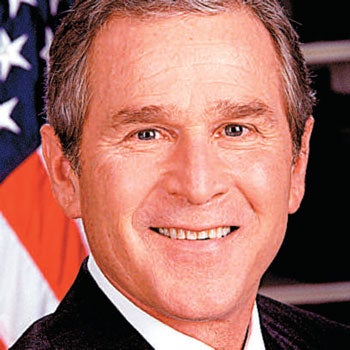
George W Bush 2001-2009
43rd president - 2001-2009

For free real time breaking news alerts sent straight to your inbox sign up to our breaking news emails
Sign up to our free breaking news emails
The famously privileged George W Bush took office with fulsome advantages. Bill Clinton had bequeathed him a more or less decent economy, his party controlled both houses of Congress, and Karl Rove, the wily political consultant who had helped him become Governor of Texas six years before, was just down the corridor – a more trusty servant than even Barney the First Dog.
He tried to forget the pesky circumstances of his election: the hanging chad débacle in Florida, the recount drama and his ensuing "victory" over Al Gore ordained by the Supreme Court. Bush had actually lost the popular vote. Thus, at least half the voters didn't much care for the Texan cowboy who couldn't pronounce "nuclear".
Domestic policy initiatives, including a package of unprecedented tax cuts for the rich and an education reform bill called "No Child Left Behind", might have been the focus of his first term but for the events of 11 September 2001. Bush was in a Florida classroom when the terrorists struck, then spent several hours circling in Air Force One contemplating the crisis. But when he stepped on to the rubble at Ground Zero three days later he captured America's attention declaring, "I can hear you. The rest of the world hears you. And the people who knocked these buildings down will hear all of us soon."
The attacks altered everything. Bush declared a "War on Terror" that was to dominate both his terms in office. Within weeks, the US military helped to topple the Taliban in Afghanistan and expel al-Qa'ida, though its leader, Osama bin Laden, was not captured. In his 2002 State of the Union address, Bush invoked the "Axis of Evil", made up of Iraq, North Korea and Iran, sowing the seeds of the Bush Doctrine in foreign policy justifying pre-emptive war to safeguard America.
Bush's popularity ratings soared to record levels, from where they would later tumble. Domestically, some critics grew alarmed as the Bush administration introduced the Patriot Act, diluting privacy laws and civil rights in the name of national security. Abroad, many traditional allies, already dismayed by Bush's refusal to sign the Kyoto Treaty on climate change, worried about his growing fixation on Iraq and Saddam Hussein. Hundreds of thousands protested worldwide in the days before the March 2003 invasion of Iraq, when America led the mostly fictional "coalition of the willing" into Baghdad. Bush was later to admit that it was a mistake to celebrate the removal of Saddam with victorious pageantry – aboard an aircraft carrier – in front of a banner declaring "Mission Accomplished".
No weapons of mass destruction, which had been used to justify the invasion, were found, and Iraq was soon to be gripped by sectarian violence that pushed it close to civil war. The 2004 Republican Convention in New York was marred by loud anti-war protests, but in November Bush won a second term after painting his Democratic challenger, Senator John Kerry, as a flip-flopper (not least on the Iraq war) and a Massachusetts elitist who liked to windsurf.
Soon after re-election Bush signed a costly bill to help seniors with prescription medicine costs, regarded by its critics as the largest expansion of the welfare safety-net in years. Other initiatives fared less well. He proposed the partial privatisation of the near-bankrupt Social Security system, embarking on a 60-day tour to sell it. The Democrats balked and so did the public. His efforts to push immigration reforms – notably aimed at offering a path to citizenship for the millions in the country illegally – fell foul of conservative fury.
Then the unexpected struck again: a hurricane called Katrina. The perceived bungling of the Government's response, combined with escalating violence in Iraq, began to have a grave impact on Bush's popularity. In the 2006 mid-term election, control of both houses of Congress shifted to the Democrats, killing what was left of Bush's domestic legislative agenda. Meanwhile, Bush was facing growing challenges to aspects of his war on terror, notably the use of Guantanamo Bay in Cuba to house so-called "enemy combatants" and his government's refusal to give them traditional trials or even habeas corpus rights.
Internationally, a reputation severely dented by America's flawed war in Iraq was hardly improving, even though Bush could claim that his decision in early 2007 to send more troops to that country – known as the surge – had contributed to a steep decline in violence there.
Beyond Iraq, Bush and his second Secretary of State, Condoleezza Rice, had little to show for their attempts at mediating Middle East peace, a record of failure that became even more vivid in the last weeks of Bush's second term when Israel opened a vicious offensive against Gaza. The US and Europe remained in a dangerous stand-off with Iran over its nuclear ambitions, meanwhile, with little indication of how it could be ended. Nor was it clear that US-led efforts to cajole North Korea into ending its nuclear programmes were working. Bush could claim, however, to have dramatically increased US involvement in the fight against HIV-Aids internationally and in Africa especially, where the US was to become responsible for providing treatment to two-thirds of the 3 million people on the continent who were being treated for the disease.
On the home front, however, it was the economy that was beginning to bite Bush. By the beginning of 2008, the US was diving into a deep recession, triggered in part by the failure of regulators to recognise a huge overhang of bad debt in the financial system.
The so-called credit crisis forced Bush and his Treasury team into direct intervention, notably guiding a $700bn package through Congress to buy mortgage instruments that had gone sour and to prop up Wall Street institutions. Thus Bush found himself presiding over a process of nationalisation that contradicted some of the most basic tenets of his party and even of capitalism itself.
In November 2008, Barack Obama, a Democrat, won the presidency and polls showed Bush breaking all records in both approval (rock bottom) and disapproval (sky high) ratings.
In his own words
"Our enemies are innovative and resourceful, and so are we. They never stop thinking about new ways to harm our country and our people, and neither do we."
"Families is where our nation finds hope, where wings take dream."
"I can press when there needs to be pressed; I can hold hands when there needs to be – hold hands."
"I know the human being and fish can coexist peacefully."
"My plan reduces the national debt, and fast. So fast, in fact, that economists worry that we're going to run out of debt to retire."
"It's clearly a budget. It's got a lot of numbers in it."
"If this were a dictatorship, it'd be a heck of a lot easier, just so long as I'm the dictator."
"Well, I think if you say you're going to do something and don't do it, that's trustworthiness."
"More and more of our imports come from overseas."
"The vast majority of Iraqis want to live in a peaceful, free world. And we will find these people and we will bring them to justice."
"They [the Taliban] have no disregard for human life."
"One of the great things about books is sometimes there are some fantastic pictures."
"I don't particularly like it when people put words in my mouth, either, by the way, unless I say it."
"You know, one of the hardest parts of my job is to connect Iraq to the war on terror."
"I know how hard it is for you to put food on your family."
"I'll be long gone before some smart person ever figures out what happened inside this Oval Office."
"Sometimes you misunderestimated me."
In others' words
"Bush is to the left of me now. Comrade Bush announced he will buy shares in private banks." Venezuela's socialist President Hugo Chavez
"By the time this administration is finished, there won't be any money left." Gore Vidal
"While President Bush likes to project an image of strength and courage, the real truth is that in the presence of his large financial contributors he is a moral coward, so weak that he seldom, if ever, says 'no' to them on anything, no matter what the public interest might mandate." Al Gore
"He has destroyed... what it took two centuries to build up. He has taken us from a prosperous nation at peace to a dead-broke nation at war." Hunter S Thompson
"In England, he wouldn't be trusted with a pair of scissors." Russell Brand
Minutiae
During his eight years as Governor of Texas, he authorised the execution of 152 people – more than any other governor in US history.
The Bush Administration turned a $236bn surplus into a $1trn deficit.
Bush was the first US president to visit Albania.
In preparation for a visit by Queen Elizabeth to the White House in 1991, during his father's presidency, a young George W Bush had a pair of new cowboy boots made emblazoned with the phrase "God Save the Queen".
In January 2002, Bush fainted after choking on a pretzel ( above) in the White House.
In 1976, he was fined $150 for driving while under the influence of alcohol and had his driving licence suspended for two years. He finally gave up drinking in 1986.
Between 1988 and 1998 he was a major shareholder in the Texas Rangers baseball franchise. He sold his shareholding for around $15m.
Bush was head cheerleader ( left) at Phillips Academy in Andover, Massachusetts.
Subscribe to Independent Premium to bookmark this article
Want to bookmark your favourite articles and stories to read or reference later? Start your Independent Premium subscription today.
Join our commenting forum
Join thought-provoking conversations, follow other Independent readers and see their replies