A clump of cells? Or a living being with a soul?
Embryo research has pitted scientists against bishops, caused a cabinet split and divided the country. Religion, politics, medicine and ethics all collide in a debate that boils down to the question above
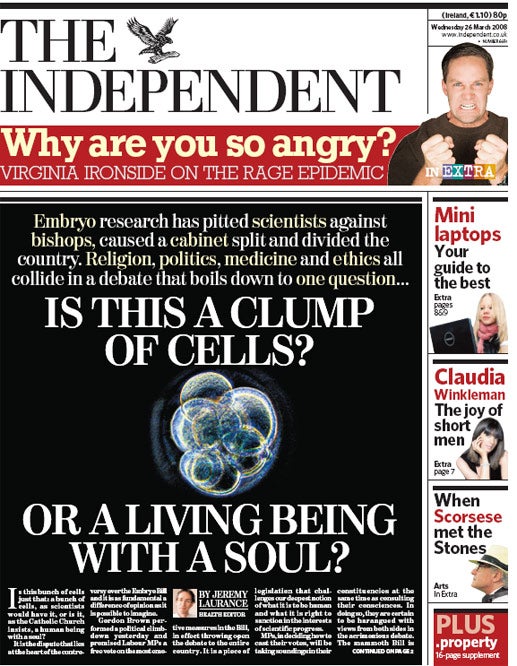
Is a bunch of cells just that: a bunch of cells, as scientists would have it, or is it, as the Catholic Church insists, a human being with a soul?
It is the dispute that lies at the heart of the controversy over the Embryo Bill and it is as fundamental a difference of opinion as it is possible to imagine.
Gordon Brown performed a political climbdown yesterday and promised Labour MPs a free vote on the most emotive measures in the Bill, in effect throwing open the debate to the entire country. It is a piece of legislation that challenges our deepest notion of what it is to be human and what it is right to sanction in the interests of scientific progress.
MPs, in deciding how to cast their votes, will be taking soundings in their constituencies at the same time as consulting their consciences. In doing so, they are certain to be harangued with views from both sides in the acrimonious debate. The mammoth Bill is designed to update the 1990 regulatory framework for fertility treatment and embryo research in line with scientific advances and changes in public attitudes during the past 18 years.
At its heart lie three issues on which Mr Brown has now granted MPs a free vote, although Labour MPs will be required to back the Bill as a whole when it is voted on in principle at the third and final reading.
The specific issues are: allowing research into possibilities such as making sperm from bone marrow that might mean women could become "fathers"; allowing the creation of "saviour siblings" (babies created with the correct tissue match to treat a sick brother or sister); and the creation of so-called hybrid animal/human embryos to aid stem cell research.
It is that last issue – the creation of hybrid embryos (also called "admix" or "cybrid" embryos) – that has angered senior members of the Catholic establishment who attacked the proposal in their sermons delivered over Easter.
Most outspoken was Cardinal Keith O'Brien, leader of the Scottish Catholic Church, who said: "This Bill represents a monstrous attack on human rights, human dignity and human life. In some European countries, one could be jailed for doing what we intend to make legal. It is difficult to imagine a single piece of legislation which more comprehensively attacks the sanctity and dignity of human life than this particular Bill.
"One might say that in our country we are about to have a public government endorsement of experiments of Frankenstein proportion – without many people really being aware of what is going on."
The Anglican Bishop of Lichfield, the Right Rev Jonathan Gledhill, also attacked the Bill. He said: "It's a very important part of our society and a very important part of the Christian faith that you should have respect for human embryos.
"If you stop obeying God, you start to limit the rights of human beings and this is a case in point. A society has to be judged by the way that it treats its poorest, most vulnerable and weakest. And what can be weaker than an unborn child?"
Cardinal O'Brien's outburst drew a stinging rebuke from Lord Winston, the Labour peer and IVF pioneer, who accused him of deliberately misrepresenting the Bill. "His statements are lying. They are misleading and I am afraid that when the Church, for good motives, tells untruths, it brings discredit on itself," he said.
Professor Colin Blakemore, former head of the Medical Research Council, expressed the same view in more moderate language. "The Bill is not about creating monsters or mocking the sanctity of human life. Indeed, it will reduce the number of human eggs and embryos used in the production of stem cells for research."
That is the core of the scientific case for the creation of hybrids – it is a response to the shortage of human eggs available for research. Extracting eggs from women is an invasive procedure that requires them to take powerful drugs to stimulate their ovaries and then undergo surgery to retrieve the eggs.
The procedure carries risks. Most human eggs used for research are therefore obtained from women undergoing IVF, as a by-product of the treatment.
But women having IVF need their eggs first and foremost for treatment – hence the shortage of eggs available for research.
A decade ago, scientists found another source – animal eggs. They discovered that by removing the nucleus from a cow or rabbit egg and replacing it with the nucleus from a human skin cell, they could create a hybrid embryo that would develop like a human one, from which stem cells could be grown.
The resulting embryo is 99.9 per cent human in genetic terms. It would never be grown beyond a few days, and the stem cells would only be used in research. But the potential benefits would be great, providing insights into diseases such as Alzheimer's, Parkinson's and motor neurone by producing stem cells containing genetic defects that contribute to those conditions.
The Association of Medical Research Charities, representing 223 organisations, said in a letter to MPs last week that the Bill "would allow new avenues of scientific inquiry to be pursued which could greatly increase our understanding of serious medical conditions affecting millions of people throughout the UK, and ultimately lead to new treatments".
The Department of Health spelt out the restrictions set out in the Bill. "There will be a limit of 14 days development of the embryo, and they cannot be put in a woman or an animal. This is not about 'creating monsters' it is purely laboratory research aimed at increasing knowledge of serious diseases and treatments for them."
In scientists' eyes, the use of animal eggs is a practical answer to a practical problem but in the eyes of the Catholic Church, it is something else entirely – a monstrous creation that is an affront to human life and dignity.
Join our commenting forum
Join thought-provoking conversations, follow other Independent readers and see their replies
Comments