Sapphire ring 'belonged to Anglo-Saxon or Viking royalty'

Sign up for a full digest of all the best opinions of the week in our Voices Dispatches email
Sign up to our free weekly Voices newsletter
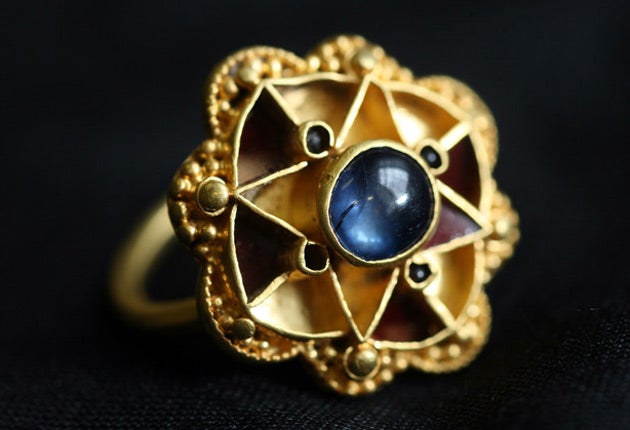
A unique gold and sapphire finger ring, found by a metal detectorist and just purchased by the Yorkshire Museum, almost certainly belonged to Anglo-Saxon or Viking royalty, very senior clergy or a leading member of the Anglo-Saxon aristocracy, say historians.
Of very great historical importance, it is the only Anglo-Saxon era sapphire ever found in the ground in Britain. The only other sapphire from the period is the one that the Queen wears in her Imperial State Crown, used at the opening of Parliament. Known as St. Edward’s sapphire, this latter gem was once part of King Edward the Confessor’s finger ring and is now the oldest gem in the British crown jewels.
The association of sapphires with high status – demonstrated by St. Edward’s gem – suggests that the sapphire ring, just purchased by the Yorkshire Museum, is of very substantial historical significance. It was found in a field some six miles to the south of York by a local metal detectorist, Michael Greenhorn, a railway technician, was subsequently declared treasure and has now been bought by the museum for £35,000.
It’s very likely that the ring belonged originally to an Anglo-Saxon Archbishop of York, one of the Earls of Northumbria or a senior member of one of Anglo-Saxon England’s royal families.
But narrowing down the field may not be an impossibility. For the Yorkshire Museum is to launch a multi-disciplinary investigation to unlock the secrets of their newly acquired and unique piece of treasure.
Although the ring probably dates from the early 10th to the mid 11th century, it could be much earlier, conceivably even from the 7th century. So the museum’s first task will be to narrow down the age range by looking for stylistic parallels in other pieces of Anglo-Saxon and other first millennium AD jewellery.
Secondly they want to better understand the sophisticated technology used to create the ring - especially the gold work. The precious metal alloy is of a very high standard – 90% gold, 8% silver and 2% copper.
The museum, in York, also plans to track down the ultimate origin of the sapphire itself. It’s possible that it came originally from India or Sri Lanka and a special scanning electron microscopy examination of the gem will almost certainly be carried out to identify trace elements and ascertain its geological background.
This may also help to reconstruct its pre-Anglo-Saxon history. Is it likely to have been imported into England or Europe from thousands of miles away in Anglo-Saxon times, or is it more likely that it was imported in Roman times and re-used in various different high status roles for hundreds of years before it was lost south of York a millennium or more ago.
Microscopic examination of ware marks on the ring may also shed light on its history – as might a detailed historical examination of the area around where it was found .
The Yorkshire ring, weighing 10.2 grams, is 25.5 millimetres in diameter, and is adorned with a six millimetre deep-blue sapphire and pieces of red glass, all set into the gold.
In medieval times, sapphires were seen as magical objects – capable of protecting kings and other members of the ruling elite against assassination. They were seen as particularly powerful against death by poisoning! In the medieval mind, the ability of a sapphire to combat poison could even be tested - by swinging the gem above a spider. If the creature died, then the sapphire was seen as being in good working order.
Sapphires were also regarded as high status health aids (able to cure a range of complaints) – and as a guarantee of morality, capable of reducing human lust and impurity of thought.
Subscribe to Independent Premium to bookmark this article
Want to bookmark your favourite articles and stories to read or reference later? Start your Independent Premium subscription today.
Join our commenting forum
Join thought-provoking conversations, follow other Independent readers and see their replies