Skeletons tell tales of brutal wars from beyond the castle's crypt
One set of remains had suffered 100 fractures and researchers found that the others had all died from blunt injuries
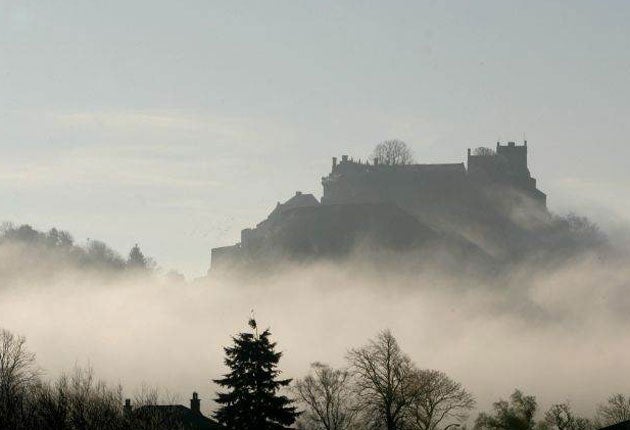
Some of the most horrific war-related injuries ever found, have been identified by scientists studying medieval warriors killed in Scotland’s wars of independence.
According to a new study of skeletons found at Stirling Castle, one individual died after suffering 100 fractures. Others had between seven and 16 fractures – all caused by massive blunt force, rather than bladed weapons, according to the study, carried out at Bradford University.
They symbolized the suffering in one of the bitterest wars ever fought in Britain. Giant siege engines, starvation, Greek fire (a sort of medieval napalm) and even early guns were used in a war in which up to 100,000 men – and some women – fought to the death.
Terror was used to systematically humiliate opponents at Stirling Castle itself. On the orders of the English king, Edward I, the Scottish garrison, though later freed, was led out of the castle with nooses round their necks to instil abject fear. Just a mile away, a few years later, thousands died at the great Battle of Bannockburn fought between Edward II and Robert Bruce over who should control the castle.
Although the skeletons, from Stirling Castle, 40 miles north-west of Edinburgh, were all discovered in the 1990s, the identification and detailed scientific analysis of the injuries all took place over the past 18 months.
It’s likely that the 9 individuals – including five men, a woman and an infant – were killed during two or more of the eight sieges that took place at Stirling Castle between 1296 and 1342. The Battle of Bannockburn - just a mile away – was fought primarily for control of the fortress.
The individual with the 100 fractures – almost certainly a soldier – had severe injuries to his skull (44 fractures), and to his lower jaw, ribs, collar bone, shoulder blades, arms, left hand, sternum and some vertebrae, according to the investigation led by biological anthropologist, Dr. Jo Buckberry of the University of Bradford’s Biological Anthropology Research Centre.
Another individual had often multiple fractures to his skull, lower jaw, shoulder blade, collar bone, upper arms and ribs while a third individual had seven fractures to his leg and ribs.
The woman – who was probably a combatant – sustained eight fractures to the right side of her skull, according to the Bradford University study. But she also appears to have been hit on the top of her head twice by a poleaxe, war hammer or similar weapon which punctured her cranium.
The precise cause of most of the victims’ injuries is not yet known.
However, it’s conceivable that many of them may have been sustained through siege warfare. The fact that they were buried inside the castle, rather than elsewhere, suggests that they were under siege at the time. What’s more, the blunt force damage is consistent with the sort of injuries which would have been sustained at the receiving end of a medieval artillery barrage, unleashed by great siege engines.
It’s known, for instance, that Edward I (nicknamed ‘Hammer of the Scots’) developed a giant trebuchet – a vast wooden catapult – to bombard Stirling Castle. Indeed, in 1304 he drove the Scottish defenders who had already surrendered, back into the castle to suffer as ‘guinea pigs’ at the receiving end of the outsized machine – known as Edward’s ‘War Wolf’.
However, it’s also possible that some of the individuals were systematically beaten up and killed – or that they were trampled by horses in the thick of battle. But the almost complete absence of sword damage on the skeletons probably makes those latter explanations less likely.
3D facial reconstructions of two of the individuals – the woman and one of the male warriors – will go on display at Stirling Castle early next month.
But only further research will determine whether the victims were Scottish or English soldiers, as the castle changed hands eight times in 46 years in the late 13th and early to mid 14th centuries.
Today, most of Stirling Castle – for many years a Scottish Royal Palace – dates from the 16th century – but is partly composed of masonry re-used from the earlier Medieval fortifications.
The skeletons were found in the medieval royal chapel, the existence of which was totally unknown until the 1990s.
The individuals’ interment there – an unusual act – suggests not only that it was done under siege conditions when burial elsewhere was impossible, but also that the individuals were of high status.
The individual with 100 fractures was aged around 30 and was 5 foot six inches tall. Another man of similar age and height, probably a knight, sported a healed battle scar on his forehead. He almost certainly died from a deep arrow wound. A slightly taller individual was aged around 20. The oldest person in the group was the only woman identified. She was aged around 40, was five foot four inches tall and was extremely robust with evidence of incredibly strong muscles in her arms and legs. The research on her raises the whole question of the role of medieval Scottish women in warfare. Interestingly at another siege (at Dunbar Castle) in the Scottish War of Independence, the Countess of Dunbar – nicknamed Black Agnes – led the defence of her castle spitting defiance at the English attackers.
Join our commenting forum
Join thought-provoking conversations, follow other Independent readers and see their replies
Comments