Cloned goat dies after attempt to bring species back from extinction
Groundbreaking experiment fails, but scientists pave way for 'return' of other creatures
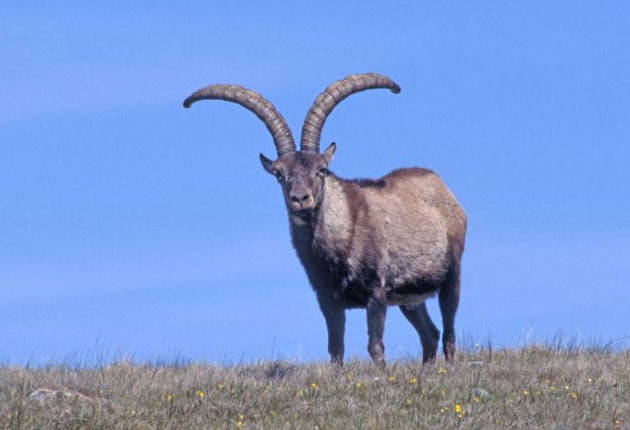
Scientists have come close to bringing an extinct species back to life for the first time with the birth of a cloned Pyrenean ibex, a type of mountain goat that is believed to have died out completely in 2000.
The cloned ibex was created from frozen skin cells taken from the ear of the last Pyrenean ibex known to have lived, but unfortunately the newborn kid resulting from the cloning attempt died within minutes of birth as a result of breathing difficulties.
Nevertheless, the cloning and pregnancy using the egg cells of domestic goats, which also acted as surrogate mothers, demonstrated that it may one day be possible to "bring back" extinct species with the help of closely related animals which have not died out.
The Pyrenean ibex, or bucardo, is a subspecies of the Spanish ibex that lives in the mountain ranges of the Iberian peninsula. Previous attempts to clone the species from skin cells stored in liquid nitrogen failed in 2003 with two pregnancies that ended prematurely during the first two months.
The latest attempt involved the creation of 439 ibex-goat hybrid cloned embryos made by inserting the cell nuclei of the ibex's skin cells into the egg cells of domestic goats which had their own cell nuclei removed. Of these cloned embryos, 57 were transferred into surrogate mothers and seven resulted in pregnancies, but only one goat gave birth and the newborn clone died after seven minutes as a result of lung deformities.
Scientists took the bucardo's skin cells from the ear of a 13-year-old female named Celia who had been captured in 1999 and subsequently released. However, she was found dead with a smashed skull lying next to a fallen tree a few months later – the last Pyrenean ibex known to have lived.
Jose Folch, director of the bucardo project at the University of Zaragoza in northern Spain, said that it may one day be possible to clone an extinct species and preserve its genetic material. "The delivered kid was genetically identical to the bucardo. In species such as bucardo, cloning is the only possibility to avoid its complete disappearance," he said.
"Our present work encourages appropriately storing tissues and cells of all endangered species or suitable animals, as they may be useful for future cloning-based conservation."
The failure of the bucardo experiment is a setback for scientists who believe it may be possible to use cloning technology to bring back more exotic species, such as the mammoth and the thylacine or Tasmanian tiger.
Samples of the bucardo's ear were taken in 1999 under experimental conditions and were frozen in liquid nitrogen. If it is not possible to produce healthy clones from this tissue, it is unlikely it will be possible to clone from the long-dead and degraded tissue of a mammoth frozen in Siberia for thousands of years, or a dead thylacine kept for decades in a museum.
There are, however, other serious proposals for cloning endangered animals, such as the giant panda, the African bongo antelope, the Sumatran tiger and the pygmy hippo. The method's advocates believe it offers hope of preserving the genetic diversity of these animals before they die out.
Sceptics have pointed out that cloning often results in physical problems for animals created by the highly invasive process.
Join our commenting forum
Join thought-provoking conversations, follow other Independent readers and see their replies
Comments
Bookmark popover
Removed from bookmarks