Cutting-edge camera may become first 'bionic eye'
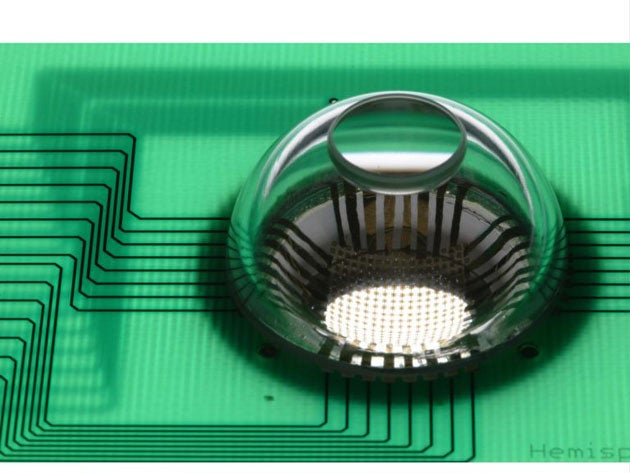
A digital camera closely modelled on the human eye has been invented in what scientists are calling a revolutionary step towards the creation of computerised bionic sensors that can be attached to the body.
The camera's unique technology is its curved light-sensitive surface that was inspired by the human eye's hemispherical retina that collects light at the back of the eyeball and transmits electrical signals to the brain.
Scientists said yesterday that it was the first time anyone has built a curved light-sensitive surface for a digital device of this sort and the breakthrough opens up the possibility of attaching similar sensors to the curved surfaces of the body.
Conventional cameras use flat surfaces to detect light but for them to work properly it is necessary to use complex lenses to ensure that light falling at the edges of the surface is not distorted due to it falling outside the focal plane of the lens.
Professor John Rogers at the University of Illinois in Champaign said that being able to build a light detector on the curved surface of an artificial eyeball provides a much broader field of view, a more uniform illumination and fewer aberrations than a flat digital camera with similar lenses.
"Hemispherical detector arrays are also much better suited for use as retinal implants than flat detectors. The ability to wrap high-quality silicon devices onto complex surfaces and biological tissues adds very interesting and powerful capabilities to electronic and optoelectronic device design, with many new application possibilities," Professor Rogers said.
"This approach allows us to put electronics in places where we couldn't before. We can now, for the first time, move device design beyond the flatland constraints of conventional wafer-based systems," he said.
"We believe some of the most compelling areas of future application involve the intimate, conformal integration of electronics with the human body in ways that are inconceivable using established technology," Professor Rogers said. The light detectors of the device are based on standard sensors for digital cameras but are mounted on a layered material that can be flexed into a curved, hemispherical shape without putting stress on the detectors.
The beauty of the human eye is that it is based on a relatively simple lens that works best with a curved retina. The new camera is equally simple in design given that it is similar in overall size, shape and layout to the human eye, the scientists said.
"The work opens new possibilities for advanced camera design. It also foreshadows artificial retinas for bionic eyes similar in concept to those in the movie The Terminator and other popular science fiction," said a spokesman for the University of Illinois.
For 20 years, scientists have tried to create an array of light detectors that work when built into a curved surface but it has taken until now to achieve that ambition, according to the study published in the journal Nature.
Part of the success of the device was being able to miniaturise photodetectors and elements of the circuits. It meant they were too small to be affected by the distortion resulting from being placed into a hemispherical shape – much like the way buildings are too small to be affected by the curvature of the Earth.
"The advantages of curved, detector-surface imaging have been understood by optics designers for a long time, and by biologists for an even longer time," said Professor Yonggang Huang of Northwestern University in Evanston, Illinois, who collaborated on the project.
"That's how the human eye works, using the curved surface at the back of the eye to capture an image," Professor Huang said.
Join our commenting forum
Join thought-provoking conversations, follow other Independent readers and see their replies
Comments
Bookmark popover
Removed from bookmarks