'Dolly' scientist should be stripped of his knighthood, colleagues tell Queen
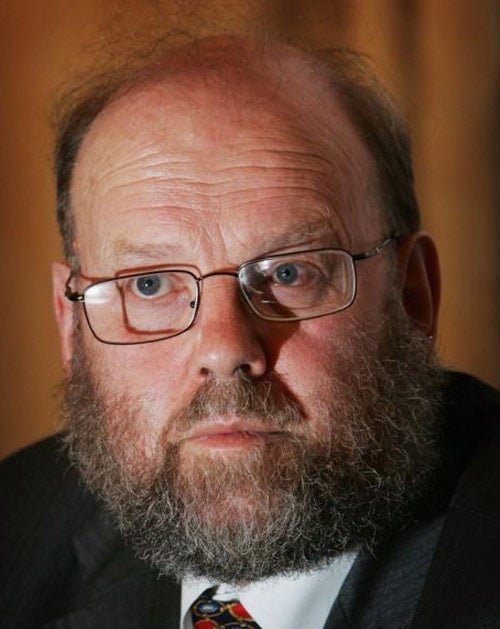
Former employees of the Roslin Institute in Edinburgh, where Dolly the sheep was cloned, have petitioned the Queen to strip the scientist Sir Ian Wilmut of his knighthood on the ground that he played only a minor role in the breakthrough.
Sir Ian, who is now a professor at the University of Edinburgh, was knighted in the New Year's honours for services to science after he became globally recognised as the scientist who in 1996 created Dolly, the first mammal to be cloned from an adult animal.
However, Sir Ian admitted last year that he played a lesser role in the breakthrough than his Roslin colleague Professor Keith Campbell, who has since left the institute to become a research scientist at Nottingham University.
Four former employees of the Roslin, none of whom was directly involved in the Dolly research, have now signed a petition calling on the Queen to withdraw the knighthood from Sir Ian on the grounds that he did not plan, design or carry out the experiment.
"The undersigned believe that Professor Ian Wilmut may have conspired with others to obtain advantage and honour to which he is not entitled should the true facts be known," the petition states.
It is signed by Prim Singh, a molecular biologist; Jeremy Brown, of the Children's Hospital Oakland Research Institute in the US; Pauline Ward, bio-informatician, and Douglas Currie, managing director of a spin-off company Roslin Nutrition. They claim that other scientists support their case but cannot speak out because of the terms of their severance agreement with the Roslin Institute.
Dr Singh, who was sacked from the Roslin, took the institute to an employment tribunal last year claiming unfair dismissal and racist treatment at the hands of Sir Ian. He won his case for unfair dismissal, but lost his claim of racism, which is now the subject of an appeal.
It was at the tribunal hearing that Sir Ian admitted that he had played only a minor role in the Dolly research and that other colleagues should have been given greater credit for the cloning breakthrough.
Asked directly if the statement "I did not create Dolly" was true, Sir Ian replied "yes". He also said that Professor Campbell deserves 66 per cent of the credit for Dolly, although Sir Ian insisted on putting his own name at the beginning of the scientific paper published in the journal Nature in February 1997.
It is also alleged that the two laboratory technicians who performed the painstaking manipulation of the sheep cells and embryos were not given the credit they believe they deserved. Instead of being in the list of authors, Bill Ritchie and Karen Mycock appeared in the list of acknowledgments at the end of the paper.
Dr Singh said that he was baffled as to why Sir Ian was awarded a knighthood given that he had himself admitted that he played only a minor role in the Dolly research and was not directly involved in the manipulation of the sheep cells.
"He has admitted he isn't the brains behind Dolly, and to then go on and award him a knighthood reflects very badly on Scottish science," Dr Singh told the magazine Times Higher Education.
Sir Ian said that he was aware of the petition and that he had also been made aware by the Queen's private secretary that this was not a matter in which she would intervene. "All that I will say is that the terms of the letter published by Dr Singh do not accord with any of the evidence at the employment tribunal and in relation to which a full judgment was issued," Sir Ian said.
"I am further puzzled that the letter appears to be signed by at least one individual who to the best of my belief can have no knowledge whatsoever of the allegations contained therein. I have no further comment to make."
Credit where credit's due?
Invention of the calculus
Isaac Newton and Gottfried Leibniz had bitter disagreements over who first discovered calculus. Newton claimed he started work on the problem in 1666, while Leibniz began his research in 1674, publishing his first study on the subject in 1684. However, Newton believed that Leibniz stole his idea after being shown one of his unpublished manuscripts. The row simmered until 1711, when it broke out in full force with an almighty argument between the pair.
Revealing the structure of DNA
The Nobel Prize was shared by Francis Crick, James Watson and Maurice Wilkins. However, Crick and Watson might not have been able to discover the DNA double helix as quickly as they had without the work of the x-ray crystallographer Rosalind Franklin, who died before the Nobel Prize was awarded. Many believe her contribution has been overlooked, especially by Watson in his popular account of the breakthrough.
Discovery of quasars
A young Cambridge doctoral student, Susan Jocelyn Bell, discovered mysterious pulses of radio energy coming from deep space in the early 1960s. She first thought they were messages from extraterrestrial beings. The pulses subsequently turned out to be star-like objects called quasars, but it was her superiors, Martin Ryle and Anthony Hewish, who were awarded the Nobel Prize for their part in the discovery, and for their more general contribution to astronomy. Many thought this was unfair on Bell.
Finding the Aids virus
Robert Gallo of the US National Cancer Institute claimed to have discovered the Aids virus in 1984 but it subsequently emerged that he had only rediscovered a virus that was first isolated in 1983 by Luc Montagnier of the Pasteur Institute in Paris. Gallo had tried to sideline Montagnier's contribution. A long legal dispute wasfinally settled with bothscientists agreeing to share joint credit for the discovery.
Cloned human embryo
Professor Alison Murdoch at the Newcastle Fertility Centre announced that her team had cloned a human embryo in 2005 at the same time that something similar was announced by scientists in South Korea. However, Miodrag Stojkovic, who worked with Murdoch and had actually done the cloning work, was upset with what he felt was a premature announcement that gave Murdoch undue credit. He subsequently left Newcastle to work in Spain.
Join our commenting forum
Join thought-provoking conversations, follow other Independent readers and see their replies
Comments