Fossil theft: One of our dinosaurs is missing
The illegal trade is increasingly lucrative, with dire results for science
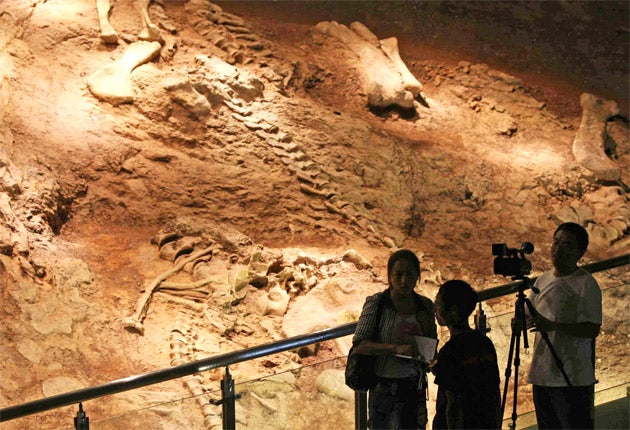
Armed with rock chisels, it took the thief only a few minutes to wipe out 135 million years of history. The fossilised iguanodon footprint was hacked out of the limestone slab where it had lain in a Dorset quarry and spirited away by an illicit collector.
Some 5,000 miles away in southern India, scientists last month issued a plea for villagers and even student palaeontologists to halt the mass looting of hundreds of dinosaur eggs whose petrified embryos could shed new light on the extinction of a species.
Fascination with the ferocious beasts has never been greater, with scientists announcing almost weekly the discovery of new prehistoric species from giant crocodiles to feathered lizards that bear testimony to an evolutionary link with birds. But with a pristine Tyrannosaurus rex specimen fetching up to $8.3m (£5m), there is growing concern that a booming trade in stolen or illicit fossils is wrecking unique sites and seeing previously unknown species disappear into private collections, where they are lost to science.
One of the world's leading palaeontologists told The Independent that fossil rustling had become a "huge international problem" stretching from developed markets like Britain to dinosaur hotspots such as Mongolia and China. The speed and anonymity of the internet has led to a thriving black market linking unscrupulous dealers to private collectors interested in "trophy" fossils for display rather than study. Once a fossil is dug out of the ground without proper recording of information such as its location and depth, at least half its scientific value is lost.
Even a correctly-recorded specimen which ends up in private hands is lost to science because scientific journals do not publish research on specimens which cannot be readily accessed or peer reviewed.
Professor Philip Currie of the University of Alberta, an eminent Canadian scientist who is chairman of the ethics committee of the Society of Vertebrate Palaeontology, said: "This is a huge international problem that affects most of us who do research in the field. I do a lot of work in China and Mongolia, where highly significant fossils, including new species of animals, feathered dinosaurs and birds, are regularly smuggled out illegally and sold at big international fossil shows and over the web. I have seen many quarries [in Mongolia] where, in the quest for illicit profit, specimens have been destroyed by incompetent collectors looking for teeth and claws. The destruction of specimens that survived underground for 75 million years only to be ripped up for a few dollars is heart-rending."
After a spate of thefts in Scotland and northern England seven years ago, when fossil hunters armed with diggers, electric saws and dynamite stole stones worth ten of thousands of pounds, police and wildlife conservation bodies launched a campaign to crack down on illegal collectors.
A voluntary code of conduct for Britain's army of enthusiasts has also been successful in ensuring that specimens are submitted for assessment to museums and conservation groups. But there is evidence that the plundering of Britain's dinosaur-bearing rocks is continuing. Earlier this year, a thief carved the 18in iguanodon footprint out of the Coombefield Quarry on Dorset's Jurassic Coast at Portland.
The discovery of the theft prompted the owner of the site, Portland Gas, to order the removal and secure storage of another 25 slabs containing footprints from various two-legged and four-legged dinosaurs.
More than 30 imprints from a three-toed dinosaur stolen from Bendrick Rock, near Barry in Wales, have been found for sale on eBay and fossil shops on the south coast of England.
Jonathan Larwood, senior palaeontologist with Natural England, said: "The vast majority of collectors out there are law-abiding and will let the appropriate people know if they find something of interest. A lot of fossils are found on our eroding coasts and this type of collecting is really important. It is something we want to encourage. But there have always been unscrupulous collectors who will steal fossils and seek to sell them on, and the internet has provided them with a much more easily accessible market."
In order to shut down illicit dealers, landowners are increasingly resorting to injunctions to restrict the activities of repeat offenders. The Independent understands that the National Trust is currently seeking an injunction against one fossil collector who has repeatedly ignored demands to stop digging at one of Britain's richest fossil sites. The Trust declined to comment on the case, saying that proceedings were still ongoing. But while the trade in illegally recovered fossils from Britain may be limited to a few dozen specimens every year, the problem is on a far greater scale elsewhere. In the village of Senthurai in Tamil Nadu, southern India, scientists had to call in police last month when storms uncovered hundreds of dinosaur eggs that had been concealed by sand 8ft below the ground. As news spread of the discovery, the site was plundered by villagers and students accused of selling on the eggs. Professor K Kumaraswamy, head of geosciences at Bharathidasan University, said: "We are unable to stop the plundering. Each egg or egg cluster may provide a unique insight into the life and extinction of the dinosaur species."
The allure of the open market means that potentially unique or important specimens like the eggs will soon be circulating in a fossil-selling industry worth at least £100m a year. A spate of museum openings in Japan and a booming market in North America in recent years has led to eye-watering prices for so-called "voucher" specimens such as a T. rex skeleton. A private buyer last week paid between $5m and $8m for a T. Rex fossil, which will now be displayed in an unnamed American museum.
The risks of mixing academia with the fossil business were highlighted 10 years ago when an archaeoraptor bought on the open market for an American museum and hailed by National Geographic magazine as proof of the missing link between birds and dinosaurs turned out to be a "composite" – two fossils cleverly fused together to make a convincing fake.
Decades of expertise in fossil cleaning mean that Britain is also profiting from the commercial trade. Consignments of Chinese dinosaur eggs discovered in the 1990s were prepared in the UK, revealing beautifully preserved dinosaur embryos. But, because they have been sold to private collections and question marks remain about whether they were legally exported from China, scientists have not been able to study the specimens.
Paul Barrett, a dinosaur researcher at the Natural History Museum in London, said: "Fossils are a finite resource. In cases where they are recovered illicitly or illegally, and sold on, there is a loss of data to science. I would not like to estimate just how big that loss is."
Bookmark popover
Removed from bookmarks