Galaxies may owe their existence to black holes
Black holes may play a far more important role in the evolution of the universe than scientists had previously realised, according to a study suggesting that these massive and mysterious structures in space could have been key to the formation of the earliest galaxies.
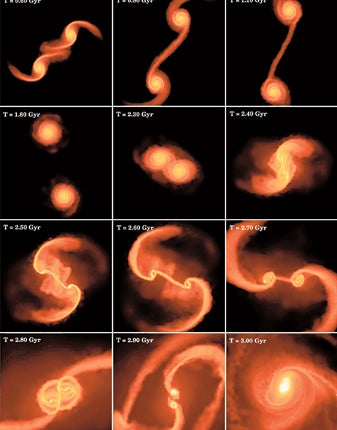
Scientists have used supercomputers to simulate what would have happened in the early universe when two galaxies collided.
They found that the collision quickly forms a "supermassive" black hole with a mass many millions of times greater than that of the sun.
The gravitational fields of supermassive black holes are so great that no cosmic objects, not even light, can escape them if they stray too close.
Until now, it was thought that they played only a secondary role in the formation and evolution of galaxies, but the latest research suggests they are in fact central players.
Cosmologists also previously believed that galaxies formed in a gradual, hierarchical fashion, with clumps of matter coming together to form stronger centres of gravity that would pull in further matter, eventually forming new constellations of stars.
However, the computer simulation suggested that galaxy formation occurs far more rapidly than this gradual process and that it may at least in part be driven by the formation of supermassive black holes, which are believed to exist at the centre of most galaxies, including our own Milky Way.
"The standard idea that a galaxy's properties and the mass of its central black hole are related because the two grow in parallel will have to be revised," said Stelios Kazantzidis of Ohio State University, who was part of the research team whose study is published in the journal Nature.
"In our model, the black hole grows much faster than the galaxy. So it could be that the black hole is not regulated at all by the growth of the galaxy. It could be that the galaxy is regulated by the growth of the black hole," Dr Kazantzidis said.
The universe is estimated to be 13.7 billion years old. The new computer simulations suggest that the first supermassive black holes formed when early galaxies began to collide with one another within the first few billion years after the universe began following the Big Bang.
"Our results add a new milestone to the important realisation of how structure forms in the universe," Dr Kazantzidis said. "Together with these other discoveries, our result shows that big structures, both galaxies and massive black holes, build up quickly in the history of the universe. Amazingly, this is contrary to hierarchical structure formation."
Astronomers believe that the earliest stars in the universe were many times larger than present-day stars, some 300 times the mass of the sun for instance, a feature that had to be built in to the computer simulations.
The computer simulations of the cosmic collisions were also far more detailed than previous simulations – the new ones contained features that were 100 times smaller than earlier studies. Dr Kazantzidis said the work should help the search for the elusive gravity ripples in space, the "gravitational waves" predicted by Albert Einstein's general theory of relativity, but never detected.
Join our commenting forum
Join thought-provoking conversations, follow other Independent readers and see their replies
Comments