Hadron Collider to be closed amid fears of a very big bang
12-month shutdown to repair design flaw that could break apart world's most expensive scientific experiment
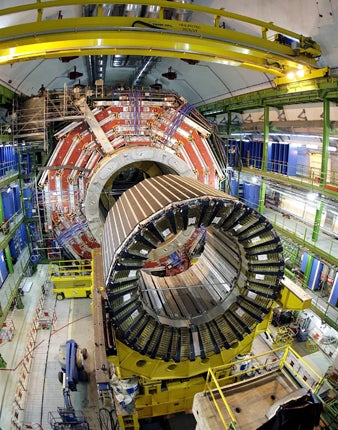
The world's single most complicated and expensive scientific experiment, designed to discover the "God particle" and recreate the conditions that existed at the dawn of creation, will be switched off for a year to correct a design problem that could break it apart if it ran on full power.
Scientists in charge of the Large Hadron Collider (LHC) in Geneva announced yesterday that the machine will only be able to run on half energy before it is temporarily shut down in two years' time. Its full operating capacity designed to probe the frontiers of science will not be achieved until at least 2013 – several years later than planned.
However, the European Centre for Nuclear Research (Cern), which operates the £2.6bn atom-smasher on the Franco-Swiss border, said that the additional costs of correcting the problem in the machine's copper sheaths or "stabilisers" would come out of its existing budget and it would not be asking for any additional funding from contributing countries, including Britain.
On 19 September 2008, the LHC had to be shut down just days after it was switched on for the first time because of an electrical fault that led to helium gas being accidentally released into the machine's underground tunnel. The fault took £25m to fix but Cern's engineers found that further work on the copper stabilisers designed to soak up spare electrical current from the supercooled magnets was needed before the machine could go to full energy.
"I wouldn't call it a design flaw. It is just that some of the copper stabilisers are not up to the quality needed to go to the full energy level," said Steve Myers, director of accelerators and technology at Cern.
As a compromise to the particle physicists eager to begin work on the fundamental forces of nature at the heart of the atomic nucleus, the Cern authorities decided to run the machine on half energy for the next two years in the hope that this would provide enough experimental data for them to begin to make discoveries in esoteric fields such as supersymmetry and dark matter.
However, the revelation that the problems at the LHC are going to delay its full potential for several more years is unlikely to soothe the growing discontent among scientists in other disciplines who feel that "big physics" gets more than its fair share of funding, especially when savage spending cuts are being planned in other areas of science back home.
Even nuclear physicists are beginning to feel envious of the funding given to their colleagues in particle physics. "What we pay to Cern just eats into other projects. There is a feeling that it gets a disproportionate amount of funding," said Jim Al-Khalili, professor of physics at Surrey University. However, Dr Al-Khalili does not want cuts to Britain's contributions to the LHC, just more funding for nuclear physics.
Britain has so far paid about £500m total towards the LHC, which is one of the most ambitious science experiments. Its objective is to collide two beams of subatomic protons circulating in opposite directions at 99.9999991 per cent of the speed of light.
By crashing the beams together at such high energy levels, scientists hope to break apart the sub-atomic constituents of matter and recreate the conditions that occurred less than a billionth of a second after the Big Bang some 13.7bn years ago.
However, the engineering difficulties involved in the experiment are uniquely difficult. The 27km tunnel that houses the atom smasher had to be so precisely aligned that it was no greater than one tenth of a millimetre out and the giant, superconducting magnets that accelerate the proton beams have to be held together with a force that can resist 500 tons per square metre, equivalent to one full-throttle jumbo jet pushing on each square metre.
Dr Myers said that following the emergency shutdown in September 2008, engineers found that the joints holding the copper stabilisers were not strong enough to withstand the full energy levels of the machine, designed to run at a maximum level of 14TeV (14 million million electron Volts). "The joints were not made to a sufficient standard. We learnt how to correct the problem as a result of the 2008 accident," he said.
So instead of running at 14TeV the machine will be run at about half this level, which is still four times higher than the energy of any previous subatomic collider, he said.
Within the next few weeks, each beam of the LHC is scheduled to reach 3.5 TeV and when they collide the resulting energy of 7TeV is expected to be high enough to produce findings that could open new avenues, such as the possible discovery of supersymmetry – subatomic particles thought to be created at the beginning of the Universe but have never been seen.
At these energy levels it might also be possible to find the elusive Higgs boson, or "God particle", which could explain why matter has mass and hence lead to a greater understanding of the force of gravity, which operates over the vast distances of space.
But many particle physicists believe that it will be necessary to go to much higher energy levels to find the Higgs, and make the sort of discoveries that could lead to the fabled "theory of everything", a unified theory to explain and bring together all the disparate forces of nature, from the small-scale nuclear forces within the atomic nucleus to the force of gravity operating at the level of stars and galaxies.
Hadron Collider: In numbers
£2.6bn
The total cost of the LHC project, including the £2.1bn cost of the collider and £575m cost of the detectors
£500m
The total cost of supporting the LHC from the UK, with an annual fee of £95m at current exchange rates
14 million million
The maximum energy, in electron volts, that the LHC is designed to produce during proton collisions
99.9999991
The velocity, in terms of a percentage of the speed of light, of the proton beams in the accelerator
27km
Length of the underground tunnel in which the collider and its detectors are buried
-271.C
The temperature of the supercooled magnets in the LHC, making it colder than anything in the known universe and only just above absolute zero
Join our commenting forum
Join thought-provoking conversations, follow other Independent readers and see their replies
Comments