How dream of reading someone's mind may soon become a reality
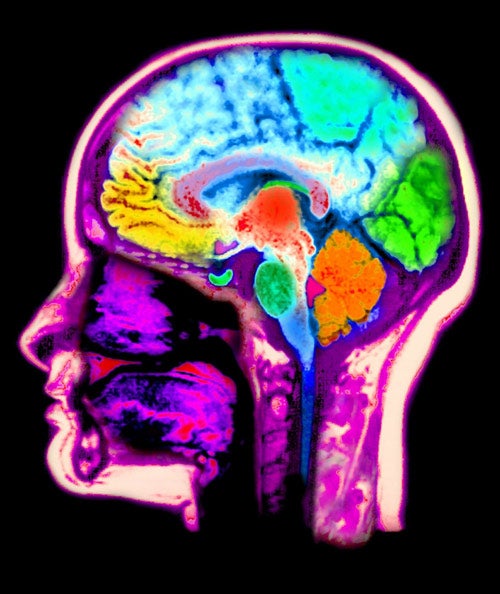
The ability to read someone's mind and even to visualise their dreams has come a step closer with a study showing that it is possible to predict accurately what someone is seeing by analysing their brain activity with a medical scanner.
Scientists have built a computer that can "decode" the brain activity signals from a scanner and match them to photographs of what a person has seen. In the future, they believe the technology will be able to reconstruct scenes being visualised in a person's head – whether real or imaginary.
Tests of the decoder show that it can predict which photograph someone is looking at with an accuracy of up to 90 per cent, although the success rate falls as the total number of photographs being assessed increases.
The scientists believe that it might be possible in the near future to adopt the same approach in making a device that can read someone's thoughts, although they warn against doing this surreptitiously or against someone's will.
"It is possible that decoding brain activity could have serious ethical and privacy implications downstream in, say, the 30 to 50-year time frame. It is something I do care about," said Professor Jack Gallant of the University of California, Berkeley, who led the study published in the journal Nature.
The decoder works by analysing the patterns of activity within the visual centre of the brain, detected by a functional magnetic resonance imaging (fMRI) machine as a person looks at a set of randomly-arranged photographs, one at a time. The decoder then attempts to predict which photograph someone is looking at – from brain activity patterns alone – when the same person is presented with a completely different set of images.
"The image identification problem is analogous to the classic magician's trick, 'pick a card, any card'. In this trick, the magician fans a deck of cards and asks you to pick a card, look at it, and then place it back in the deck. The magician's job is to figure out which card you saw," said Professor Gallant.
"Imagine that we begin with a large set of photographs chosen at random. You secretly select just one of these and look at it while we measure your brain activity. Given the set of possible photographs and the measurements of your brain activity, the decoder attempts to identify which specific photograph you saw," he said.
When volunteers in the study were given a set of 120 photographs, the decoder managed the correct prediction 90 per cent of the time. As the set was expanded to 1,000 images, the prediction rate fell to about 80 per cent.
The scientists estimated that even with a set of one billion images – roughly the number of pictures indexed by the internet search engine Google – the decoder would be able to make the correct prediction of what someone saw about 20 per cent of the time.
"In other words, if a person undergoing an fMRI brain scan were to select and view an image at random from the internet, our data suggests that we would be able to use brain activity measurements to identify the precise image that the person saw about once out of every five times," said Professor Gallant.
The scientists emphasised that at present the decoder can only match pictures seen by a person rather than reconstruct images visualised in a person's head. At this point they can only identify which image was seen when the image was drawn from a known set – reconstruction is currently an unsolved problem, said Professor Gallant.
"However, our data suggests that there might potentially be enough information in brain activity signals measured using fMRI to do this in the future... In fact, so much information is available in these signals that one day it may even be possible to reconstruct the visual contents of dreams or visual imagery," he said.
Join our commenting forum
Join thought-provoking conversations, follow other Independent readers and see their replies
Comments
Bookmark popover
Removed from bookmarks