Science

8° London Hi 11°C / Lo 7°C

How global warming shrank St Kilda's sheep

Darwinism turned on its head as milder winters allow smaller lambs to survive
By Steve Connor, Science Editor

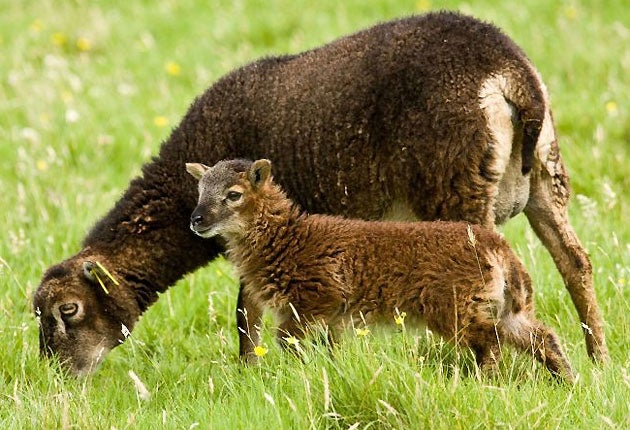
This photograph provided by the journal Science shows Soay Sheep on St Kilda Archipelago near Scotland

AP Photo/Science, A. Ozgul

This photograph provided by the journal Science shows Soay Sheep on St Kilda Archipelago near Scotland

It was the curious case of the shrinking sheep. For nearly a quarter of a century the wild Soay sheep on the windswept Scottish island of Hirta have been getting smaller when evolution should have made them bigger.

It was a conundrum that had mystified the scientists who began studying the flock back in the mid-1980s, but now they believe they have come up with a convincing explanation: it all comes down to climate change.

A succession of milder winters and earlier springs have allowed smaller lambs to survive the harsh Hirta winters, with the result that the average body size of the typical Soay ewe has shrunk by about 5 per cent over the past 24 years.

Scientists believe that the findings might begin to explain the subtle interactions between ecological pressures that act on a species' body size over short periods, and the longer-term evolutionary pressures that can lead to the sort of extreme "island dwarfism" seen in fossils of extinct animals trapped on islands, such as pygmy hippos and dwarf elephants.

"Our findings have solved a paradox that has tormented biologists for years – why predictions did not match observation," said Professor Tim Coulson, of Imperial College London, who led the study, published in the journal Science, with colleagues Josephine Pemberton and Tim Clutton-Brock.

The Soay sheep fatten up on the lush grass during summer, in the hope that this will take them through the long winter when food is in short supply. Evolutionary theory suggested that the bigger sheep with the most fat would be the most likely members of the flock to survive until the following spring.

"According to classic evolutionary theory, they should have been getting bigger, because larger sheep tend to be more likely to survive and reproduce than smaller ones, and offspring tend to resemble their parents," said Professor Coulson.

But the scientists found that over the course of their observations, which dated back to the 1980s, the average size of female sheep has been getting smaller, largely because smaller lambs that in the past would not have made it through the bitter winter months were beginning to survive until the following spring.

They found that a typical ewe was getting smaller each year by between 80g and 100g, and that lambs were not growing as quickly as before. Previously, the larger lambs that put on weight the fastest during their first summer were the most likely to survive until the following spring. "Climate change has moved spring a little bit earlier and as spring came earlier, fewer sheep were dying," said Professor Coulson. "This decline in the growth rate has also led to an increase in the population size of the Soay flock."

Another contribution to the remarkable case was what the scientists called the "young-mum effect". They found that ewes pregnant for the first time were physically incapable of giving birth to large lambs, which means that there is a constant flow of small lambs being born.

This runs counter to the evolutionary pressure for larger lambs and the scientists are still unsure about the reasons for the persistence of the young-mum effect, although it forms an important part of the explanation for smaller sheep.

As to what will happen in future years, Professor Coulson is more reticent. "It's a little bit early to predict that we'll be having Chihuahuas running around herding pygmy sheep in say a hundred years from now," he said.

Island wildlife: From giants rats to pygmy hippos

When animals and plants get trapped on an island, weird things begin to happen. They sometimes evolve over many thousands of years into smaller versions. Sometimes they get bigger – such as the giant extinct rats of Indonesia that grew to the size of a small dog, or the tall dandelion trees of Madeira.

On the Galapagos Islands, Charles Darwin was amazed by the sight of giant tortoises. With an absence of predators, the long-living reptiles could evolve into forms larger than their mainland ancestors.

Fossils of pygmy mammoths have been found on Wrangel Island off northern Siberia. They had become trapped on the island for many centuries before dying out, and may have been the last mammoths on Earth.

Similar fossils of dwarf elephants have been found on Malta, as well as the remains of pygmy hippos in Madagascar. It is believed that such large animals evolved into dwarf forms in response to the limited food resources that could support such large herbivores on an island.

Post a Comment

View all comments that have been posted about this article.

Offensive or abusive comments will be removed and your IP logged and may be used to prevent further submission. In submitting a comment to the site, you agree to be bound by the Independent Minds Terms of Service.

Comments

How is this Darwinism on its head?
[info]northiebabes wrote:
Friday, 3 July 2009 at 08:16 am (UTC)
Erm.. surely this is evolution in action? The fact that we're sometimes not sure why a particular characeristic may be helpful to a species doesn't mean Darwinism has to be 'turned on its head' it just means that we're not as smart as we thought we were. Further evidence for the latter proposition will doubtless be provided if this article provokes a significant number of comments.
What a load of sheep dip
[info]colin_brown wrote:
Friday, 3 July 2009 at 08:42 am (UTC)
Here we go again
[info]andrewjp wrote:
Friday, 3 July 2009 at 08:51 am (UTC)
another one for the list - http://www.numberwatch.co.uk/warmlist.htm

[info]john_levett wrote:
Friday, 3 July 2009 at 09:17 am (UTC)
Another attempt to embed climate change as a concern in the public consciousness. But it doesn't really work does it because the sheep appear to adapting to their environment without recourse to cap and trade or the inanities of carbon capture. And in the unlikely event of Al Gore's promised sea rises, my guess is that the sheep will just go up the hill a bit...

On the strength of this, I wonder whether sheep deserve their reputation for herd stupidity. The followers of the Goracle have a much bigger claim on that particular epithet.
[info]turk_diddler wrote:
Friday, 3 July 2009 at 11:13 am (UTC)
Unfortunately 7 billion people so far seem likely less able to adapt than 200 goats.
[info]john_levett wrote:
Monday, 6 July 2009 at 02:15 pm (UTC)
And your evidence for such a statement is...?

Millions of people are moving around the globe all the time, often to environments that are distinctly hotter, colder, higher or lower than those to which they are accustomed. They adapt remarkably quickly don't they? And for their descendants, that new environment becomes the status quo..
[info]turk_diddler wrote:
Monday, 6 July 2009 at 02:23 pm (UTC)
You are speaking of individuals, I am speaking of societies. If climate change continues as it is expected to, we are talking potentially massive challenges for sustainable living in many areas of the world not wealthy enough to afford lawn sprinklers.
[info]john_levett wrote:
Monday, 6 July 2009 at 03:33 pm (UTC)
But you referred to 7bn people, not societies.
Man is adapting les well.
[info]richardjeff wrote:
Friday, 3 July 2009 at 09:50 am (UTC)
Darwinism turned on its head. What a silly line. Darwinism in action is the real case. Adaption to change and stresses is about. Too rapid a change then the stress becomes unbearable and evolution cannot adapt fast enough and local or general extinction is the result. The two other adaption mechanism, culture learning and individual innovation act more rapidly but are limited to a smaller number of species, though a lot more than just mankind. In fact I suspect that that, given what I see at much out there, man is losing his ability to learn and innovate....we're losing out intelligence gene!!!
Same thing happens to humans - they dont evolve
[info]corporeal4now wrote:
Friday, 3 July 2009 at 11:42 am (UTC)

When food is in short supply, the human population gets shorter. Then when food supply is restores, then the subsequent generations get taller.
But in between these long term phases, the humans dont turn into another species.
There is sufficient complexity in the programming within the genes to adapt to circumstances.
Am I missing something?
[info]kodak321 wrote:
Friday, 3 July 2009 at 01:19 pm (UTC)
I do not understand the 'surprising' results of this article. If conditions become 'more' temperate, weaker lambs survive and these are likely to evolve into smaller sheep. As the article states, the sheep population has increased and this is due to weaker members surviving milder winters. Am I missing something?....why is this surprising?....surely it's a case of survival of the weakest due to milder weather....hence smaller sheep....and why does this apparently conflict with Darwinian Theory?

On the subject!
[info]kodak321 wrote:
Friday, 3 July 2009 at 01:47 pm (UTC)
...and the Global warming tag (I thought it was Climate change these days!) is completely ridiculous. There have always been periods (long and short), of warming and cooling, before and after the Industrial Revolution.

PS, Telegraph journalists often reply to comments.....Steve Connor.... I think this is a shoddy piece of journalism...would you care to reply?

Most popular