How the IVF revolution nearly didn't happen
Three decades after the first test-tube baby, report shows how pioneering doctors struggled for funding
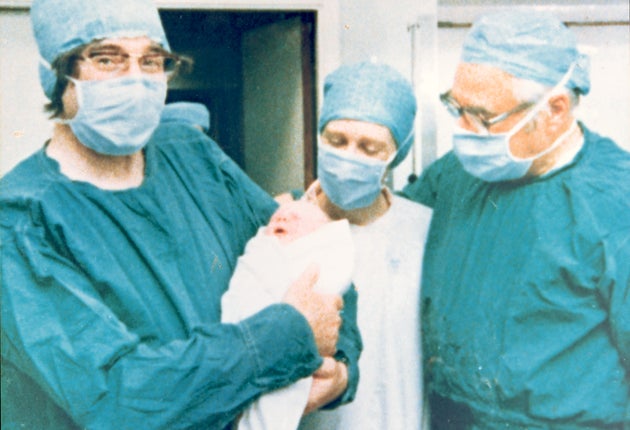
It remains one of the biggest medical breakthroughs of the past 50 years. The birth, 32 years ago today, of Louise Brown – the world's first test tube baby – pushed back the boundaries in fertility treatment and paved the way for an estimated 4.3 million babies to be born using new fertility techniques. Yet previously unseen documents today reveal that the groundbreaking research almost didn't go ahead.
A major review published in the medical journal Human Reproduction today reveals that research by the two pioneering doctors who created Louise – Robert Edwards and Patrick Steptoe – was repeatedly hampered by the medical establishment.
In 1971, the Medical Research Council refused to fund their studies, putting their entire research programme in jeopardy. The doctors were only able to continue their work at Cambridge University thanks to a large private donation from America. Without it, Louise Brown may have never been born.
Last night Martin Johnson, professor of reproductive sciences at Cambridge University, who led the review, said: "Clearly this was one of the landmark grant-applications of our time. When Edwards and Steptoe failed to secure long-term funding from the MRC, it almost jeopardised their research into IVF.
"There were many occasions where the doctors were on the verge of giving up and only continued because of the extraordinary letters of support they received from childless couples who encouraged them to continue against the odds.
"However, our review has revealed their failed application for long-term financial support was not simply due to widespread establishment hostility to IVF. It failed, we argue, for more complex reasons."
The three-year review, funded by the Wellcome Trust, studied MRC archives and documents from the Royal College of Obstetricians and Gynaecologists, Addenbrooke's Hospital and Cambridge University Library.
It reveals that Edwards and Steptoe's application for £3.3m funding (today's prices) over a five-year period was refused by the MRC because:
* The doctors were not considered to be part of the medical establishment. Steptoe was a gynaecologist from Oldham and Edwards was not a medical doctor but a physiologist.
* The pair refused an earlier invitation by the MRC to join a new Clinical Research Centre at Northwick Park Hospital, in Harrow, north London. This meant they had to compete for funding with all the other research projects bidding for MRC support.
* Most of the MRC referees who were consulted on the proposal believed it was more important to focus on limiting fertility through contraception than to treat infertility. Treating infertility was seen as experimental research, rather than something that could help childless couples.
* There were serious concerns about patient safety and whether children born using the technique would develop severe abnormalities.
* The doctors talked about their work in the media, antagonising the MRC.
Professor Johnson said: "The MRC's negative decision on the funding of IVF, and their public defence of this decision, set the MRC policy on IVF research funding for the next eight years." Only in the late 1970s did they announce a change of policy to support IVF research.
Professor Johnson believes the case raises wider questions about which areas of medical research should receive funding. While there is no doubt that the awarding of grants is now more open and transparent, biases still operate, he said. "A continuing problem is that there are some very fashionable topics that can create a buzz and attract huge research interest and funding, sometimes in disproportionate amounts. Then, it was fertility limitation; more recently, genome sequencing would be an example."
Patrick Steptoe died in 1988, and Louise Brown was said to be deeply affected by his death. She has also described Edwards as being "like a granddad to me". After Steptoe's death, Edwards continued as a scientist and editor of noted medical journals. Now 84, he has five daughters of his own. He is understood to be in a nursing home.
Although the Browns knew that the procedure was experimental, they had not been told that Louise would be the first baby to be born via IVF. However, they underwent another course of IVF three years later and gave birth to Natalie, the 40th test tube baby born in the UK. Natalie would go on to be the first test tube baby to have a healthy child of her own, when she became pregnant at the age of 17.
Louise is now married, and the couple have a three-year-old son, who was conceived naturally. They have shunned publicity and live quietly.
Join our commenting forum
Join thought-provoking conversations, follow other Independent readers and see their replies
Comments