Impact Earth: Could we divert a giant asteroid?
A century ago this week, an asteroid fireball exploded over Siberia with the power of 185 Hiroshima bombs. Steve Connor asks how we can prevent a similar catastrophe in a major world city
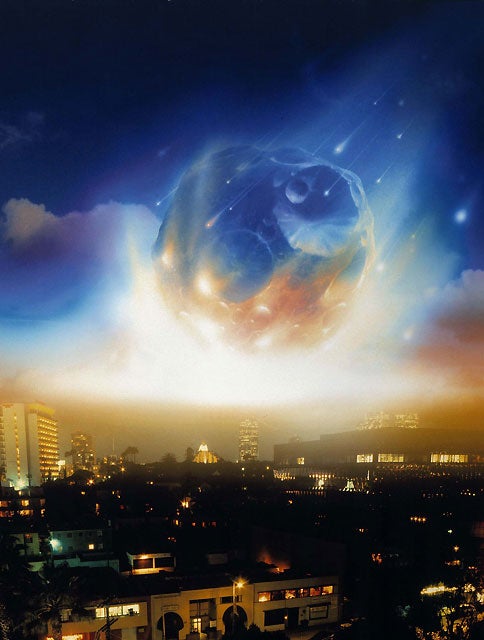
A hundred years ago this week a man was sitting in the wooden porch of a trading post in the village of Vanavara in deepest Siberia when a blinding flash of light, followed by a huge blast of sound threw him to the ground. Several years later, he recounted the terrifying moment to an inquisitive Russian scientist from St Petersburg who was on an expedition to find out what had caused such a massive explosion in one of the remotest regions on Earth.
The man's story turned out to be the first confirmed, eye-witness account of the extraordinary explosion caused when a large object from space explodes violently in the air above the ground after striking the Earth's atmosphere. "Suddenly, in the north sky... the sky was split in two, and high above the forest the whole northern part of the sky appeared covered with fire," the man told the scientist. "There was a bang in the sky and a mighty crash... The crash was followed by a noise like stones falling from the sky, or of guns firing. The earth trembled," he said.
The heat from the blast was so intense the man thought that his shirt was on fire. The light from the explosion, and sunlight subsequently reflected in the atmospheric dust, could be seen for miles around. People as far away as London said that the night sky was so unusually bright that it was possible to read a newspaper in their gardens at midnight. The blast felled some 80 million trees over an area of 800 square miles.
If the asteroid had collided just a few hours later, or had come in on a slightly different trajectory, it could easily have exploded over Paris, London, New York or Moscow, with devastating consequences. Scientists calculate that if something of similar size exploded over London today, little within the M25 would remain standing. It would be as if a large thermonuclear bomb equivalent to 20 million tons of high explosives had been set off in the heart of the city.
What happened at about 7am on 30 June 1908, near the Podkamennaya Tunguska River in Siberia is now legendary among scientists studying near-Earth objects – asteroids and comets with orbits around the Sun that can bring them perilously close to our own planet. The Tunguska Impact is a stark reminder that, within living memory, a large enough object from space has hit the Earth on a latitude that could kill millions of people.
"If you want to start a conversation with anyone in the asteroid business, all you have to say is 'Tunguska'," says Don Yeomans, manager of the Near-Earth Object Office at Nasa's Jet Propulsion Laboratory in Pasadena, California. "It is the only entry of a larger meteoroid we have in the modern era with first-hand accounts."
Although the impact happened in 1908, it was not until 1921 that Leonid Kulik, the chief curator of meteorites at St Petersburg Museum, led the first expedition to find out what happened, and possibly discover the crater it had left behind. He failed on that occasion because of the harsh conditions – swampy, mosquito-infested forests in summer and penetrating cold and ice in winter. In 1927, Kulik made another attempt and managed to reach the blast area to witness the devastation. He tried to get the deeply suspicious locals – reindeer herders called the Evenki – to tell him what they remember of that fateful morning 19 years earlier. They were reluctant, but he did manage to speak to the man at Vanavara, about 40 miles away from the blast's epicentre.
"At first, the locals were reluctant to tell Kulik about the event. They believed the blast was a visitation by the god Ogdy, who had cursed the area by smashing trees and killing animals. Those trees acted as markers, pointing directly away from the blast's epicentre. Later, when the team arrived at ground zero, they found the trees there standing upright – but their limbs and bark had been stripped away. They looked like a forest of telephone poles," says Dr Yeomans.
Kulik failed to find the impact crater, or any sign of the meteoroid itself. But the radial pattern of the felled timber, and in particular the central stand of trees stripped of branches, hinted at something else – that the blast wave had come from directly overhead and radiated out. In other words, instead of smashing into the ground, the object had disintegrated high overhead. Such an air burst causes the branches of trees directly below to be stripped off, leaving the trunks standing – as they did at Hiroshima.
The absence of a crater and of meteoroid fragments has led to wild speculation about what may have caused the explosion – from mini black holes to space aliens. A more sensible suggestion, however, is that it was not a space object, but an explosion caused by the sudden release of huge quantities of methane or some other kind of explosive gas from deep below the ground. But Dr Yeomans, along with most other experts, dismisses this "earth-belch" idea as implausible.
"A century later, some still debate the cause and come up with different scenarios that could have caused the explosion. But the generally agreed-upon theory is that on the morning of 30 June 1908, a large space rock about 120 feet across entered the atmosphere of Siberia and then detonated in the sky," Dr Yeomans says.
Such a rock would have been travelling at about 33,500mph as it plunged into the upper atmosphere. Friction with air molecules would have raised the temperature of the surrounding air to something like 25,000C. At about 28,000 feet, the pressure and heat would have cause the rock to explode into a fireball, releasing energy equivalent to about 185 Hiroshima bombs, according to Dr Yeomans. "That is why there is no impact crater. The great majority of the asteroid was consumed in the explosion."
Not all scientists agree with the details of this scenario. Giuseppe Longo of Bologna University and colleagues believe they have located a potential crater, a large water-filled depression known as Lake Cheko, where the meteoroid hit and was buried under permafrost. They intend to dig for what remains of the space object to prove their case. However, others point out that Lake Cheko lacks the attributes of a crater – such as raised edges – and is probably nothing more than one of the region's many oxbow lakes, formed from a river bend that collects slow-running water that then sinks into the permafrost below.
The really big question about Tunguska is how likely it is that something similar or worse will happen again? Asteroid experts have calculated that something the size of the object that hit Tunguska would strike the Earth at an average rate of one every 300 years. This does not mean that we can expect one in 200 years' time, only that, over a long period, they happen with a typical frequency of one every 300 years. It could happen tomorrow, or in several hundred years' time.
But as bad as a Tunguska would be over a heavily populated area, there are far more frightening scenarios. A larger object that hits the ground or ocean would cause more devastation by flinging debris into the air, or causing a tsunami. These sorts of objects are estimated to hit the Earth with a frequency of greater than once in every 1,000 years.
But their impact would be dwarfed by even bigger objects between 1km and 10km wide. These have struck the Earth in the past with devastating consequences. One such object is believed to have hit the Earth 65 million years ago, throwing up so much debris that it created a "nuclear winter" that cut out sunlight for several seasons, causing the famous mass extinction that led to the demise of the dinosaurs.
Dr Yeomans is part of a band of scientists lobbying for more research to investigate the orbits of the near-Earth objects that could pose a threat.With enough warning of an asteroid heading our way, it may be possible to deflect it if it appears to be on a collision course. Such surveys are under way. "We're identifying problems and hope to be able to do something about it," says Dr Yeomans.
Nasa hopes to identify and track 90 per cent of all hazardous objects greater than 450 feet in diameter by the end of 2020. Scientists say that if ever a large object is discovered on a collision course with Earth, it might be possible to send up a nuclear-tipped rocket to blast it off course. A safer way would be to nudge it aside with smaller impacts, or even a "space sail" that uses the solar wind.
One of the lessons from Tunguska is that, although we are vulnerable to the threat, it is not something that should turn us to despair – such massive impacts are rare. As Dr Yeomans says: "I think about Tunguska all the time from a scientific point of view, but the thought of another Tunguska does not keep me up at night."
What are asteroids?
* Asteroids are chunks of rock or space debris left over from the birth of the solar system. The biggest is known as Ceres, which is 567 miles wide. Comets are "dirty snowballs" composed of ice and dust – they are less likely to hit the Earth than asteroids.
* 1Asteroid 2007 TU24 passed within 334,000 miles of Earth on 29 January 2008. At 800 feet wide, it was big enough to have caused global devastation if it had hit us.
* 1Asteroids larger than 160 feet wide are big enough to survive the journey through the Earth's atmosphere and hit the ground, causing further devastation as they throw debris into the air.
* 1Britain and the US are taking the issue seriously. The US Government has a near-Earth object survey Act and the UK has its own task force on potentially hazardous near-Earth objects.
Join our commenting forum
Join thought-provoking conversations, follow other Independent readers and see their replies
Comments
Bookmark popover
Removed from bookmarks