Microbes found miles beneath Greenland ice given new life
Discovery raises hopes of lifeforms enduring harsh conditions on other planets
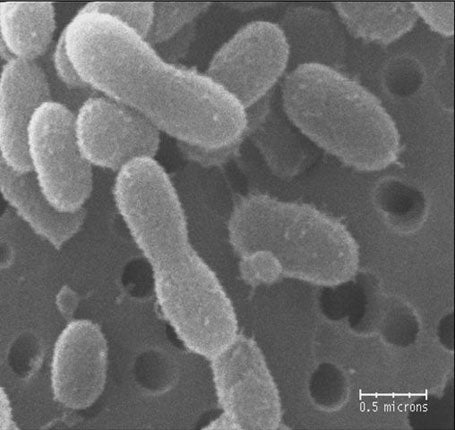
Tiny microbes that have been buried below nearly two miles of ice for at least 120,000 years have been revived in the laboratory, in a study that raises the prospect that similar life forms could have survived on other planets.
Scientists have found at least two species of miniature bacteria, many times smaller than normal microbes, in an ice core bored deep beneath the surface of a Greenland glacier where they have been trapped for tens of thousands of years.
The researchers managed to isolate and grow the bacteria in the laboratory, where they have established thriving colonies of small, purple-brown microbes that are so small that they can pass straight through conventional medical filters used for sterilisation.
The microbes' ability to survive the harsh environment of a Greenland glacier for such a long period of time suggests that extraterrestrial life forms – if they exist – could survive in equally extreme environments on Mars or Europa, the ice-covered moon of Jupiter where extraterrestrial life is thought to be possible.
"These extremely cold environments are the best analogues of possible extraterrestrial habitats," said Jennifer Loveland-Curtze of Pennsylvania State University, who led the study.
"The exceptionally low temperatures can preserve cells and nucleic acids [DNA] for even millions of years," said Professor Loveland-Curtze, whose study is published today in the International Journal of Systematic and Evolutionary Microbiology.
The ultra-small size of both bacteria – which are up to 50 times smaller than the E. coli bacteria found in the human gut – may have helped them to survive in the small liquid veins between ice crystals, she said.
"They were trapped in the ice for at least 120,000 years and possibly much longer. We're not sure how much metabolism was going on during this time but there was probably some activity in the cells to preserve their DNA," Professor Loveland-Curtze said.
"They may have divided perhaps once every 100 years or 1,000 years. We don't know. A lot of organisms are out there in environments that we consider harsh and extreme."
The study has so far revived two kinds of bacteria, which have been formally named as Herminiimonas glaciei and Chryseobacterium greenlandensis. H. glaciei is about half the size of C. greenlandensis and can pass through the ultra-fine filters used to sterilise chemical solutions – although it is not harmful, Professor Loveland-Curtze said. Both bacteria were recovered from ice cores drilled from a depth of 3,042 metres (10,000 ft) below the surface of the glacier. The ice at this depth is at least 120,000 years old but it could be up to several million years old, Professor Loveland-Curtze said.
"Studying these bacteria can provide insights into how cells can survive, and even grow, under extremely harsh conditions, such as temperatures down to minus 56C, little oxygen, low nutrients, high pressure and limited space," she said.
Similar bacteria have now been recovered from a range of extreme environments on Earth, including ice cores drilled deep beneath the surface of the Antarctic ice sheet. In 2000, scientists claimed to have revived bacterial spores that had been trapped in salt crystals 2,000ft below ground.
Join our commenting forum
Join thought-provoking conversations, follow other Independent readers and see their replies
Comments