Mystery of giant light spiral in Arctic solved
Spectacle that baffled astronomers turns out to be failed missile launch
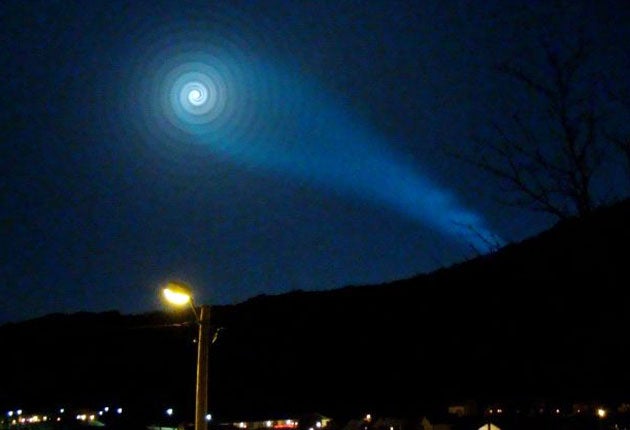
When the people of Tromso in Norway's northern reaches awoke to the sight of a giant blue and white spiral of light hanging in the still dark sky above them, they were understandably shocked. It didn't look like the northern lights. Was it a meteor? A UFO?
Calls flooded in to radio stations and air-traffic control towers. Astronomers were baffled. Extra-terrestrial enthusiasts got on their blogs. "It looked like a rocket that spun around and around and then went diagonally across the heavens," said Totto Eriksen, who saw the display while driving his daughter to school. And when an explanation finally came, he wasn't far wrong. It turned out to be a failed Russian nuclear-capable missile test launch.
The new Bulava missile was fired from the submarine Dmitry Danskoi, the Russian defence ministry confirmed. The White Sea, close to Norway's Arctic region, is Russia's standard missile-testing site. This one failed at the third stage.
Eyewitnesses described a blue light that seemed to soar up from behind a mountain in the north of the country. Others said it in stopped mid-air, then began to move in circles. Within seconds a giant spiral had covered the entire sky. Then a green-blue beam of light shot out from its centre, lasting for 10 to 12 minutes before disappearing.
The missile is a key part of Russia's plan to rebuild its ageing weapons arsenal. But it has been beset by problems which have caused increasing embarrassment. Yesterday was the seventh time in at least 12 test launches that the missile has failed. The previous failure, on 16 July, forced the resignation of Yury Solomonov, director of Moscow's Institute of Thermal Technology, which is responsible for developing the missile.
"The first two stages of the rocket worked but in the final and third stage there was a technical failure," the defence ministry admitted yesterday.
The Bulava can carry up to 10 individually targeted nuclear warheads and has a maximum range of 8,000km (5,000 miles). It is the sea-based version of the Topol-M, Russia's land-based intercontinental missile, which entered service in 2006. New Borei submarines were developed primarily to launch it. If the missile does not work the vessels will be virtually useless.
Pavel Felgenhauer, a leading Russian defence analyst, said the latest failure was a major embarrassment for the military, and was a serious blow to Russia's attempts to maintain a credible nuclear deterrent. He said: "By the year 2030, Russia could lose its position as a global nuclear power if the problems are not solved. And it could be that these missiles will never fly properly."
Mr Felgenhauer added that the spectacular lights over northern Norway were typical of a missile failure. "Such lights and clouds appear from time to time when a missile fails in the upper layers of the atmosphere and have been reported before," he said. "At least this failed test made some nice fireworks for the Norwegians."
Join our commenting forum
Join thought-provoking conversations, follow other Independent readers and see their replies
Comments
Bookmark popover
Removed from bookmarks