Next foot and mouth outbreak will not require mass cull
In 2001 10 million farm animals, including 700,000 cattle, were slaughtered at a cost of about £8bn
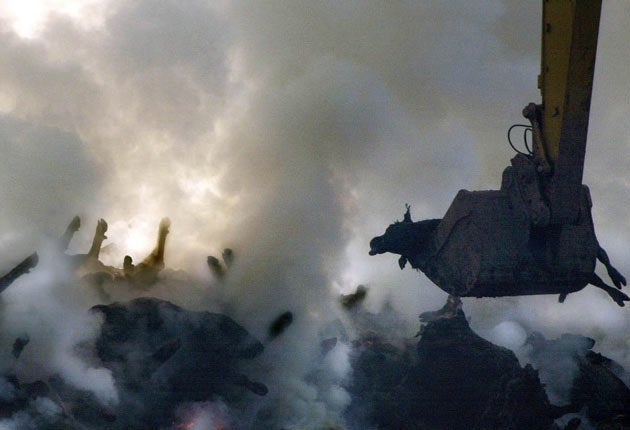
The mass culling of cattle to control outbreaks of foot and mouth disease may soon be a thing of the past, according to scientists who have made a breakthrough in understanding how the virus is transmitted.
A study has established a hidden "window of opportunity" between the point when a cow becomes infected with the foot and mouth virus and the time when she is able to transmit the virus to another animal.
Scientists said that this discovery, combined with the realisation that cattle are only infectious for about a two-day period, means it should be possible to identify infected animals and eliminate them from a herd before they can pass on the infection.
If tests for detecting the virus can be made that are cheap enough and fast enough to be used by farmers in the field, epidemics could be controlled without having to cull huge numbers of uninfected cattle, as happens now.
"We now know that there is a window where, if affected cattle are detected and removed from the herd promptly, there may be no need for pre-emptive culling in the immediate area of an infected farm. We have an opportunity now to develop new tests which can detect infected animals earlier and reduce the spread of the disease," said Professor Mark Woolhouse of Edinburgh University.
In the devastating 2001 epidemic, 10 million farm animals, including 700,000 cattle, were slaughtered and burnt at a total cost to the UK economy of about £8bn. Yet relatively few of these animals were infected with the virus; most were cattle and sheep living on farms next to affected farms.
The study, published in the journal Science, was conducted by researchers at the Pirbright Laboratory in Woking, Surrey, part of the Institute for Animal Health. They examined a smaller, localised outbreak of foot and mouth in 2007 on a nearby farm to study how the virus is transmitted.
The team also performed experiments in which an uninfected cow was placed for eight hours next to an animal that had been deliberated infected with the virus. Tissue samples were used to monitor how the transmission developed. Testing for viral genes showed when the uninfected animal became infected, and when the deliberately infected animal was able to transmit the virus. The team found that cows with foot and mouth virus only become infectious about half a day after showing the first clinical symptoms of the disease and remain infectious only for 1.7 days – less than half what had been thought.
Professor Woolhouse said: "There is a short window of opportunity, a day or two, when we can tell when a cow is infected with foot and mouth virus but it is not infectious to other cows." Previously it was thought that cows were infectious from the time they their infection was detected, he said.
Join our commenting forum
Join thought-provoking conversations, follow other Independent readers and see their replies
Comments
Bookmark popover
Removed from bookmarks