Official: just 20 moves needed to solve a Rubik's Cube
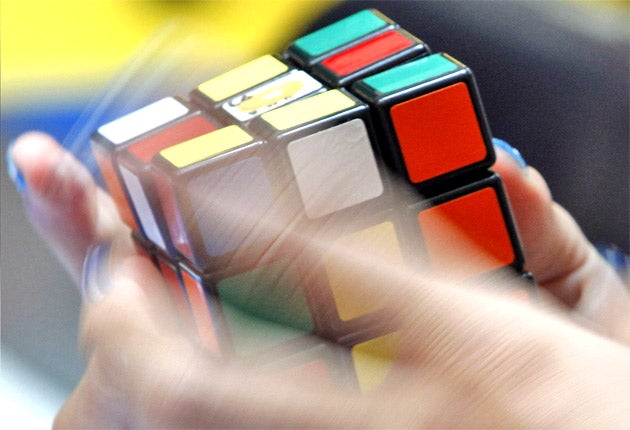
To be precise: there are 43,252,003,274,489,856,000 different possible configurations of the coloured squares on any Rubik's Cube. Yet now researchers have calculated that you're never more than 20 moves away from solving the famous puzzle.
That might seem startling to anyone who has owned one of the classic toys for decades without being able to solve it just once – or has even resorted to peeling off the stickers and placing them back on in the correct pattern to pretend to their friends they have cracked it.
But using one of Google's supercomputers, an international team of square-eyed enthusiasts in California have confirmed that the puzzle need not take any time at all, no matter what its starting position. In fact, only 300 million arrangements – a small fraction of the total number – require a full 20 moves, with the majority of solutions taking between 15 and 19. It had already been thought that 20 was the maximum number of moves needed, after a previous estimate of 18 was disproved upon the 1995 discovery of a configuration that needed two more.
Announcing definitively that 20 was the "magic number", Professor Morley Davidson, a mathematician from Ohio's Kent State University, said: "We were secretly hoping in our tests that there would be one that required 21."
Despite Google's state-of-the-art technology, Professor Davidson said it would have been "completely hopeless" to try testing all of the combinations individually, and so the team studied duplicate and symmetrical patterns to reduce the number that required analysing.
They began by splitting the configurations into 2.2 billion groups of 20 billion positions, which they were eventually able to whittle down to the 56 million groups of 20 billion combinations they analysed. Even then, their calculations would have taken a good desktop PC 35 years to work its way through them, but with Google's equipment it took just a few weeks.
More than 400 million Rubik's Cubes have been sold since it was invented in 1974 by the Hungarian architect Erno Rubik, and Professor Davidson told the BBC his devotion to the project was because the puzzle had inspired his whole career.
"It's come full circle for me," he said. "Rubik's Cube was an icon of the Eighties when I was growing up and was the reason I went into mathematics. It's the universal popularity of the puzzle – it's probably the most popular puzzle in human history."
Professor Davidson carried out the work with John Dethridge, an engineer at Google, Herbert Kociemba, a maths teacher and Tomas Rokicki, a computer programmer from California. With the preliminary results now available online, the quartet are submitting their evidence to peer-reviewed journals for final confirmation among the mathematical community. Beyond that, they are considering looking at the Cube's other mathematical mysteries or working on the four-layered version.
Join our commenting forum
Join thought-provoking conversations, follow other Independent readers and see their replies
Comments
Bookmark popover
Removed from bookmarks