One of the great inventions that never was – until now?
Campaign for Babbage's 'Analytical Engine' to be built – 173 years after it was devised
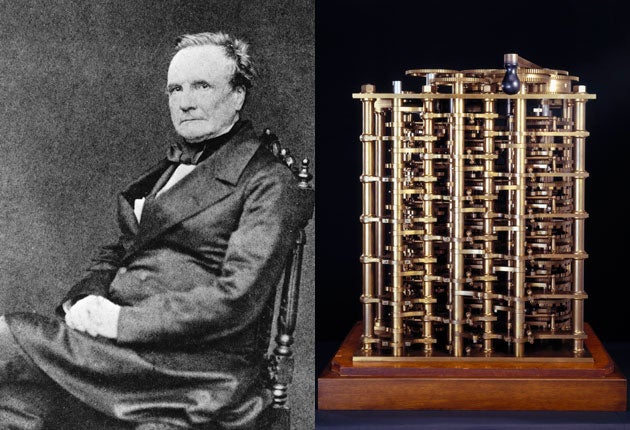
It may seem an anachronism in the era of the ever-shrinking digital gadget, but Charles Babbage's locomotive-size "Analytical Engine" remains one of the greatest inventions that never was.
Babbage's brainchild, first conceived in 1837, never wound into life. But now John Graham-Cumming, an influential programmer and science blogger, is leading a quest to build the Analytical Engine in all its 19th-century glory. He plans to use detailed blueprints which Babbage laid down in a series of notebooks held in the archives of London's Science Museum.
To be powered by steam and built in brass and iron, the giant machine would have towered over its inventor, now known as the father of computing. Years of soaring costs, and personal bust-ups with his political paymasters, meant it was never built. Yet it was so advanced that it could have propelled Victorian Britain into the computer age a century ahead of time.
The drawings held in the Science Museum reveal the ungainly machine as the forerunner of the modern electronic computer. It contained a central processing unit, which Babbage called a "mill", and 1.7 kilobytes of expandable memory, which he referred to as "the store". It was fully programmable via punched cards used to input data.
"The big difference between it and machines which came 100 years later was that the programme was stored externally, in punch cards," explained Mr Graham-Cumming. "It is basically a giant number-crunching machine – which is effectively what modern computers are today, it's just that those numbers appear to us as words or images on a screen."
Mr Graham-Cumming last year secured from the government a posthumous pardon for Alan Turing, the genius code-breaker and computer pioneer who took his own life in 1954 after falling foul of Britain's repressive anti-homosexuality laws. Now he believes it is time for Babbage's contribution to the development of British science to be fully honoured.
"It is an inspiration. This is what blue-sky research is all about, and it can have fantastic benefits for people's lives. Just think of the impact of the computer, and ask yourself how different the Victorian world would have been with Babbage engines at its disposal. He was 100 years ahead of his time, and this is especially important when the Government is thinking hard about how it funds scientific research," he said.
It is estimated that to build a working prototype of the Analytical Engine would cost more than £400,000. (It would be a follow-up to the "Difference Engine", which Babbage had similarly planned to build and which was reconstructed at the Science Museum in 1991.) But first, detailed research is needed.
It is hoped that the end product could inspire youngsters to study computing, thus fostering a new generation of inventors. One of the reasons, apart from cost, that Babbage's creations were never built in his lifetime, argues Mr Graham-Cumming, was his irascible personality.
Born into a wealthy banking family, he began working on logarithms and calculating machines in the 1820s, at a time when navigation was crucial to the fortunes of the British Empire. Sailors and traders were seeking ever more accurate maps, requiring complex astronomical calculations.
Babbage could see almost unlimited applications for his research, but convincing the political classes, in including figures such as the Duke of Wellington and Sir Robert Peel, to continue funding it was another matter.
Babbage was a great socialite, throwing glamorous parties at his home in London's Marylebone, but he could also be rude and eccentric. He once launched a campaign to ban organ grinders from city streets on the grounds that their noise prevented people from thinking.
His contribution was largely overlooked by his peers and the establishment, though The Royal Astronomical Society awarded him a Gold Medal for his work on star charts. He twice stood unsuccessfully for Parliament, and invented a "cow-catcher", to remove obstacles from the paths of trains.
Join our commenting forum
Join thought-provoking conversations, follow other Independent readers and see their replies
Comments
Bookmark popover
Removed from bookmarks