Polythene's story: The accidental birth of plastic bags
We can thank a chance discovery by a German scientist for the carriers that have become the scourge of modern life. Rob Sharp reports on an anniversary the world won't be celebrating

Sign up for a full digest of all the best opinions of the week in our Voices Dispatches email
Sign up to our free weekly Voices newsletter
It was at the end of the 19th century when a German scientist, Hans von Pechmann, discovered a waxy residue at the bottom of his test tube. He had little idea of the material's significance; he was not to know that the substance was an early form of what we now use to bottle our shampoo, cocoon our sandwiches and wrap our wires. He had, completely by accident, made polythene, one of the world's most widely used and controversial materials.
The product Von Pechmann made that day in 1899 was virtually identical to the modern chemical and a pair of his colleagues – Eugen Bamberger and Friedrich Tschirner – called it polymethylene. But unlike polythene, which is versatile enough to make hardy and filmic plastics, this waxy resin was not useful in practical terms; and so little was made of it.
Like future volumes of plastic, the Von Pechmann experiment was duly buried. It was not for another 34 years that the people who are officially credited with inventing polythene chanced upon it. But tomorrow, on the 75th anniversary of this discovery, there will be no ticker-tape parades for any inventor of the woebegone plastic. Due to the recent push to eradicate plastic bags, people are more likely to want to forget the occasion.
"Polythene seemed a great boon, not least to the food industry, when it was first invented. But it is now increasingly being seen as a mixed blessing. It has helped improve food hygiene at the cost of environmental degradation. It is a classic example of a short-term fix now unravelling," said Professor Tim Lang, a commissioner for natural resources and land use at the Sustainable Development Commission, of polythene's discovery.
Polythene's innovation – in the form that we now know it – in fact occurred in 1933. It was the work of ICI's Eric Fawcett and Reginald Gibson, who, after waking up one morning and deciding to experiment with gases under high pressure, spotted that part of their apparatus looked like it had been dipped in paraffin wax. Gibson's simple notes, made at the time at the company's base in Northwich, Cheshire, belied their importance: "Waxy solid found in reaction tube."
Two years later ICI developed the means for making polythene on an industrial scale, and shortly afterwards it was used for the first round-the-world telephone cable. During the Second World War, it won near-heroic-status as a vital radar component. It was not until the rise of the British supermarket in the 1950s that it really came into mass use. These stores' indulgences have since been freely criticised. The substance is made from crude oil through a process known as "cracking", and the resultant product essentially comes in two forms: "hard" and "soft", the former being used to bind our pipes and contain our fuel in tanks, the latter to shrink-wrap our sausages and insulate our television cables. In Britain we get through a combined 1.6 million tonnes of both types every year. The results create mountains of landfill.
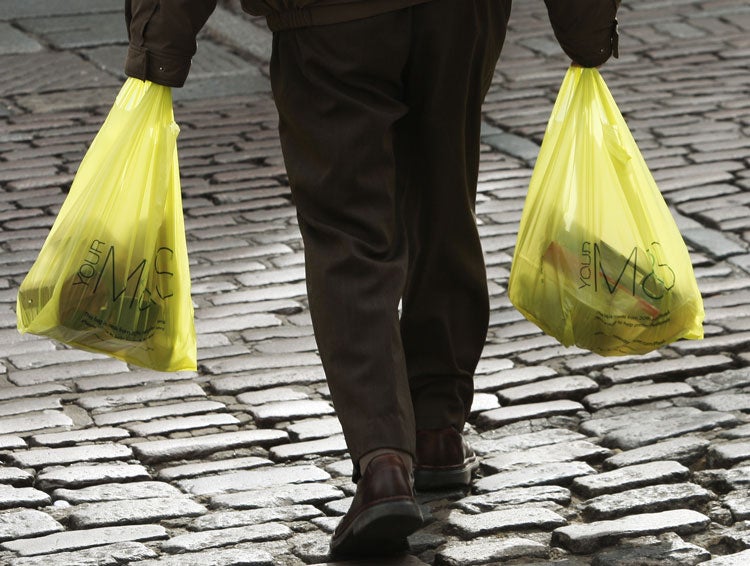
This environmental problem is epitomised by outrage surrounding the disposal of the plastic bag. In an average 12 months, 13 billion of them are dished out to consumers. They are generally employed for a mere 20 minutes before being discarded, and take a gargantuan 1,000 years to rot to nothing.
Recent reports have highlighted plastic bags as pollutants which maim birds, and annihilate vast numbers of seals, turtles and whales. Now, the national consciousness appears to be shifting away from the use of polythene packaging to more reusable alternatives. Diane Gaston, the National Consumer Council's spokeswoman, said: "I think there needs to be much more done on the plastic bag front. And in more general terms when stores overuse packaging it drives me mad. The use of polythene is so ingrained in people's lives. But we need to consider how damaging it all is to the environment."
But trade industry bodies are unwilling to let polythene's birthday pass without a fight. Philip Law, a director at the British Plastics Federation, said of the discovery: "It is being seriously misinterpreted. Recent campaigns have taken a very emotional stance on drawing attention to the causes of plastic damage in the sea and possible effects on wildlife. But we need to verify what is being reported. Is it true that wildlife is being impaired on a large scale? And you've got to look at the environmental benefits of polythene.
"If you're going to have a bag, you're much better having a polyethylene bag than any other material because of the amount of energy that goes into their manufacture; which is minimal. And they can be recycled. It's not the fault of the product that things are dumped in large quantities at sea."
But the memory of what was started by Von Pechmann more than 100 years ago is unlikely to fade for at least another millennium – in the form of your average plastic bag, of course.
By numbers
60 million
Tonnes of polythene produced worldwide every year
13 billion
Polythene bags handed out to shoppers in Britain every year
£424.1m
Turnover in 2007 of British Polythene Industries plc
400
Number of plastic bags used per adult in the UK every year
1 million
Number of plastic bags used worldwide every minute
5p
Price Marks & Spencer charges per plastic bag
70,000
Plastic waste, in tonnes, annually recycled by British Polythene Industries plc
Subscribe to Independent Premium to bookmark this article
Want to bookmark your favourite articles and stories to read or reference later? Start your Independent Premium subscription today.
Join our commenting forum
Join thought-provoking conversations, follow other Independent readers and see their replies