Scientists fear kilograms don't weigh as much as they used to
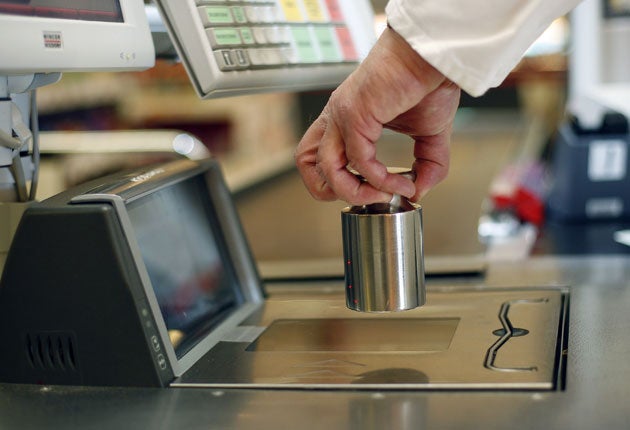
When is a kilogram not a kilogram? When it starts to weigh less. It came into existence more than two centuries ago and has become the standard unit of weight around the world, from the shopping malls of Europe to the souks of the Middle East, but scientists believe that the reign of the kilo as we know it is about to come to an end.
A group of experts meeting in London today want to redefine the kilogram so that it is no longer based on the mass of a solid cylinder of platinum-iridium alloy that sits beneath three layers of protective glass sealed in a locked vault in Sèvres, France.
This metal block, known as the International Prototype Kilogram, has been used since it was first registered with the International Bureau of Weights and Measures (BIPM) in 1889 as the definitive unit of mass against which all other kilograms are measured.
In the past 122 years, it has been brought out of storage just three times to calibrate the national prototype kilograms used by countries around the world. However, scientists now believe it is time to redefine the kilogram because there is evidence that the precise mass of the international prototype in Sèvres is not as constant as it should be.
"We think it is losing weight, and we don't know why," says the BIPM's Michael Stock, who is due to attend the meeting at the Royal Society in London that will look again at the kilogram. "From the three times we have had it out to make calibrations, we have had indications that it is not perfectly stable. It seems to have lost about 50 micrograms and there is no real explanation."
The loss of mass, amounting to fifty-millionths of a gram, is equivalent to a small grain of sand, but for metrologists, who make a religion out of measuring things with extreme accuracy, the change represents a disturbing disparity from the expected.
Cleaning, polishing or touching the international prototype is strictly controlled as they can all alter its weight. One theory for the loss of mass is that over the years, the platinum-iridium alloy may have emitted some of the gas that had been incorporated into the metal block when it was made in London in 1879, Dr Stock said.
"There are no real problems now but if it continues, then we may run into problems in 10 or 20 years' time because measurements are getting even more precise. We need to anticipate the problems and, from time to time, we have to improve our definitions of the standard units of measurement – if you need to make an accurate measure of length, you need a good ruler," he said.
The kilogram is one of the seven "base units" on which all other units of measurement in science are derived. The other six are the metre, second, ampere, kelvin, mole and candela, measuring, respectively, length, time, electric current, temperature, chemical amount and light intensity.
What makes the kilogram different is that it is the only international standard unit of measurement that is based on a physical object rather than a fundamental physical constant.
The metre, for instance, is no longer defined as the distance between two scratches on a metal bar, but on the distance travelled by light in a vacuum in 1/299792458 of a second, whereas the second is the duration of 9,192,631,770 cycles of radiation emitted by a particular electronic transition in an atom of caesium-133.
Getting the unit of the kilogram right is important for other units of measurement, such as the volt and the ampere, which are used to measure electric potential and current. Physicists believe that redefining the kilogram based on something that is as immutable as a physical constant, rather than relying on a physical object, could improve the precision of electrical measurements fifty-fold.
The favoured option to be discussed at the Royal Society is for the kilogram to be based on the Planck constant, which represents the sizes of the quanta in quantum physics, and is as reliable as the speed of light in a vacuum.
"Our experiments are moving forward; however, it is too early to implement the new definition of the kilogram just yet," Dr Stock said.
In practice, the kilogram would be based on the electric power needed to counter perfectly a kilogram pulled by the Earth's gravity by levitating it in mid-air. The idea, called a watt balance, was first proposed by British metrologist Bryan Kibble in the 1970s when he worked for the National Physical Laboratory in Teddington, London.
Length and time: the history of measurement
The metre
In 1781, the French Academy of Sciences defined the metre as one ten-millionth of the length of the Earth's meridian along a quadrant, or the distance from the Equator to the North Pole. The academy organised an expedition to measure the distance from Montjuic in Barcelona to Dunkirk, considered to be half the length of the meridian. A miscalculation meant that this metre fell a fifth of a millimetre short of a true metre. In 1983, scientists adopted the latest definition of a metre based on the speed of light. The metre today is defined as the length travelled by light in a vacuum during the time interval of 1/299,792,458 of a second.
The second
The origins of the 12-hour day and night can be traced to the ancient Egyptians. This gives us a starting point for the origin of dividing the hours of the day up into a series of one-sixtieths – an invention of the ancient Babylonians in about 300BC – and hence the invention of the second.
The first clocks to depict seconds appeared in the latter part of the 16th century and a modern definition appeared in 1956 based on the movement of the Earth around the Sun. The latest definition is based on the duration of 9,192,631,770 cycles of radiation emitted by a particular electronic transition in an atom of caesium-133. Scientists want to refine this still further by basing the definition on the optical transition of atoms, which is at even higher frequencies than electronic transitions, and even more precise.
Join our commenting forum
Join thought-provoking conversations, follow other Independent readers and see their replies
Comments