Scientists hail breakthrough images of star
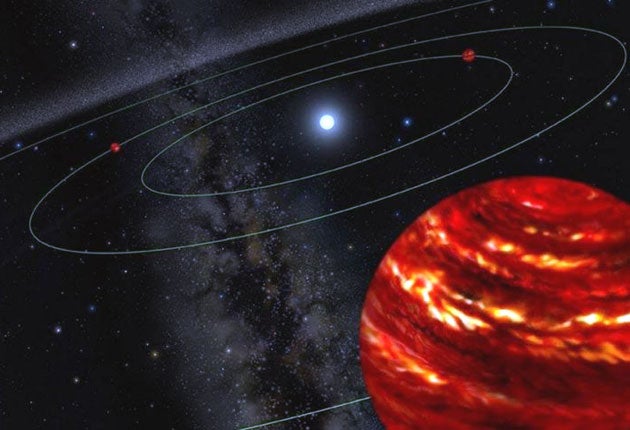
Astronomers have taken direct images of a three-planet solar system around a distant star, using a revolutionary technique that may one day lead to the discovery of an Earth-like planet that can harbour life.
All three planets are orbiting a star known as HR 8799, which is 130 light years from Earth and is just visible to the eye in the constellation of Pegasus. A team of British and American astronomers detected the planets using the Gemini North and Keck Observatory telescopes on Hawaii.
The planets are larger than Jupiter, the biggest planet in our solar system, and orbit too close to their sun to support life. The images confirm that there are other solar systems in the Milky Way galaxy.
Astronomers took the images of the planets in the infrared part of the electromagnetic spectrum using a technique called adaptive optics to eliminate the interference and turbulence that the Earth's atmosphere causes.
"Until now, when astronomers discover new planets around a star, all we see are wiggly lines on a graph of the star's velocity or brightness. Now we have an actual picture showing the planets themselves, and that makes things very interesting," said Bruce Macintosh, a team member from the Lawrence Livermore National Laboratories in California. Astronomers were hoping to eventually take images and measurements of Earth-like planets.
"After all these years, it's amazing to have a picture showing not one but three planets. The discovery of the HR 8799 system is a crucial step on the road to the ultimate detection of another Earth," he said.
Astronomers have detected about 200 "exoplanets" orbiting distant stars, but they are normally discovered by measuring the dip in luminosity of the star as a planet passes in front of it.
The planets, which formed about 60 million years ago, are still young enough to glow from the heat that was released as they contracted after their initial formation. The brightness and colours that the scientists analysed indicate that the planets are between seven and 10 times the mass of Jupiter.
The star HR 8799 has about 1.5 times the mass of our Sun, is five times more luminous, and is younger. Infrared observations by satellites have shown evidence of a massive disk of cold dust orbiting the star, according to Professor Ben Zuckerman, from the University of California at Los Angeles.
"HR 8799's dust disk stands out as one of the most massive in orbit around any star within 300 light years of Earth," Professor Zuckerman said.
The study is published in the journal Science alongside another study that has added another exoplanet to the list of planets found outside our solar system. A separate team detected the planet orbiting the star Formalhaut.
Join our commenting forum
Join thought-provoking conversations, follow other Independent readers and see their replies
Comments