Scientists read the minds of the living dead
Brain scanner enables man presumed to be in vegetative state to communicate with outside world
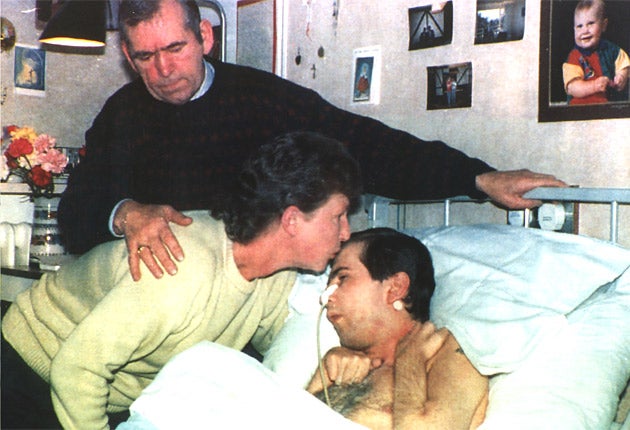
Scientists have succeeded in reading the mind of a man thought to have been lacking all awareness after a traumatic head injury, opening a host of questions about what it is to be a sentient person and how we should treat people in his condition.
The 29-year-old, who had been presumed to be in a vegetative state for five years following a road accident, was able to communicate with the researchers by thought alone, giving "yes" and "no" answers to questions. Using an advanced brain scanner, researchers were able to detect that he was thinking, and interact with him, even though it proved impossible to establish any communication at the bedside. It was the first time since his injury in 2003 that he had managed to make contact with the outside world.
The discovery by an Anglo-Belgian team led by Adrian Owen of the Medical Research Council's Cognition and Brain Sciences Unit at the University of Cambridge was praised by other scientists yesterday. Nicholas Schiff, associate professor of neurology at Weill Cornell College, New York, said the findings had "extremely broad implications" for the assessment of patients in the twilight zone between consciousness and unconsciousness. Once the biological basis of the results was explained it would "have a profound impact across medicine," he said.
Chris Frith, emeritus professor of neuropsychology at University College London, said: "It is difficult to imagine a worse experience than to be a functioning mind trapped in a body over which you have absolutely no control. We now have the distinct possibility that in the future we will be able to detect cases of other patients who are conscious and be able to communicate with them."
The man, who has not been identified, was hit by a vehicle and had been physically unresponsive since being admitted to hospital following the 2003 accident. He later emerged from a coma, his eyes were open, and he followed the normal sleep/wake cycle, but showed no awareness of his surroundings and did not respond to any visual, auditory, tactile or noxious stimuli. He was therefore presumed to be in a vegetative state with no intellectual activity. There are several thousand such patients at any one time in the UK.
Despite his lack of responsiveness, researchers decided to test whether he had any awareness by giving him instructions and monitoring his brain activity as part of a larger study of 55 patients in a similar condition, 23 of whom had been defined as in a vegetative state.
Using a scanning technique called functional Magnetic Resonance Imaging (fMRI), developed by Dr Owen and his team, they asked the man to imagine two scenarios: playing a game of tennis and walking through a house or place that was familiar to him. They mapped his brain activity in response to both instructions and compared them with the responses from healthy controls. The results showed that he had carried out their requests.
Then they posed a set of six test questions, such as "Is your father's name Alexander?" and asked him to respond by imagining playing tennis if the answer was yes or walking through his home to indicate a no. He answered "yes" correctly. He was then asked if his father's name was Thomas and again answered correctly with a "no".
Dr Owen said: "We were astonished when we saw the results of the patient's scan and that he was able to correctly answer the questions that were asked by simply changing his thoughts. Not only did these scans tell us that this patient was not in a vegetative state but, more importantly, for the first time in five years it provided the patient with a way of communicating his thoughts."
Steven Laureys, co-author of the study from the University of Liège, where the man was treated, said: "So far these scans have proven to be the only viable method for this patient to communicate in any way since his accident ... In the future we hope to develop this technique to allow some patients to express their feelings and thoughts, control their environment and increase their quality of life."
Four other patients also showed evidence of awareness measured by brain activity, indicating they were aware of what was going on but totally "locked in" and unable to communicate. However, none responded to questions solely by modifying their thought processes in the same way.
The findings are published in the New England Journal of Medicine (NEJM). The discovery means doctors may in future be able to ask patients who cannot move or speak but are aware whether they are in pain and need more medication. Ultimately, the technique might be developed to allow them to control their environment, express their thoughts and increase their quality of life. Drs Owen and Laureys are working on cheaper and more portable alternatives to fMRI based on EEG (electroencephalogram) recordings.
An accompanying editorial in the NEJM says the "imaginative" study has "revealed a form of preserved cognition in ostensibly unconscious patients" which will in future make it "difficult for physicians to tell families confidently that their unresponsive loved ones are not 'in there somewhere'."
But it adds that it would be premature to conclude that the responses given by the man indicate the presence of a fully functioning mind. "Cortical activation does not provide evidence of an internal 'stream of thought', memory, self-awareness, reflection, synthesis of experience, symbolic representations or – just as important – anxiety, despair or awareness of one's predicament. Without judging the quality of any person's inner life, we cannot be certain whether we are interacting with a sentient, much less a competent, person."
Citing the 17th-century philosopher Descartes' precept "Cogito, ergo sum" (I think therefore I am), it says it would be a mistake to conclude from the experiment that the presence of brain activation has existential implications.
Dr Owen disputed this conservative interpretation. "We don't have any evidence that this guy's inner life is any different from yours or mine. He is probably perfectly consciously aware but totally locked in. I think we will find this in other patients."
Vegetative state: Prisoners in their own bodies
* Tony Bland suffered severe brain damage when he and hundreds of other football supporters were crushed at Hillsborough Stadium in Sheffield on 15 April 1989. Ninety-six fans died. Bland survived for four years in a persistent vegetative state, despite the wishes of his doctor and his parents that he be allowed to die. His case became a cause célèbre, until a court ruled in March 1993 that his nutrition and hydration could be withdrawn. He died nine days later, aged 22.
* Terri Schiavo entered a vegetative state in 1990, probably as a result of a rigid diet that led to a potassium deficiency causing irreversible brain damage. She was in this state for the last 15 years of her life, the subject of a legal battle between her husband, who wanted her to be allowed to die, and her parents, who said there was hope of a recovery. The case was heard in the Florida courts more than 20 times before her feeding tube was removed in 2005. She died two weeks later, aged 41.
* Rom Houben, 46, was trapped in his body, unable to communicate, for 23 years following a car accident in 1983 and was presumed to be in a vegetative state. Three years ago, Steven Laureys, a neurologist at the University of Liège and one of the authors of today's study, used a brain scanner to show that his brain was still functioning. Now Houben is reported to communicate with one finger and a touchscreen on his wheelchair.
Join our commenting forum
Join thought-provoking conversations, follow other Independent readers and see their replies
Comments
Bookmark popover
Removed from bookmarks