Silver found on Moon – and you thought it was made of cheese
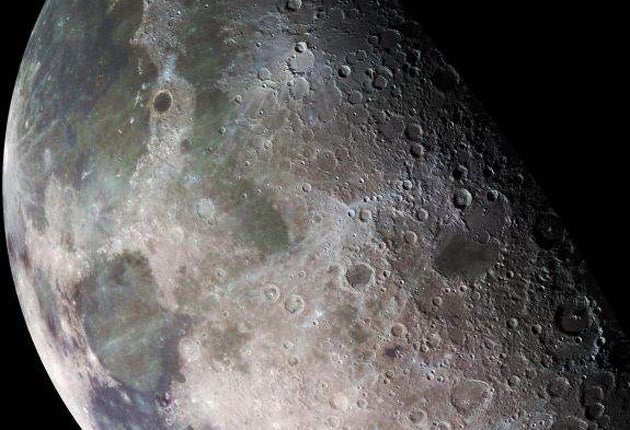
An ambitious attempt to discover the contents of a lunar crater by crash landing a spent rocket has revealed a "treasure chest" of elements on the Moon.
Nasa last night said that its mission last year to fire a rocket into the dark shadows of the Cabeus crater near the lunar South Pole produced a plume of debris containing an astonishing array of volatile substances, including silver and enough water to fill a paddling pool.
An analysis of the chemical constituents of the plume, published in the journal Science, shows that 155kg (342lbs) of water ice were blown out of the crater when the Lunar Crater Observation and Sensing Satellite (LCROSS) hurled its spent rocket section into centre of Cabeus, which is in permanent shadow.
Nasa scientists said that the deliberate crash landing into the lunar crater had revealed that the make-up of the Moon's soil and subsurface is more complex than they had previously believed. The soil also contains carbon monoxide, carbon dioxide, sodium, mercury and trace amounts of silver.
"This place looks like it's a treasure chest of elements, of compounds that have been released all over the Moon, and they've been put in this bucket in the permanent shadows," said Peter Schultz of Brown University, Rhode Island, one of the scientific investigators on the LCROSS mission.
It is believed that many of these compounds have been deposited on the lunar surface by comets and meteorites which have crashed into the Moon over many millions of years. The permanent shade of the lunar craters at the poles has prevented these substances from evaporating back into space, Professor Schultz said.
"There's a balance between delivery and removal. This suggests the delivery is winning. We're collecting material, not simply getting rid of it," he added.
The researchers estimated that about 6 per cent of the crater's contents could be water ice left behind by passing comets. If other craters at the lunar polar also contained similar amounts of water then there could be enough of this vital substance to sustain a permanently manned lunar base.
Until last year, many lunar scientists had thought that there would only be trace amounts of water on the lunar surface, but the LCROSS mission demonstrated for the first time that there were significantly bigger quantities that could prove useful for future manned missions to the Moon.
It appears that many of the chemical elements and compounds deposited on the Moon by passing comets, asteroids and meteorites eventually migrate to the polar regions, where the deeper, shaded craters provide permanent protection against the burning heat of the Sun, the scientists said.
Nasa estimates that there are 12,500sq km of permanently shaded terrain on the Moon and if the top one metre of this area were to hold just 1 per cent by mass of water, this would still produce thousands of litres of water.
Apollo astronauts collected evidence showing that there were trace amounts of silver and gold on the side of the Moon that always faces the Earth.
The LCROSS mission produced an impact hole between 70 and 100ft wide and tossed up lunar soil from 6ft below the surface to a height of half a mile, high enough for it to be illuminated by sunlight so that spectroscopic instruments on board another spacecraft could analyse its constituent materials.
Mission facts
70-100 The diameter, in feet, of the crater left when the Nasa rocket hit the surface of the moon.
6 The depth, in feet, of the lunar material thrown up by the impact.
800 The height, in metres, of the plume of debris that rose from the crash site.
4 The number of minutes after the collision in which the scientists were able to study the ejecta.
2 The weight, in tons, of the material dislodged by the rocket.
Join our commenting forum
Join thought-provoking conversations, follow other Independent readers and see their replies
Comments
Bookmark popover
Removed from bookmarks