So what the heck is a hadron?
Who is behind today's experiment?
This is probably the biggest international collaboration outside of the United Nations. It has involved something like 10,000 scientists and engineers from 500 research institutes in 80 countries. The building of the Large Hadron Collider (LHC) has been co-ordinated by the European Organisation for Nuclear Research (Cern) in Geneva, which carries out studies into particle physics on behalf of the 20 nations that fund it. Cern has already built several particle colliders, or "atom smashers", which have produced fundamental discoveries in physics leading to several Nobel prizes.
How safe is it?
The risks of anything going disastrously wrong are so small as to be insignificant. Reports referring to the "infinitesimally small" risk of the LHC creating a giant black hole have been universally ridiculed by the experts involved in the project – and many more who are not involved.
Why is it happening this week?
Today, at about 8.30am British time, scientists will attempt to introduce a beam of protons – the nuclei of hydrogen atoms – into the 27km circular tunnel that forms the backbone of the LHC experiment. The aim ultimately is to get two proton beams circulating at 99.9999991 per cent of the speed of light, but in opposite directions, so that they can both collide into each other.
However, all that will be attempted today will be to get one beam into the tunnel to complete one full circuit. The switch on, therefore, is largely symbolic. Within the next few days, though, the second beam will be put into the machine, but scientists are not expecting any collisions between the beams for several more weeks. It could be some time before the beams are powered up to the very high energy levels needed for meaningful collisions to take place.
What are they hoping to discover?
Many things. Essentially they are trying to find out what else matter is made of – the sub-atomic particles that have yet to be found – and how it is all stuck together. Ultimately, there is the hope of unifying all the fundamental forces of nature into a single "theory of everything" that can explain everything from the strong, short-acting forces holding an atomic nucleus together to the relatively weak, long-range forces acting between planets and galaxies – otherwise known as gravity. One early discovery may be to find the Higgs boson, a fundamental particle that has never been detected.
What's a Higgs particle?
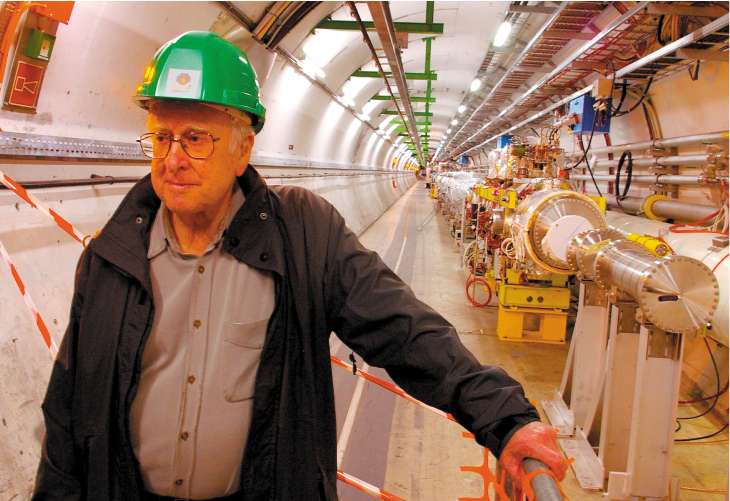
These sub-atomic particles were first proposed by Professor Peter Higgs of the University of Edinburgh in the 1960s. In theory, they could explain why gravity behaves in the way it does – by exerting an effect on matter. The so-called "Higgs field" is filled with these particles and when matter passes through this field they experience mass. So if the LHC discovered Higgs particles, it would go a long way to explaining the force of gravity.
Why does the LHC have to be 27KM long?
It needn't be 27km long. This was the tunnel that was already there at Cern from a previous particle collider known as the LEP (Large Electron-Positron Collider). Because scientists decided to "recycle" the tunnel, they were stuck with a length of 27km. The important thing was to have a tunnel long enough for the protons to be accelerated to high-enough energy levels, and big enough to house the large machines that make up the four experiments that form the LHC. For that, engineers had to cut out huge underground caverns to contain the four experiments.
How much has it all cost?
The ballpark figure is £5bn (Sfr10bn). It has come mostly from international subscriptions to Cern, with the UK's Science and Technology Facilities Council paying about £500m over the decade or so that it took to build the LHC. CERN's 20 member states have contributed the bulk of the cost, with the remainder coming from collaborating institutes around the world.
What's a hadron?
Hadrons are types of sub-atomic particle. Protons are hadrons.
What is dark matter?
This is the 95 per cent of the Universe that cannot be seen by conventional scientific instruments. We know it's there from the gravitational influence it exerts, but we don't really know what it's made of. However, the LHC could discover sub-atomic particles that might explain dark matter. One hot contender is super-symmetry particles that are mirror images of the particles we know about, but which have never been detected.
Join our commenting forum
Join thought-provoking conversations, follow other Independent readers and see their replies
Comments
Bookmark popover
Removed from bookmarks