Stem cells could be the secret reason why breast is best

Scientist says mother's milk may play vital role in helping children 'fulfil their genetic destiny'
News in pictures
News in pictures
On Facebook
From the blogs

Tyrannosaur and Drive: The difference between loneliness and being alone

The prospect of loneliness is probably one of the biggest fears that humans have to contend with. Mo...

The Woman in Black: From page, to stage, to film

Director James Watkins and screenwriter Jane Goldman discuss how they kept up the constant high leve...

The future of academic publishing

These are the most uncertain times in living memory for academic publishing. After decades of bumpin...

Books with soundtracks: no, really, this one works…

Books with soundtracks. The idea is so glaringly obvious, and so obviously feeble, that I hesitate t...

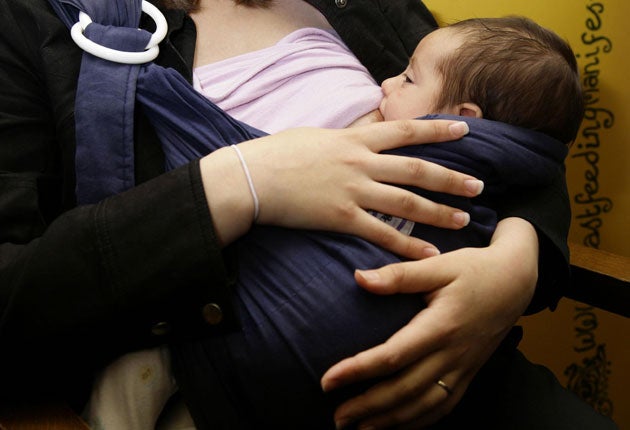
Breast milk, long revered for the nutritional advantages it gives a newborn, could be just as vital in terms of infant development, a leading scientist will claim this week. Up to three different types of stem cells have been discovered in breast milk, according to revolutionary new research.

Dr Mark Cregan, medical director at the Swiss healthcare and baby equipment company Medela, believes the existence of stem cells means breast milk could help a child "fulfil its genetic destiny", with a mother's mammary glands taking over from her placenta to guide infant development once her child is born.

"Breast milk is the only adult tissue where more than one type of stem cell has been discovered. That is very unique and implies a lot about the impressive bioactivity of breast milk and the consequential benefits to the breastfed infant," said Dr Cregan, who is speaking at Unicef's Baby Friendly Initiative conference this week. His research has isolated adult stem cells of epithelial (mammary) and immune origin, with "very preliminary evidence" that breast milk also contains stem cells that promotes the growth of muscle and bone tissue.

Scientists will use his discovery, made at the University of Western Australia, in Perth, Australia, to attempt to harvest stem cells from breast milk for research on a range of issues – from why some mothers struggle to produce milk to testing out new drugs that could aid milk production. "There is a plentiful resource of tissue-specific stem cells in breast milk, which are readily available and from a non-invasive and completely ethical source," Dr Cregan said.

Advocates hope the discovery will help to lift the UK's breastfeeding rates: only one-third of babies are exclusively breastfed at one week, the number dropping to one-fifth at six weeks. At five months, only 3 per cent of mothers still exclusively nurse their babies – although the World Health Organisation recommends that babies should consume only breast milk until they are at least six months old.

Rosie Dodd, campaigns director at the National Childbirth Trust, said: "This finding highlights the many factors that are in breast milk that we know so little about and that all have different advantages, such as helping a baby's immune system to develop."

Dr Cregan said the discovery of immune stem cells was the "most exciting development", adding, "It's quite possible that immune cells in breast milk can survive digestion and end up in the infant's circulation. This has been shown to be occurring in animals, and so it would be unsurprising if this was also occurring in human infants."

British scientists gave a cautious welcome to Dr Cregan's discovery, warning that just because stem cells exist in breast milk did not mean that they could be used to develop a therapy – the ultimate goal of stem cell research. Chris Mason, professor of regenerative medicine at University College London, said: "It may give us some insight into specific breast diseases and is potentially valuable when it comes to drug discovery and drug development but it is fanciful to think it could provide routine therapies."

Independent Comment
blog comments powered by Disqus

Day In a Page

Jim Gamble: We are losing the race to protect our young

Jim Gamble: We are losing the race to protect our young

Technology and the children who use it won't wait for slow-moving child-protection services and police to catch up
Sarah Sands: A friend is not the one you turn to, but the person who turns to you

Sarah Sands on friendship

A friend is not the one you turn to, but the person who turns to you
Andy Burnham: 'It's a genie out of the bottle moment'

Andy Burnham interview

'It's a genie out of the bottle moment'
Leveson: What we've learnt so far

Leveson: What we've learnt so far

Ingenious hacks, shifty editors and attacks of Sudden Memory Loss Syndrome – Matthew Bell assesses the state of play at the Royal Courts of Justice
Modern lovers: The 'sexual body warriors' and pioneers transforming 21st-century relationships

Modern lovers: The 'sexual body warriors'

Sarah Morrison meets the people redefining love in the 21st century.
'I was angry, so angry': How heartbreak, betrayal and Su Pollard helped Estelle find pop success

Estelle: 'I was angry, so angry'

The singer talks about heartache, betrayal and bouncing back.
Choc tactics: Bill Granger's Valentine's recipes for chocoholics

Bill Granger's Valentine's recipes for chocoholics

Should it be white, milk or plain? Can you make a melt-in-the-mouth pudding without using any?
Male, pale & stale: Could more women on the board help Mothercare – and other ailing firms?

Male, pale & stale

Could more women on the board help Mothercare – and other ailing firms?
Upstairs, downstairs, 2012-style

Upstairs, downstairs, 2012-style

There are now more domestic workers in Britain than in Edwardian times
Boos in Berlin for Jolie's war drama

Boos in Berlin for Jolie's war drama

Hollywood star defends her hard-hitting and controversial story set during the 1990s Bosnian conflict
How Whiteclay (population: 11) sells 5m cans of beer a year

How Whiteclay (population: 11) sells 5m cans of beer a year

It's 20 minutes' drive from a 20,000-strong Native American reservation, which is now suing brewers and the town's off-licences
Ian Holloway: Choose Harry, then give the next English batch a chance

Ian Holloway

Choose Harry, then give the next English batch a chance
Peter Storrie: Forgotten man has his day in the sun

Peter Storrie interview

Forgotten man has his day in the sun
The Last Word: If Harry can't get England out of jail, we may as well throw away the key

The Last Word

If Harry can't get England out of jail, we may as well throw away the key
Suits you sir: Bill Nighy talks politics and sartorial style

Suits you sir: Bill Nighy talks politics and sartorial style

He avoids Shakespeare at all costs, almost killed Judi Dench in his latest film, and only steps out in the sharpest jacket and tie...